- Home
- China
- World
- Asia-Pacific
- Americas
- Europe
- Middle-East and Africa
- Politics
- Business
- Opinions
- Tech & Sci
- Culture
- Sports
- Travel
- Nature
- Picture
- Video
- Live
- TV
- Radio
- Specials
- Learn Chinese


Share







Copied
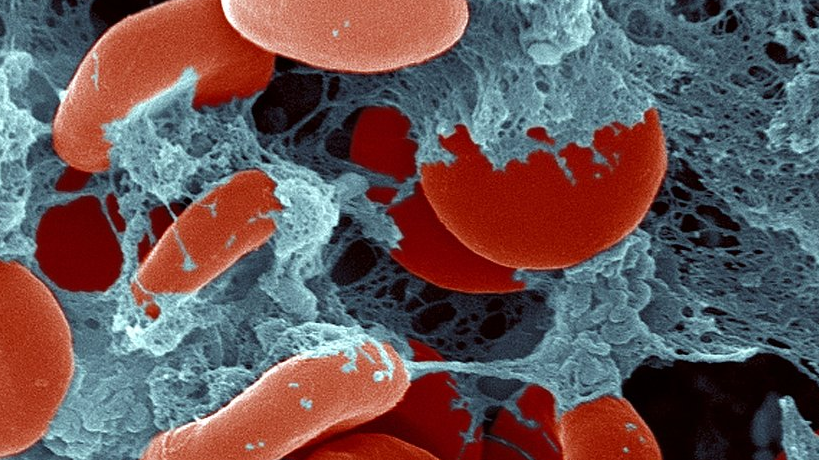
A scanning electron microscope shows red blood cells and fibrin. /CFP
Dysfunctional red blood cells contribute to the blood vessel injuries common in severe COVID-19, according to laboratory studies that also may suggest a way to treat the problem.
New findings from the blood of 17 moderately ill COVID-19 patients and 27 healthy volunteers confirm "profound and persistent endothelial dysfunction" as an effect of the coronavirus, researchers reported in JACC: Basic to translational science on Wednesday.
Compared to the red blood cells in healthy people, those from COVID-19 patients release fewer beneficial nitric oxide molecules and more detrimental inflammation-causing molecules, said Dr. Ali Mahdi of Karolinska University Hospital in Stockholm.
In combination with elevated levels of a certain enzyme, the inflammatory molecules injure the blood-vessel lining, his team found. As a result, the vessel cannot relax properly.
The dysfunction is reversed by drugs that restore normal enzyme levels and limit production of the harmful molecules, Mahdi said. Whether test-tube findings can be replicated in people is not yet clear. The experiment was performed on the original coronavirus, so it is also unclear whether red blood cells are similarly affected in infections caused by variants of SARS-CoV-2.
