- Home
- China
- World
- Asia-Pacific
- Americas
- Europe
- Middle-East and Africa
- Politics
- Business
- Opinions
- Tech & Sci
- Culture
- Sports
- Travel
- Nature
- Picture
- Video
- Live
- TV
- Radio
- Specials
- Learn Chinese


Share







Copied
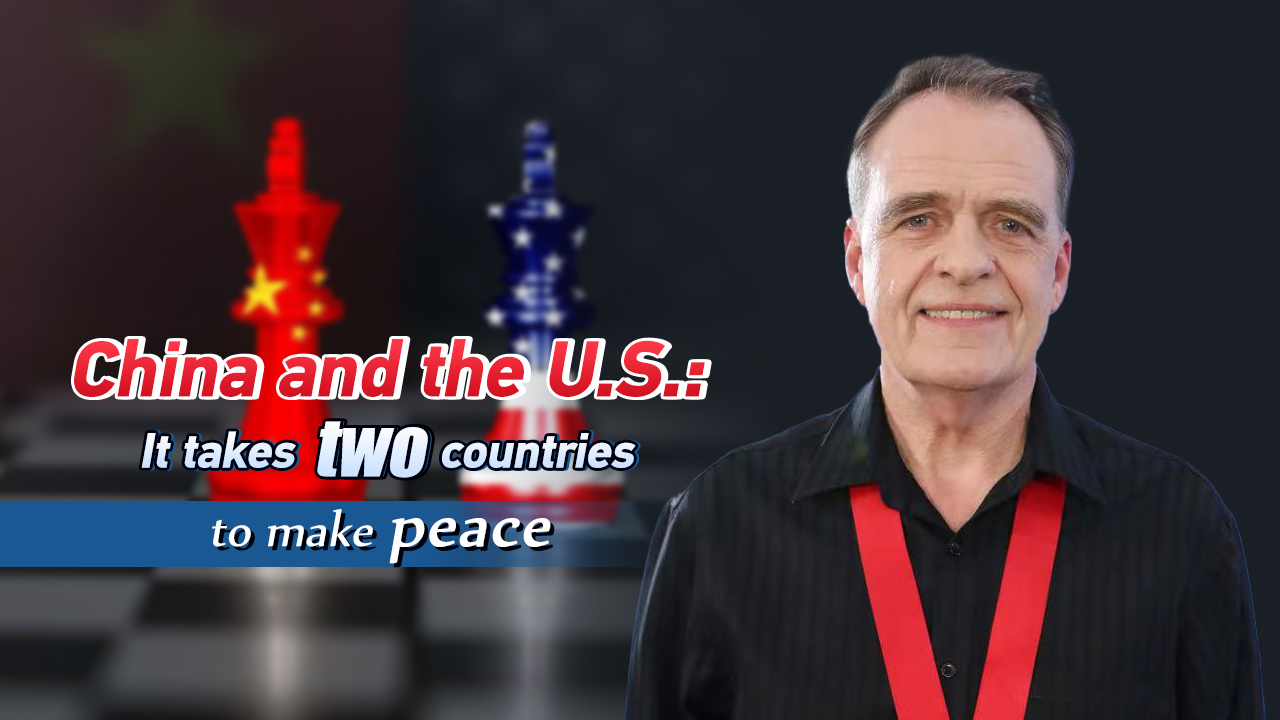
Editor's note: While there are mounting appeals for strengthening benign interaction between China and the U.S., the two countries are still locked in some frictions. What are the root causes for the frictions? David Ferguson, senior translation editor at the Foreign Languages Press, shares his insights with us. The views expressed in the video are his own and not necessarily those of CGTN.
CGTN: There is a growing concern that China and the U.S. are being locked in a technology war to "win the 21st century." The U.S. has adopted a chip strategy to contain China. What's your take on the bilateral competition in science and technology? Do you think the Huawei case will happen again, and why?
David Ferguson: Well, there's only going to be one winner in the technological battle, and that, from my perspective, is very clearly China. China's education system is growing and becoming stronger. China's power in STEM subjects is growing and becoming stronger. And Western countries, not just the U.S., but Western countries in general, are losing their preeminence in that particular field. So, as the century moves forward, I don't have any doubt that China is going to win the technological battle from a technological perspective.
But there is also a political element to the battle and that is where the Western countries and the U.S. are much stronger. I sometimes put it this way: Whoever controls the megaphone controls the message. And at the moment, it is the West, and particularly the U.S., who control the megaphone and therefore who control the message.
And if you take an example like Huawei, Huawei's position and Huawei's whole history have been significantly misrepresented to the Western public [and] to the U.S. public. They've been turned into a threat. Huawei grew in China when China had no telecommunications industry at all. Telecommunications in China belonged to Western countries and Huawei achieved preeminence by doing things they [the Western telecommunications giants] were not interested in doing, by traveling, not to remote parts of China, but outside of the main centers of population and working there and building their strength there. And Huawei became a telecommunications giant by sheer hard work; the kind of hard work that typifies China as a country and China as a people. But I would expect incidents like Huawei to recur simply because that's the tool that the U.S. has. When you've only got a hammer, everything looks like a nail, and Huawei looks like a nail to the U.S.
CGTN: It's said that the current frictions between China and the U.S. are mainly due to the latter's fear that China is developing while the U.S. is losing its leading position, and it's said that the lack of efficient bilateral communication also intensifies this kind of fear. What can China and the U.S. do to enhance effective communication?
Ferguson: Well, it takes two to tango. It takes two people to make peace. One person can make war. I would put it this way: China is a "win-win" country. China's attitude to its relationships with other countries is "If you win, we win." And that is a sane and sound attitude. America is much more of a "win-lose" country, both at an individual level and at a national level. They can't appreciate victory unless they can see a beaten foe. It's gonna be: "I win, you lose." And that is very much reflected on an individual level in a lot of violence, a lot of anger in the U.S. turned against itself. And that's what it comes down to fundamentally: It's win-lose and win-win.
America has been a top dog for not a very, very long time in historical terms, but a long time in individual terms. People living in America today are living as the third or fourth generation of Americans who were the top dog and they see themselves as being the top dog. And America has a real problem with not being first. From their perspective, No. 1 is their rightful position and they find it very, very difficult to relate to anybody that threatens that predominance.
Interviewer: Yang Chuchu
Cameramen: Zhao Jing
Video editing: Feng Ran
Producer: Wang Xinyan
Supervisor: Mei Yan
(If you want to contribute and have specific expertise, please contact us at opinions@cgtn.com. Follow @thouse_opinions on Twitter to discover the latest commentaries on CGTN Opinion Section.)
