- Home
- China
- World
- Asia-Pacific
- Americas
- Europe
- Middle-East and Africa
- Politics
- Business
- Opinions
- Tech & Sci
- Culture
- Sports
- Travel
- Nature
- Picture
- Video
- Live
- TV
- Radio
- Specials
- Learn Chinese


Share







Copied
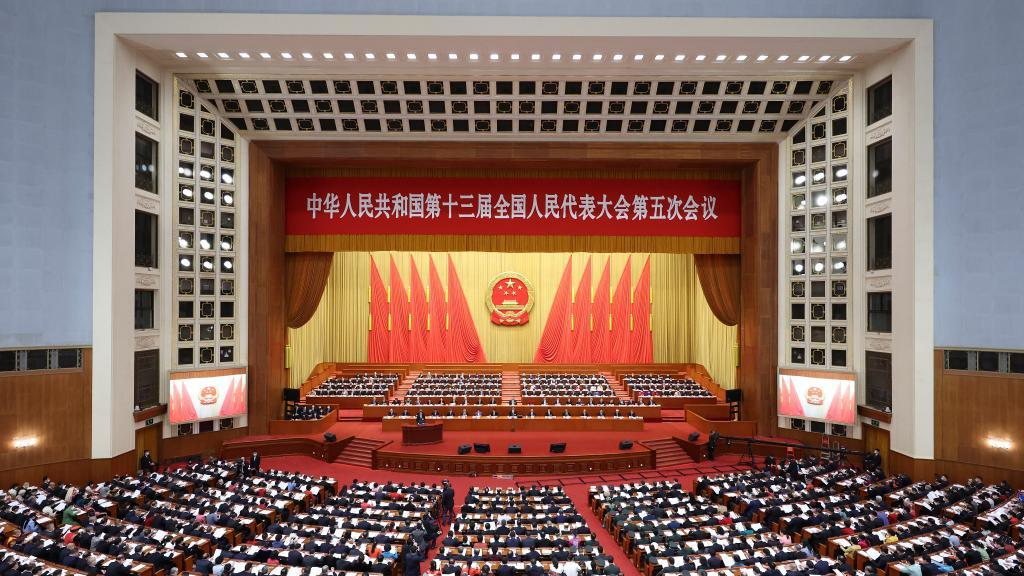
The opening meeting of the fifth session of the 13th National People's Congress starts at the Great Hall of the People in Beijing, China, March 5, 2022. /Xinhua
Editor's note: Hannan Hussain is a foreign affairs commentator and author. He is a Fulbright recipient at the University of Maryland, the U.S., and a former assistant researcher at Islamabad Policy Research Institute. The article reflects the author's opinions and not necessarily the views of CGTN.
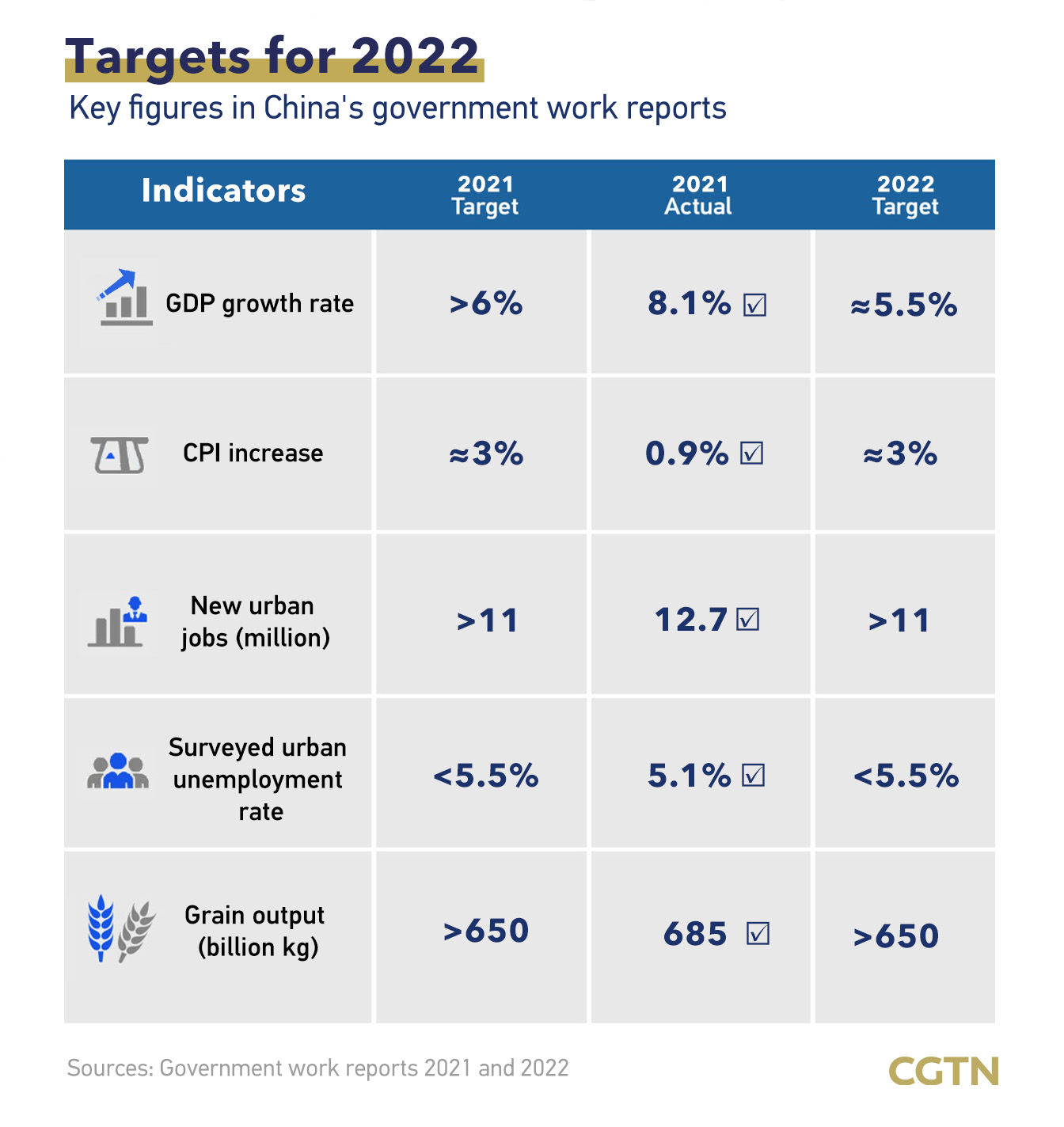
At the opening meeting of the fifth session of the 13th National People's Congress (NPC), Premier Li Keqiang announced China's economic growth target at around 5.5 percent in a government work report to the national legislature. "A comprehensive analysis of evolving dynamics at home and abroad indicates that this year our country will encounter many more risks and challenges, and we must keep pushing to overcome them," the premier said.
Beijing's approach to economic stabilization this year is likely to be marked by a deep awareness of risks both domestic and external. Commodity prices have been rightly acknowledged as "prone to fluctuation," and China's focus on expanding domestic demand could be a key inlet for assisting recovery in consumption and investment during the year.
The 5.5 percent GDP growth target lies well ahead of the expectations from the International Monetary Fund (IMF) and the World Bank. Beijing's preference to prioritize steady growth "in the face of new downward pressures" signals optimism for sustaining accumulated growth "long into the future."
Urban employment stands to benefit as Beijing aims to produce over 11 million jobs on the one hand, and cap the urban unemployment rate at 5.5 percent on the other – a practical and attainable balance.
The National Development and Reform Commission made it clear last month that fostering "entrepreneurial practices and employment opportunities" among China's college graduates was a key priority this year. This policy focus is important given that growth in newly kick-started businesses can stimulate higher returns for the employment market.
With an estimated 10.76 million Chinese college students expected to graduate this year, Beijing's objective to drive-up lending to small businesses (from big banks) by over 40 percent this year is a welcome sign for one compelling reason. The move can cultivate conditions that are conducive for job support as well as the progression of firms central to its economy. After all, 80 percent of urban employment in China is delivered by small firms.
Other notable targets set for 2022 include narrowing China's budget deficit to 2.8 percent of GDP, and an inflation target of about 3 percent. The country's unwavering commitment to opening up its economy also stands reinforced through a package of measures aimed at injecting stability in foreign trade, and ensuring that the benefits to foreign businesses and enterprises in China are widely enjoyed. For a country that is cognizant of the manifold challenges and risks surrounding growth objectives this year, it is quite a sight to see it continually embrace a higher standard of opening-up. That resolve is significantly supportive of foreign businesses in China, thousands of which hold a largely optimistic outlook, according to a recent Ministry of Commerce (MOC) survey.
Saturday's speech was also receptive to many facets of social spending and livelihoods. Consider housing. Stabilization in housing prices, land costs, and market expectation are seen as an important composite to facilitating development in the real estate sector, indicating progress against a downturn. Additionally, Premier Li's call on the property market to better satisfy the housing demands of home buyers is one that resonates with the government budget.
The issued budget directs plenty of spending towards the goal of assisting rural families and capitalizing on rental housing, signifying a people-centric vision front and center. It is also difficult to overstate the pragmatism of the central government in all this: it recognizes the prominent role played by local and provincial governments in the country's social spending and commits to an increase of 18 percent in money transfers to them this year. This way, crucial support is channeled where much of the country's social spending is exercised. Proximity as a measure of resource allocation makes perfect sense.
In conclusion, the 2022 government work report signals an advancement of China's past economic and social successes by taking key risks and challenges head-on. It offers no room for policy experimentation at the cost of stability.
(If you want to contribute and have specific expertise, please contact us at opinions@cgtn.com. Follow @thouse_opinions on Twitter to discover the latest commentaries on CGTN Opinion Section.)
