- Home
- China
- World
- Asia-Pacific
- Americas
- Europe
- Middle-East and Africa
- Politics
- Business
- Opinions
- Tech & Sci
- Culture
- Sports
- Travel
- Nature
- Picture
- Video
- Live
- TV
- Radio
- Specials
- Learn Chinese


Share







Copied
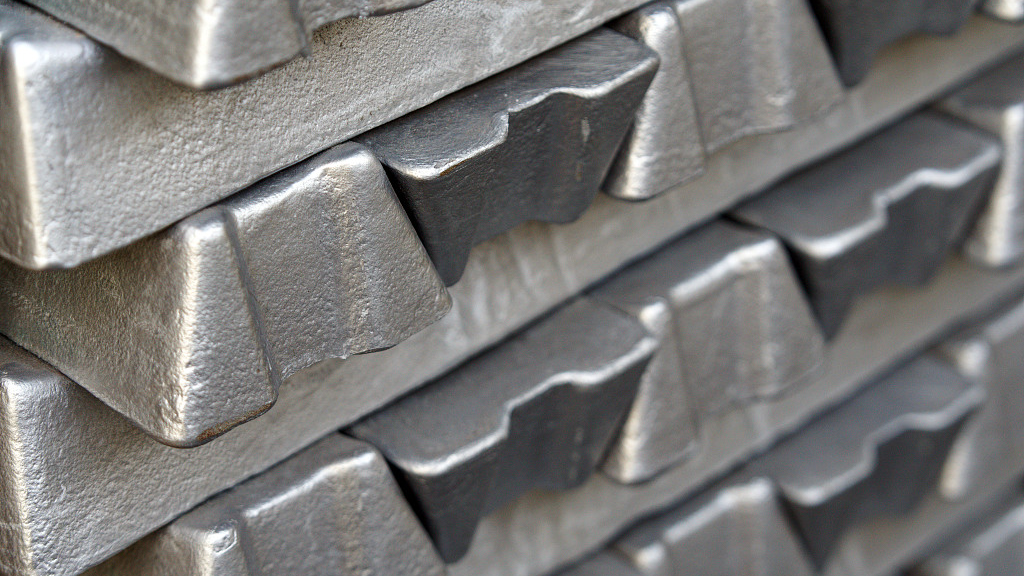
Aluminum ingots seen in the Aluminum Dunkerque plant of American Industrial Partners Group (AIP), January 13, 2022. /CFP
The Russia-Ukraine conflict is ramping up the price of metals used in cars, from aluminum in the bodywork to palladium in catalytic converters to the high-grade nickel in electric vehicle batteries, and drivers are likely to foot the bill.
While metals have not been the target of Western sanctions yet, some shippers and auto parts suppliers are already steering clear of Russian goods, putting more pressure on carmakers already reeling from a chip shortage and higher energy prices.
"We have an escalation of cost that comes from raw materials and energy that is going to put more pressure on the business model," said Carlos Tavares, chief executive of Stellantis, the world's fourth-biggest automaker, when speaking to reporters last week.
Aluminum and palladium both hit record highs on Monday while nickel, which is also used to make stainless steel, crossed the $100,000-a-tonne level for the first time ever on Tuesday.
The auto industry uses it in catalytic converters for gasoline models — or platinum for diesel models — both of which still make up the vast majority of car sales.
Palladium prices have been rising for about six years and Russia accounts for about 40 percent of the global market.
"There is no other option beyond palladium and platinum for catalytic converters, and you can't build a car without a catalytic converter," said Chris Blasi, chief executive of precious metals dealer Neptune Global.
He said he bought a lot of palladium in December at $1,940 an ounce. On Monday, it hit a record $3,440.
Blasi estimated that the value of the palladium used in the average car is about $200, but that could easily double.
Metals for EV batteries
While Russia accounts for 5 percent of global nickel production, it supplies about 20 percent of the world's high-grade nickel.
The metal is used to make batteries for electric vehicles (EVs), posing a fresh challenge for carmakers already investing billions to move away for combustion engines just as demand for zero-emission models is starting to take off.
Batteries are one of the most expensive components in EVs and automakers have been hoping they will become cheaper so they can offer more affordable electric cars.
BMW said it was focusing as much as possible on recycling battery nickel, with up to 50 percent scrap nickel used in the high-voltage battery of its new BMW iX model.
Forced to draw the line
German carmakers such as Volkswagen and BMW have already been hit by the conflict in Ukraine as it has forced makers of wire harnesses in the west of the country to halt production. A wire harness is a vital set of parts which neatly bundle up to 5 km of cables in the average car, and Ukraine is a key supplier.
And when it comes to metals, Russian companies are major suppliers to Germany. In 2020, they accounted for 44 percent of Germany's nickel imports, 41 percent of its titanium, a third of its iron, and 18 percent of its palladium.
With production of 108 million tonnes last year, Russia is the world's fifth-largest provider of iron ore, according to Credit Suisse, supplying European steelmakers who now face higher prices and possible difficulties procuring the metal.
It is also a big manufacturer of aluminum — the most energy-intensive metal to produce — accounting for 6 percent of global output.
Faced with the choice of buying Russian goods and indirectly funding Russia, German steel and aluminum supplier Voss Edelstahlhandel has decided to draw the line.
"Even though aluminum is not on the sanctions list, it is used by Russia to get money into the country and therefore we quit," Chief Executive Thorsten Studemund told Reuters.
(With input from Reuters)
