- Home
- China
- World
- Asia-Pacific
- Americas
- Europe
- Middle-East and Africa
- Politics
- Business
- Opinions
- Tech & Sci
- Culture
- Sports
- Travel
- Nature
- Picture
- Video
- Live
- TV
- Radio
- Specials
- Learn Chinese


Share







Copied
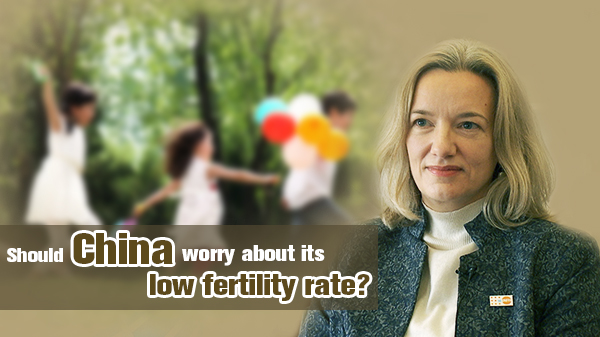
Editor's note: The government work report delivered during the Two Sessions has rolled out supporting measures for the third-child policy. But the latest census showed the country's total fertility rate at a low level of 1.3 in 2020. What are the factors that may influence a family's decision to have more children? How should people understand the low fertility rate? Dr. Justine Coulson, the United Nations Population Fund (UNFPA) representative in China, shares her insights. Views expressed in the video are hers, and not necessarily those of CGTN.
'Couples should ask themselves four questions before deciding how many children they intend to have.'
I mean, last year we saw that China had the lowest number of births it actually had probably in the last 60 years. And we're now talking about a total fertility rate of 1.3, which means that on average each woman has 1.3 children.
But the demographic changes and what China is seeing is not unique to China. What we see across the world is as economies become more developed, that you will see a reduction in fertility. The reasons for that are many.
One of them is that in less developed economies, you will see a greater reliance on children for subsistence agriculture. Families think about having more children almost as an insurance policy. But as quality of health care improves, as wealth of individual households improves, education levels improve, then the need to have these very big families is no longer there.
At the same time, over the last 50, 60 years, we've seen a huge increase in terms of levels of education for women, women coming into the labor force as well. This also has had an impact on the number of children that couples choose to have.
But if we take it down to a personal level, because deciding how many children you have is a personal issue, I always say that I think couples ask themselves four questions.
The first question is: Can we afford it? And that very much depends on how much does it cost to have a living space that's big enough to have more than one child, how much is education, how much is afterschool activity and those investments we want to see.
The second question a couple asks is how do we balance work and child, having a child family life. So, if I need to work 12 hours a day, six days a week and my spouse needs to work six days a week for 12 hours, how are we going to manage having a bigger family? And so that obviously impacts the decision.
And I always say that the third question then is maybe a question more than a woman asks herself, which is if we're going to have all these children, who's actually going to spend their time doing the childcare and actually managing the domestic sphere?
If that's the woman on her own, then the willingness to have more children would be very different than if we actually see a couple doing an equal responsibility for childcare, and equal responsibility for the domestic sphere.
And that's actually coming out now in research, that's very clearly showing that when men take on a greater responsibility of household chores and childcare, you will see a couple be more willing to consider having an additional child.
The fourth one, which I think we think about less in terms of economic sense and demography is: Do we really want to have more children? And what I mean by that is that the model of parenting and what it means to be a good parent has changed substantially over the last 50 years.
Now parents think much more about the quality of the relationship they have with their child and how do they parent well to really put maximum investment into their child and to ensure their child has the best future possible.
With that type of quite intensive model of parenting, it obviously becomes much more difficult to maintain that and be that "modern concept" of a good parent if you have more children. That can also feature in decision-making around how many children you might have.
'UNFPA would say that demographic transitions have happened across history; they're not necessarily bad things.'
I mean United Nations Population Fund (UNFPA) would say that these demographic transitions have happened across history; they're not necessarily bad things. It's about looking at how your demographic change is happening and then thinking about how the government is thinking about the best investments you can make to really harness the population that's there.
For China, now it is moving into a demographic transition of an aging population, which is seen in many countries across the world. And now we're talking about the potential of a second dividend.
So when you see this aging population and this large cohort of older people in the population, whereas traditionally we used to think you're born, you're a child, you work, you retire, you stop working, now I think there's a whole new way of thinking about old age because people are coming to the age of 60 or 65, they're healthier, they're wealthier, they're better educated, life expectancy has gone up, and we're now talking about living to 100 being a normality in the next 20 to 30 years. Nobody's going to stop work at 65 and sit around for the next 35 years doing nothing.
So thinking through the second demographic dividend- what policies and investments and changes in the workplace do we need to make to really enable those older people to play this productive role in society?
Interviewer: Huang Jiyuan
Camera: Ma Wei, Liu Tianxu
Video editor: Feng Ran
Managing editor: Li Yunlong
Producer: Wang Xinyan
Supervisor: Mei Yan
(If you want to contribute and have specific expertise, please contact us at opinions@cgtn.com. Follow @thouse_opinions on Twitter to discover the latest commentaries in the CGTN Opinion Section.)
