- Home
- China
- World
- Asia-Pacific
- Americas
- Europe
- Middle-East and Africa
- Politics
- Business
- Opinions
- Tech & Sci
- Culture
- Sports
- Travel
- Nature
- Picture
- Video
- Live
- TV
- Radio
- Specials
- Learn Chinese


Share







Copied
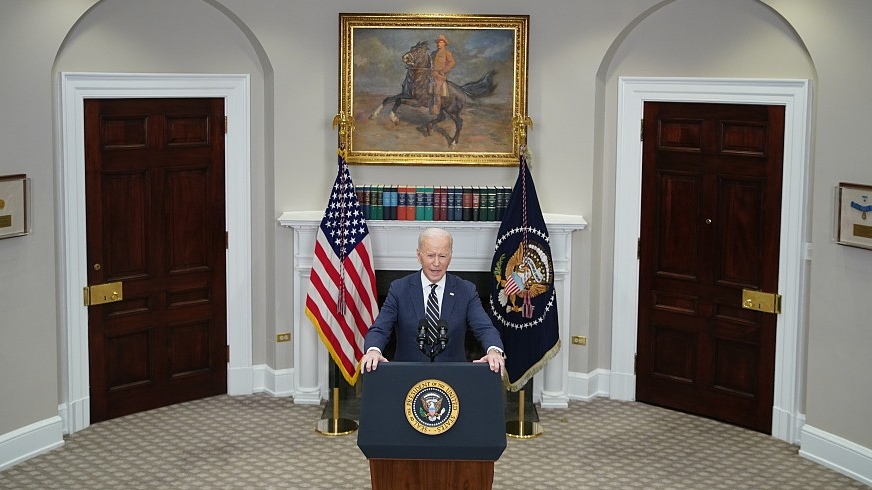
U.S. President Joe Biden speaks about revoking PNTR (permanent normal trade relations) for Russia in the Roosevelt Room of the White House in Washington, D.C., U.S., March 11, 2022. /VCG
Editor's note: Hannan Hussain is a foreign affairs commentator and author. He is a Fulbright recipient at the University of Maryland, the U.S., and a former assistant researcher at Islamabad Policy Research Institute. The article reflects the author's opinions and not necessarily the views of CGTN.
On March 11, U.S. President Joe Biden – alongside key allies – committed to ending Moscow's "most favored nation" (MFN) trade status, with Biden calling it "another crushing blow to the Russian economy that's already suffering very badly from our sanctions."
At a time when the world is in dire need to unite in peace and urgently end the Ukraine crisis, the West – led by the United States – is making attacks against the Russian economy its chief priority.
Understand that downgrading trade ties with Moscow is only part of the escalation. The U.S.-backed effort is also geared towards taking anti-Russian economic campaigning to major trade and financial institutions. Consider the World Trade Organization (WTO). On Friday, the Group of Seven (G7) economies issued a joint statement that suggested the takedown of Russia's WTO membership benefits on the back of the same MFN status revocation. It is no surprise that part of the G7's confidence also stems from what it calls a "broad coalition" put together with an eye on Moscow. Make no mistake that this is the same G7, which until recently, was projecting itself as big on diplomacy, de-escalation and ceasefire in the Ukraine-Russia conflict.
Observers of international peace should take note of the example being set by the West as tensions over Ukraine run high. At the WTO, the MFN treatment is what the organization sees as a non-discrimination guarantee for its 164 members. The MFN also reinforces the value of equal treatment for all states and should not serve as a political lever for some to sideline a sovereign state. "Under the WTO agreements, countries cannot normally discriminate between their trading partners," the organization explicitly mentions as part of its trading system principles.
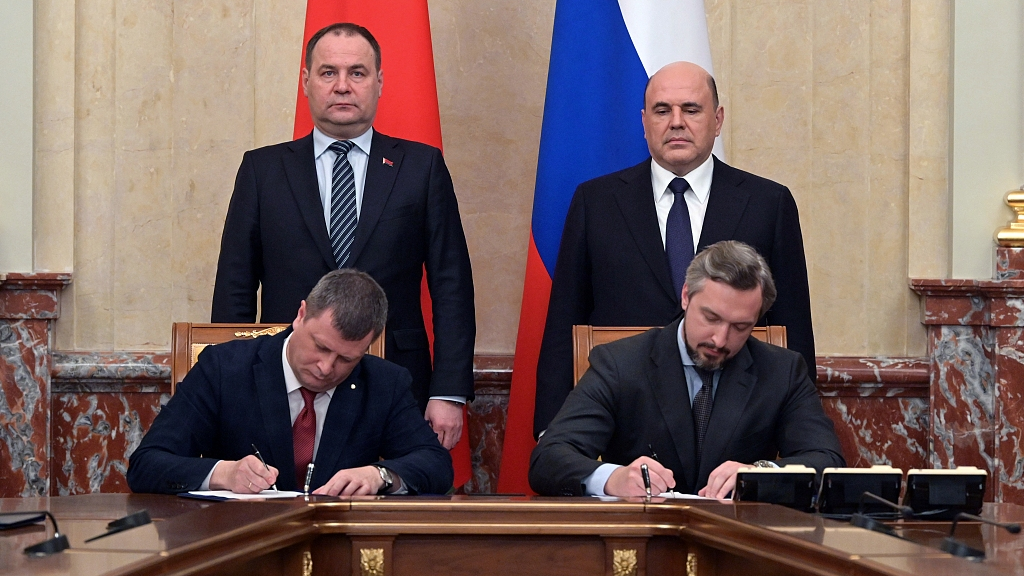
Belarusian Finance Minister Yury Seliverstov (front row L) and Russian Deputy Finance Minister Timur Maksimov sign documents on ditching U.S. dollars in energy payments during a ceremony in Moscow, Russia, March 14, 2022. /VCG
The latest U.S.-led trade offensive against Russia goes against the very spirit of the WTO's MFN principle, as the U.S. is targeting Russia politically. History can be a valuable guide here too. Washington itself has revoked the MFN status of more than two dozen countries largely on political grounds. That sends a powerful message about how this so-called "coalition" effort is aimed at singling-out Russia below the global trade baseline and serves no tangible peacemaking purpose to stem the Ukraine crisis.
In his White House remarks on Friday, Biden appealed to the "foundations of international peace and stability" while alluding to a concerted push that denies Russia financial support from select multilateral institutions. It is a fact that the credibility of multilateral institutions is determined by an equal and representative consensus of its participating states. It is not supposed to be driven by the weight of select democratic cliques, particularly those that assume international consensus by virtue of their own will.
As the world watches key Western powers go all-out with their economic escalation spree against Russia, the fundamental goal of a Ukraine-Russia ceasefire demands urgent support. The United Nations political affairs chief, along with a number of countries – including China – have been supportive of the possibility of a ceasefire, recognizing the central role of a negotiated solution to satisfy all parties.
It is here that Washington's trade offensive against Russia fails to advance that quest for peace, given that its Western allies are well aware of the need to stem violence, and keep a 2.3-million strong refugee crisis from escalating further.
"From everything that we know and have witnessed, [President] Putin shows no sign of engaging in serious diplomacy," blamed U.S. Vice-President Kamala Harris during her recent visit to Romania.
Washington is in absolutely no position to make its provocation streak and diplomatic resistance all about Russia. It is the U.S. that has contributed to a sanctions toll of over 3,600 against Moscow and confined what Harris called "serious diplomacy" to mere verbal assurances. A desire to capitalize on the Ukraine crisis to feed Cold War duels is a pivot towards more escalation, and chiefly of Washington's own making.
(If you want to contribute and have specific expertise, please contact us at opinions@cgtn.com. Follow @thouse_opinions on Twitter to discover the latest commentaries in the CGTN Opinion Section.)
