- Home
- China
- World
- Asia-Pacific
- Americas
- Europe
- Middle-East and Africa
- Politics
- Business
- Opinions
- Tech & Sci
- Culture
- Sports
- Travel
- Nature
- Picture
- Video
- Live
- TV
- Radio
- Specials
- Learn Chinese


Share







Copied
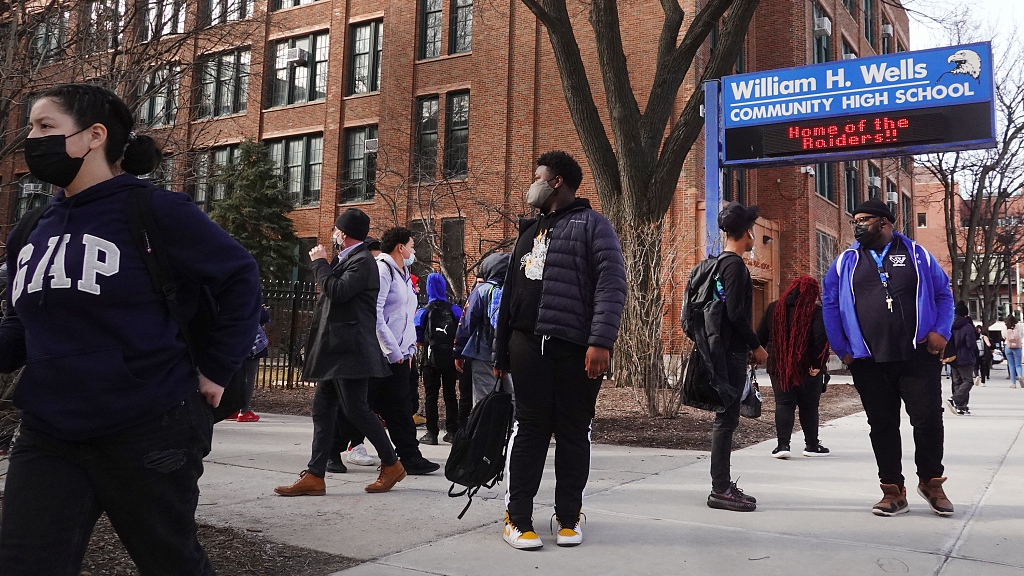
Students leave William Wells High School at the end of the school day in Chicago, Illinois, U.S., March 14, 2022. /CFP
The number of new COVID-19 deaths reported worldwide dropped by 17 percent in the past week, while the new weekly infections increased by 8 percent after "a consistent decrease" in the caseload since the end of January, according to the World Health Organization (WHO).
A total of 11 million new COVID-19 cases and 43,000 new deaths were reported worldwide in the past week, the WHO said in its weekly report on the pandemic issued late Tuesday.
The number of new COVID-19 deaths globally has been dropping during the past three weeks, according to the WHO.
The biggest increase in cases was seen in the Western Pacific and Africa, where infections rose by 29 percent and 12 percent respectively. Elsewhere, cases dropped by more than 20 percent in the Middle East, Southeast Asia and the Americas. In Europe, cases inched up by about 2 percent.
The WHO said those numbers "should be interpreted with caution." It noted that many countries are changing their COVID-19 testing strategies as they exit the acute phase of the pandemic, and are testing far less than previously, meaning that many new cases are going undetected.
Western countries lifting restrictions
As the Omicron variant of the coronavirus appeared more contagious and less lethal, several Western countries, where cases have been falling in recent weeks, decided to lift their restrictions.
In the U.S., the worst-hit country with the highest caseload and the most deaths in the world, President Joe Biden called on Americans to return to the office and "fill our great downtowns again" in his State of the Union Address earlier this month.
The U.S. has recorded around 79 million cases and over 960,000 deaths, while daily cases continue to drop, according to the U.S. Centers for Disease Control and Prevention.
"We currently have about 35,000 cases in this country. We expect some fluctuation, especially at this relatively low level, and, certainly, that to increase," White House Press Secretary Jen Psaki said at a press briefing on Monday.
The British government said Monday that all remaining COVID-19 international travel restrictions will end Friday to make going on holiday easier for the Easter school vacation.
Transport Secretary Grant Shapps said the changes will mean people "can travel just like in the good old days."
Britain recorded an average of 73,310 cases per day last week, according to COVID-19 statistics from The New York Times. The country's caseload has increased by 77 percent from the average two weeks ago, while deaths have fallen by 10 percent.
France also lifted most coronavirus bans on Monday, ending the need to wear masks in schools, offices and shops, and allowing the unvaccinated back into bars, restaurants and cinemas.
Official data showed COVID-19 cases in France have increased by 23 percent from the average two weeks ago, while deaths have decreased by 37 percent.
On Tuesday, Dutch Health Minister Ernst Kuiper announced that the government would further scale down COVID-19 rules from next Wednesday. The mask obligation in public transport will disappear, and a negative test is no longer required at events with more than 500 participants.
In Oceania, daily COVID-19 cases have been falling in Australia, but still rising in New Zealand.
Australia said on Tuesday that it is about to ease its entry ban for international cruise ships next month, bringing an end to all major COVID-19 travel bans. Last month, Australia reopened its airports to vaccinated international travelers.
New Zealand Prime Minister Jacinda Ardern said Wednesday that the country was "ready to welcome the world back" as the nation continued to ease its COVID-19 restrictions.
"Closing our border was one of the first actions we took to stop COVID-19 two years ago. It did the job we needed. But now that we're highly vaccinated and predicted to be off our Omicron peak, it's now safe to open up," she said.
(With input from agencies)
