- Home
- China
- World
- Asia-Pacific
- Americas
- Europe
- Middle-East and Africa
- Politics
- Business
- Opinions
- Tech & Sci
- Culture
- Sports
- Travel
- Nature
- Picture
- Video
- Live
- TV
- Radio
- Specials
- Learn Chinese


Share







Copied
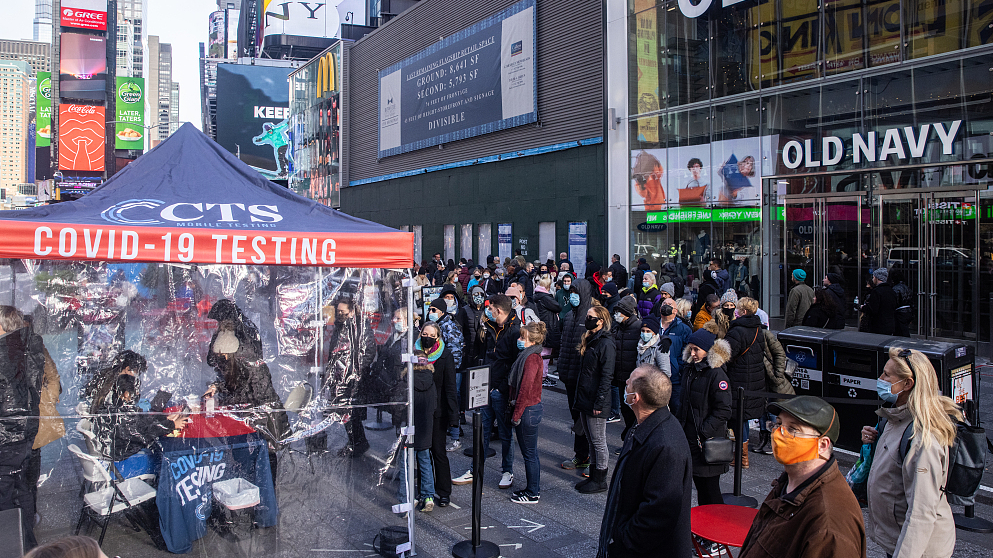
People wait in line at a COVID-19 mobile testing site in Times Square in New York, U.S., December 5, 2021. /CFP
As COVID-19 infections rise in some parts of the world, experts are watching for a potential new surge in the U.S. and wondering how long it will take to detect.
One of experts' biggest concerns is that more and more people in the U.S. are taking rapid COVID-19 tests at home, while fewer are getting the gold-standard tests that the government relies on for case counts.
Jennifer Nuzzo, a Brown University pandemic researcher, said that "we're not in a great situation," warning that the case numbers are not as much a reflection of reality as they once were.
Tallies of test results have been at the core of understanding the spread of COVID-19 from the start, but they have always been flawed. Initially, only sick people got tested, meaning case counts missed people who had no symptoms or were unable to get swabbed.
Home test kits became widely available last year in the U.S., and demand took off when the Omicron wave hit. But many people who take home tests don't report results to anyone, nor do health agencies attempt to gather them.
Mara Aspinall, the managing director of an Arizona-based consulting company that tracks COVID-19 testing trends, estimates that in January and February about 8 million to 9 million rapid home tests were being done each day on average, four to six times the number of polymerase chain reaction (PCR) tests.
The other key concern of experts is that U.S. health officials are increasingly focusing on hospital admissions which rise only after a surge has arrived.
Last month, the U.S. Centers for Disease Control and Prevention (CDC) outlined a new set of measures for deciding whether to lift mask-wearing rules, focusing less on positive test results and more on hospitals.
Hospital admissions are a lagging indicator, given that a week or more can pass between infection and hospitalization.
If the federal government lifts its public health emergency declaration, officials will lose the ability to compel hospitals to report COVID-19 data. A group of former CDC directors recently wrote to the U.S. Congress, urging it to pass a law that will provide enduring authorities "so we will not risk flying blind as health threats emerge."
(With input from AP)
