- Home
- China
- World
- Asia-Pacific
- Americas
- Europe
- Middle-East and Africa
- Politics
- Business
- Opinions
- Tech & Sci
- Culture
- Sports
- Travel
- Nature
- Picture
- Video
- Live
- TV
- Radio
- Specials
- Learn Chinese


Share






Copied
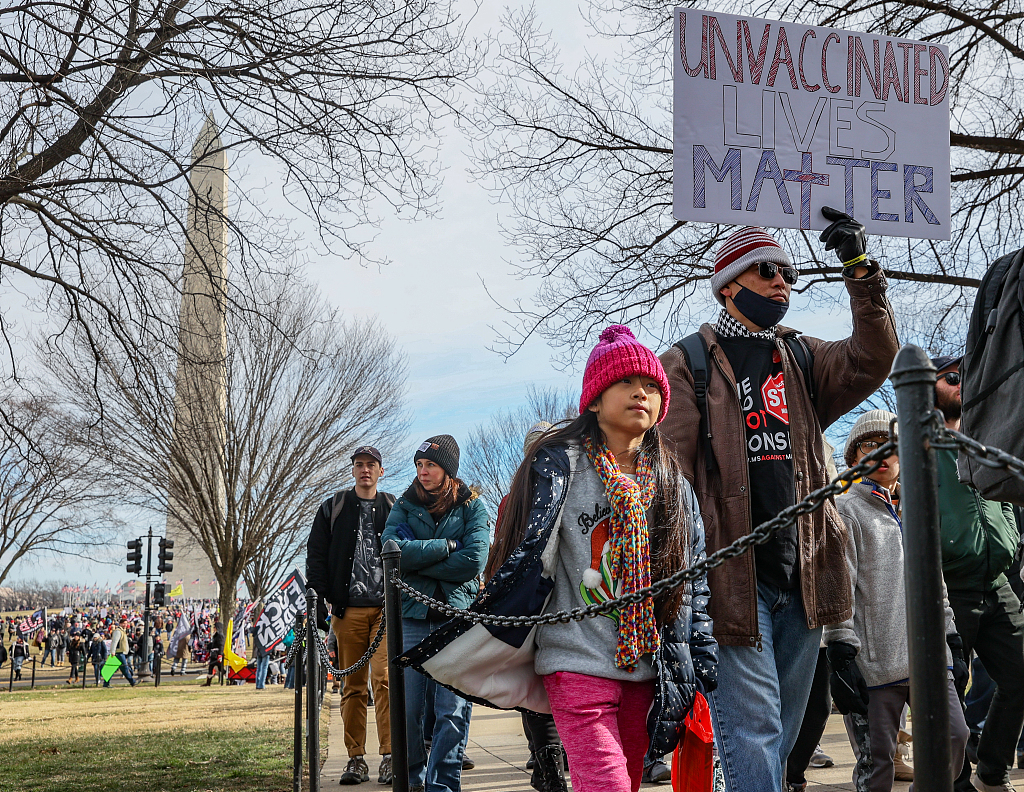
Protesters make their way to the Lincoln Memorial during a march in protest of vaccine mandates on the National Mall in Washington DC, U.S., January 23, 2022. /CFP
Nearly a year after COVID-19 vaccines became freely available in the U.S., one-fourth of American adults remain unvaccinated, and a picture of the economic cost of vaccine hesitancy is emerging. It points to financial risk for individuals, companies and publicly funded programs.
Vaccine hesitancy likely already accounts for tens of billions of dollars in preventable U.S. hospitalization costs and up to hundreds of thousands of preventable deaths, public health experts said.
For individuals forgoing vaccination, the risks can include layoffs and ineligibility to collect unemployment, higher insurance premiums, growing out-of-pocket medical costs or loss of academic scholarships.
For employers, vaccine hesitancy can contribute to short-staffed workplaces. For taxpayers, it could mean a financial drain on programs, such as Medicare, which provides healthcare for seniors.
"When the vaccines emerged, it seemed like everyone wanted one, and the big question was how long it would take to meet the demand," said Kosali Simon, a professor of health economics at Indiana University. "It didn't occur to me that, a year later, we'd be studying the cost of people not wanting the vaccines."
Alicia Royce, a 38-year-old special education teacher in Coachella, California, opted out of getting the COVID-19 vaccine or having her two vaccine-eligible children get it. Royce's parents got the shots, but she has been concerned by issues, including reports of adverse reactions.
The decision puts Royce in a delicate spot. Her school, like others in California, began a vaccine mandate for staff last year. For now, Royce has a religious exemption and gets tested for COVID-19 twice a week before entering the classroom. The situation has prompted her family to plan a move to Alabama, where schools have not imposed mandates, after the school year.
"I'll get paid less," said Royce, who expects to take a $40,000-a-year pay cut. "But I'm moving for my own personal freedom to choose."
A no-vac tax
However, higher insurance premiums are the price many Americans who opt-out of getting vaccinated may have to pay for their "freedom of choice."
Vaccination status and other health risks – such as obesity or smoking – are metrics life insurers can request when potential clients seek coverage. Under the U.S. Affordable Care Act, individuals seeking health insurance can't be denied insurance due to pre-existing conditions, including COVID-19, or charged more for not being vaccinated. But companies that cover some of their employees' health insurance costs can pass along higher costs to unvaccinated employees.
Last year, Delta Airlines said it would charge employees who didn't get vaccinated an extra $200 a month for health insurance. The airline said the extra charge reflected the higher risk of COVID-19 hospitalization for those employees and noted that employee hospitalizations for COVID-19 had cost $50,000 each so far, on average.
Big companies, such as J.P. Morgan and Bank of America, have informed their U.S. employees that they should expect to pay more or receive fewer perks through company wellness programs if they don't provide proof of vaccination.
Other companies have extended their insurance premium surcharge for unvaccinated spouses or family members of employees if they want to be insured as a dependent under an employee's health plan.
Also, after global life insurance providers were hit with a higher-than-expected $5.5 billion in claims during the first nine months of 2021, insurers will be looking to calibrate premiums more closely to COVID-19 mortality risks going forward, Reuters reported.
University students also can face serious consequences for opting out. At least 500 U.S. colleges have vaccine mandates, some barring enrollment or in-person schooling for those who don't comply or require them to undergo frequent COVID-19 testing.
Preventable care, billions in cost
In a December study by the nonprofit Kaiser Family Foundation, which tracks U.S. health policy and outcomes, it estimated that unvaccinated American adults accounted for $13.8 billion in "preventable" COVID-19 hospitalization costs nationwide between June and November of 2021.
Kaiser estimated that over that six-month period, which included the Delta wave, vaccinations could have averted 59 percent of COVID-19 hospitalizations among U.S. adults. Kaiser tallied 690,000 vaccine-preventable hospitalizations at an average cost of $20,000. And it estimated vaccinations could have prevented 163,000 U.S. deaths over the same period.
If vaccine hesitancy accounted for half of the more than 1 million new U.S. COVID-19 hospitalizations since December, the added cost of preventable hospital stays could amount to another $10 billion, Reuters found.
One thing is clear: As U.S. insurance providers and hospital networks reckon with vaccine hesitancy, it's likely that patients hospitalized for COVID-19 will end up shouldering a bigger portion of the bill.
"These hospitalizations are not only devastating for patients and their families but could also put patients on the hook for thousands of dollars," Krutika Amin, a Kaiser associate director and one of the December study's co-authors, told Reuters. Unlike earlier in the pandemic, Amin said, most private health insurers have stopped waiving cost-sharing or deductibles for COVID-19 patients who are hospitalized.
(With input from Reuters)
