- Home
- China
- World
- Asia-Pacific
- Americas
- Europe
- Middle-East and Africa
- Politics
- Business
- Opinions
- Tech & Sci
- Culture
- Sports
- Travel
- Nature
- Picture
- Video
- Live
- TV
- Radio
- Specials
- Learn Chinese


Share







Copied
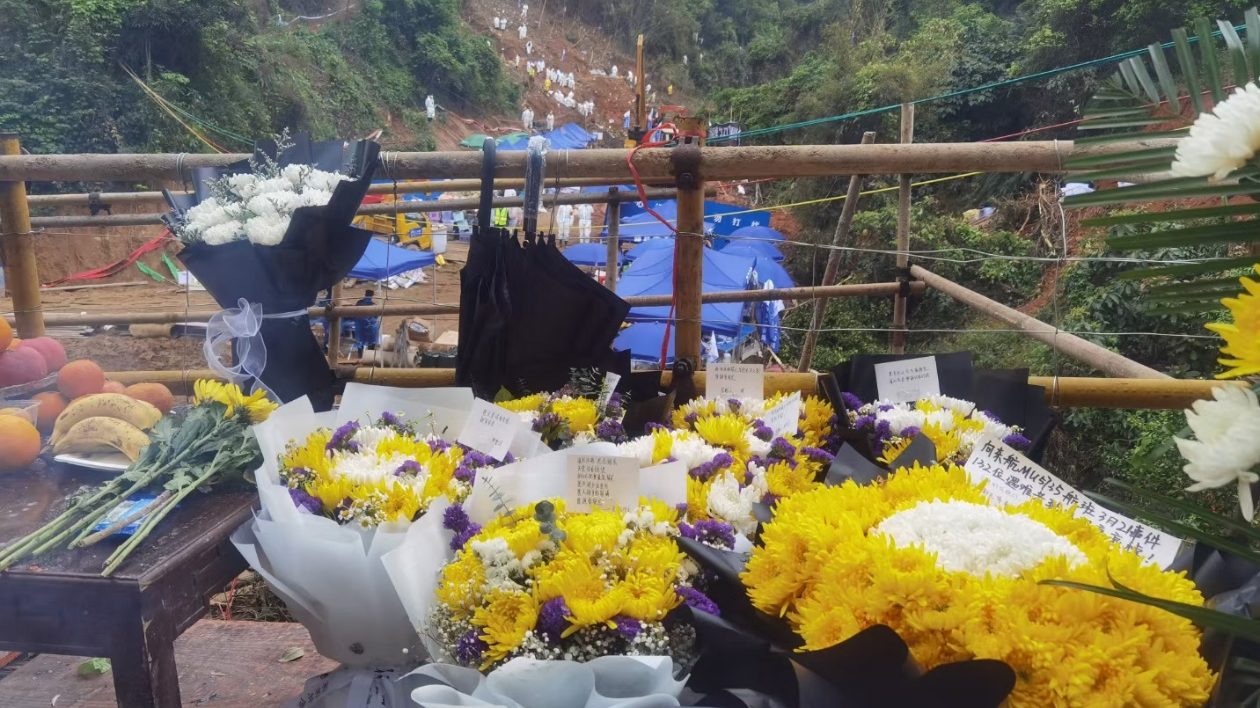
A memorial area is set up near the crash site, March 28, 2022. /CGTN
A China Eastern Airlines passenger plane crashed on March 21 in Tengxian County, Guangxi Zhuang Autonomous Region, killing all 132 people on board. This is the country's deadliest airline disaster in more than a decade.
CGTN reporters He Weiwei and Cao Chufeng were at the site, covering the search and rescue operation for seven days. Here are their diaries and observations.
Something we can't show our audience – the smell at the rescue site
By He Weiwei
Although I had seen some pictures of the crash site, it was still shocking when my cameraman, Wang Yuxiang, and I first stepped onto the search and rescue site.
Wreckage and broken pieces of the plane were scattered all over the mountain, rescuers had to climb up for the search operation, which could only rely on manpower rather than machines due to difficult terrain. Excavators were not allowed in until experts confirmed that there were no signs of life in a certain area.
We used up our battery filming as many details of the search as we could, but there was something we couldn't show our audience: the smell.
It was a smell that I could hardly describe, something mixed with mud, rotten wood and other objects. It made people feel uncomfortable at the site.
It rained heavily, then the sun came out to make the temperature go up to almost 30 degrees Celsius on the first day we entered the site. That, according to experts, can hasten the decomposition of human remains that have yet to be found at the site. It also means a bigger risk of exposure to pathogens in the atmosphere, meaning people at the site need to wear protective suits, N95 masks and gloves when working there.
I was already sweating all over when I entered the area.
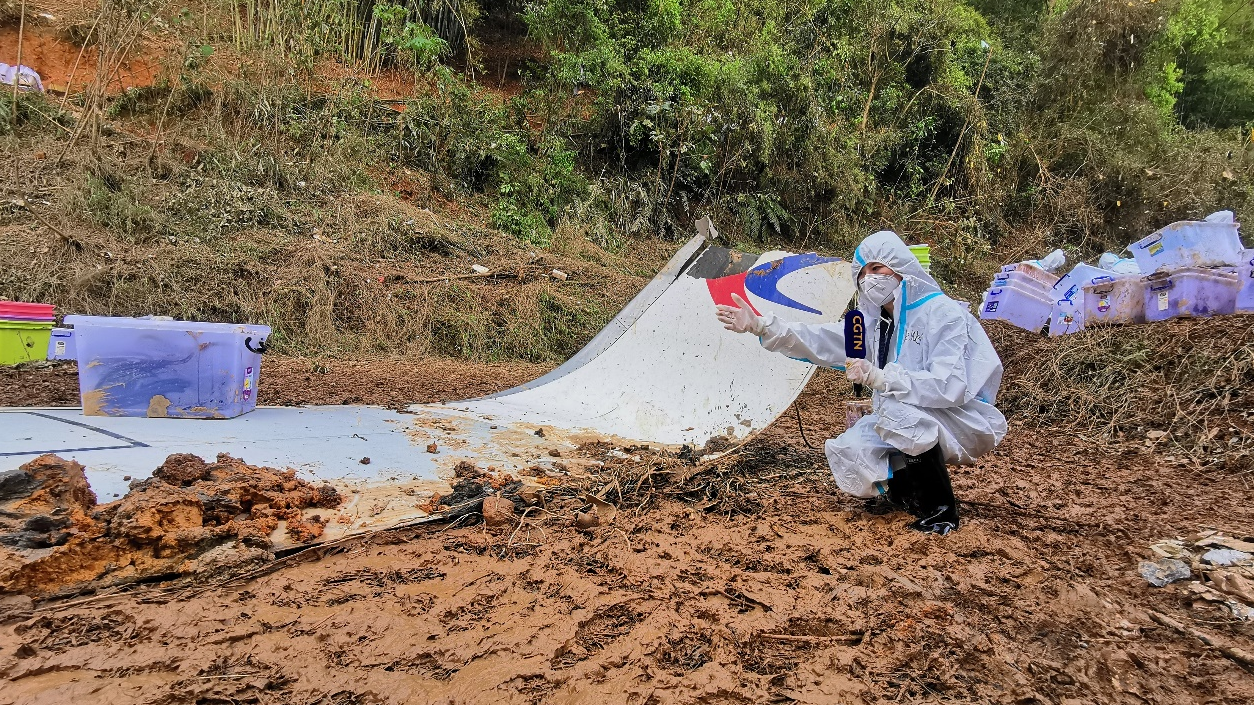
CGTN reporter He Weiwei reports beside part of the plane's wing found at the crash site, March 25, 2022. /CGTN
It was also difficult to walk as there was no road, and the core search area was a steep slope that was almost vertical. Our rain boots often got stuck in the mud, and I nearly fell down a couple of times.
You can imagine how tough the work can be for the rescuers, looking for possible survivors and plane wreckage on such difficult terrain in protective gear, and bearing that smell.
We filmed for nearly 2.5 hours, and had to leave for some rest after feeling exhausted and using up our batteries. A rescue leader told me that was quite a long time, as each of their shifts was only about 1.5 hours.
A total of 7,000 people joined the search and rescue operation, working in shifts.
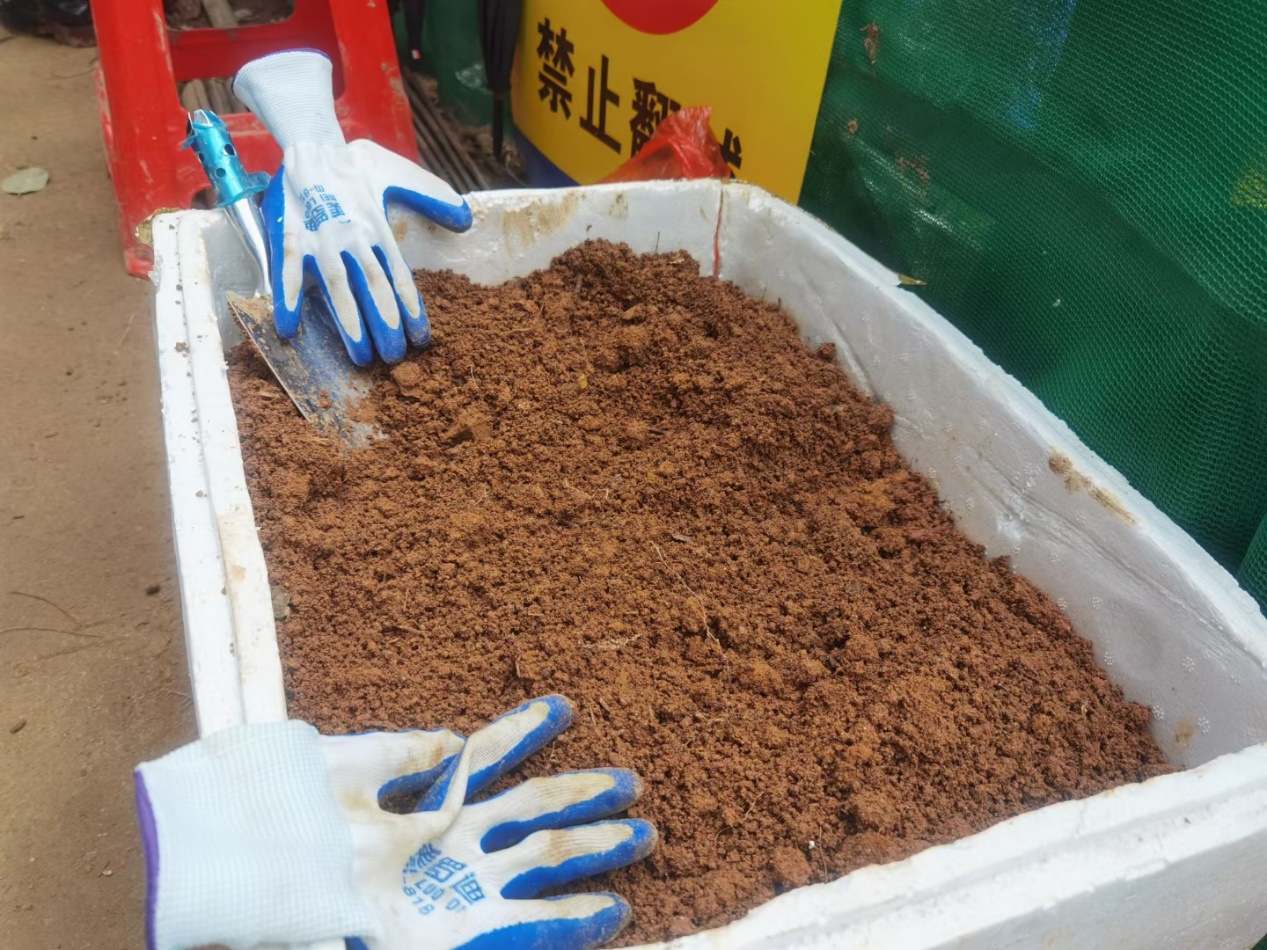
A box of mud is collected for the victims' families to take home, March 28, 2022. /CGTN
Memorial services were available at a special area set up near the crash site to mourn the victims. Families came holding flowers and pictures of their lost ones. I saw some relatives collecting mud and putting it into plastic bags or cinerary caskets to take home.
The extent of the crash makes it extremely difficult to find body parts.
That was the most heartbreaking moment of my seven-day coverage of the plane accident.
I almost couldn't contain myself during live broadcast
By Cao Chufeng
This was certainly my most memorable live-cross. It was on the night of March 26, six days after the plane crash. We were told on short notice that a press conference would be held at 10 p.m. Our headquarters realized that a big news story might be announced. I was instructed to do a live-cross immediately after the presser on our 10 p.m. news program, which is produced by our team in Europe.
I walked into the briefing room. There were only two nameplates on the table, which meant the announcement would be short. My heart stopped for a second, thinking it might not be good news. When Hu Zhenjiang, deputy director of the Civil Aviation Administration of China, announced "all 123 passengers and nine crew members on board China Eastern Airlines flight MU5735 are confirmed dead," the atmosphere was particularly somber inside room – all of us stood up for a moment of silence.
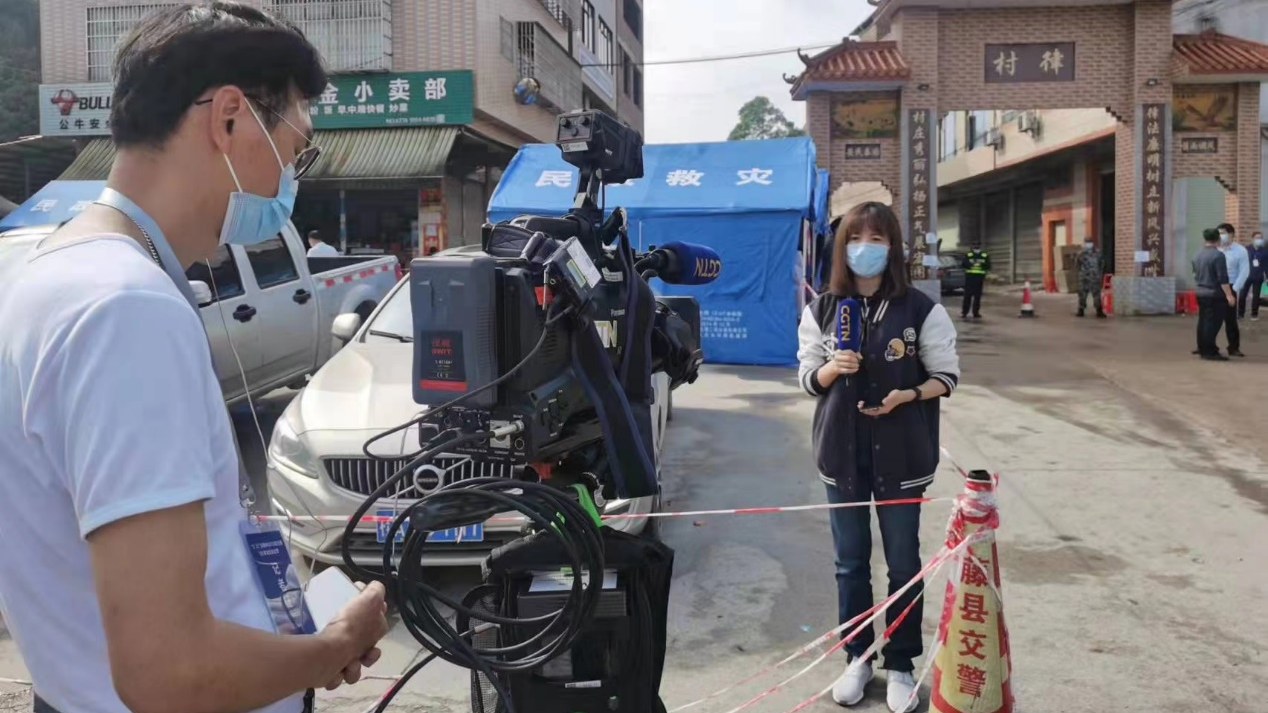
Reporter Cao Chufeng (R) and cameraman Huang Yi report from outside the search and rescue command center, March 25, 2022. /CGTN
My subsequent live-cross to Europe lasted only a minute or so, but I struggled with every word I spoke. I tried to remain professional, keeping my emotions in check.
I had dinner with our cameraman at midnight, neither of us talked much. I only remember in the middle of our meal, he looked at me and said, "Continue eating, don't skip dinner."
CGTN was the only English media outlet to enter the core search and rescue site. Livestream signals were available on digital platforms. The cause of the tragedy is still under investigation after two black boxes were found.
Psychological aid is needed not only for the victims' families, but everyone at the site: rescuers, media and other supporting staff. Yin Ping, head of the MU5735 Passengers' Relatives Counselling Service Team, said the best way to pay respects to the victims is not to forget them. "This is a devastating disaster, and those alive should embrace each other."
