- Home
- China
- World
- Asia-Pacific
- Americas
- Europe
- Middle-East and Africa
- Politics
- Business
- Opinions
- Tech & Sci
- Culture
- Sports
- Travel
- Nature
- Picture
- Video
- Live
- TV
- Radio
- Specials
- Learn Chinese


Share







Copied

CFP
Editor's note: Hannan Hussain is a foreign affairs commentator and author. He is a Fulbright recipient at the University of Maryland, the U.S., and a former assistant researcher at the Islamabad Policy Research Institute. The article reflects the author's opinions and not necessarily the views of CGTN.
On April 1, UK-based newspaper The Times falsely accused Beijing of staging what it called "a huge cyberattack on Ukraine's military and nuclear facilities," in the lead-up to Russia's military operation in February. "In an apparent sign of complicity … Chinese attacks started before the end of the Winter Olympics and peaked on February 23, the day before Russian troops and tanks crossed the border," alleged the outlet.
Meanwhile, disproven "intelligence memos" were attributed to Ukraine's Security Service (SBU), sold to readers as credible proof, as a band of select British outlets picked on the story to advance their own anti-China agenda.
The reality stands exposed, clear as day: The SBU confirms there was no such intelligence data, it shared nothing with The Times, and that there is no "investigation" underway.
All this is emblematic of the larger truth about select British media outlets when it comes to reporting accurately on China. That includes the extent to which these outlets are willing to go to invent information about China's geopolitical behavior and communicate the final product as "news" to readers and officials. Take a close look at the untruth of Chinese cyberattacks on Ukrainian facilities: it was promoted, in part, by the unwarranted position of the British government. "The National Cyber Security Center is investigating these [The Times] allegations with our international partners," said a UK government spokesperson quoted by The Guardian.
Critical to note here is how neither the media outlet nor the government appears big on questioning the credibility of the cyberattack allegations, as they allude to China. That is despite it being clear that the source of the allegations – so-called Ukrainian intelligence memos on China – doesn't presently exist at all.
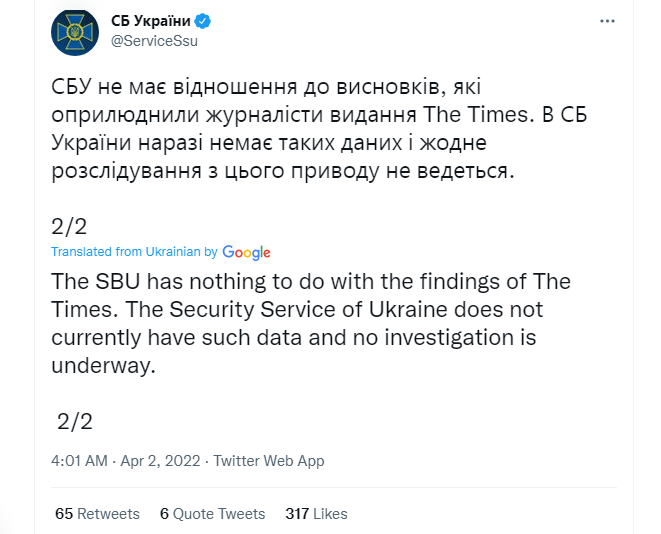
A screenshot of Ukraine's Security Service's tweet on April 2 refuting The Times' accusations that China carried out a cyberattack on Ukraine's military and nuclear facilities. /@ServiceSsu
Calling out anti-China rhetoric by upholding journalistic standards would require a principled approach from papers and the government alike. It also demands a marked departure from some elements of London's National Cyber Strategy, which continues to enshrine a degree of ideological bias against China on so-called cyber threats. For instance, the strategy blames China for advocating "greater national sovereignty over cyberspace," and insists China was a source of consistent threats during the past year. This is important in the context of The Times' groundless allegations and the implicit approval afforded to it by other British outlets: all have been careful not to challenge the Cyber Strategy's core assumptions about China when pushing the narrative around the Russia-Ukraine conflict.
Understand that when government policy reflects ideological bias in its cyber initiative, it risks empowering media outlets to advance disinformation about a sovereign power. Consider the Ukraine Secret Service's cyberattacks rebuttal as a case in point. The SBU pushed back against The Times' story on grounds largely overlooked by the British government: the outlet's exercise of false attribution and self-identified "findings" that in the SBU's own telling, have nothing to do with it.
Where is the protest? If impartial coverage was truly a matter of broad concern, it would've been London – not the SBU – issuing such a statement in support of truth.
Current developments demonstrate why China's constructive role in resolving the Russia-Ukraine conflict cannot be spun out of context. It is a fact that China continues to stand in firm defense of peace and has engaged in key multilateral fora to incentivize momentum for much-needed talks. China represents an important voice for stemming the current humanitarian crisis as well, and continues to factor the interests of all parties in a shared attempt to keep the regional conflict from escalating.
Thus understood, a refusal to acknowledge these consistencies and distort China's role in the current conflict are destined to hit a brick wall. Persistence would further expose the deep-seated anti-China bias that dominates the likes of The Times and render commitments to truth – especially on China – untrustworthy.
(If you want to contribute and have specific expertise, please contact us at opinions@cgtn.com. Follow @thouse_opinions on Twitter to discover the latest commentaries in the CGTN Opinion Section.)
