- Home
- China
- World
- Asia-Pacific
- Americas
- Europe
- Middle-East and Africa
- Politics
- Business
- Opinions
- Tech & Sci
- Culture
- Sports
- Travel
- Nature
- Picture
- Video
- Live
- TV
- Radio
- Specials
- Learn Chinese


Share







Copied
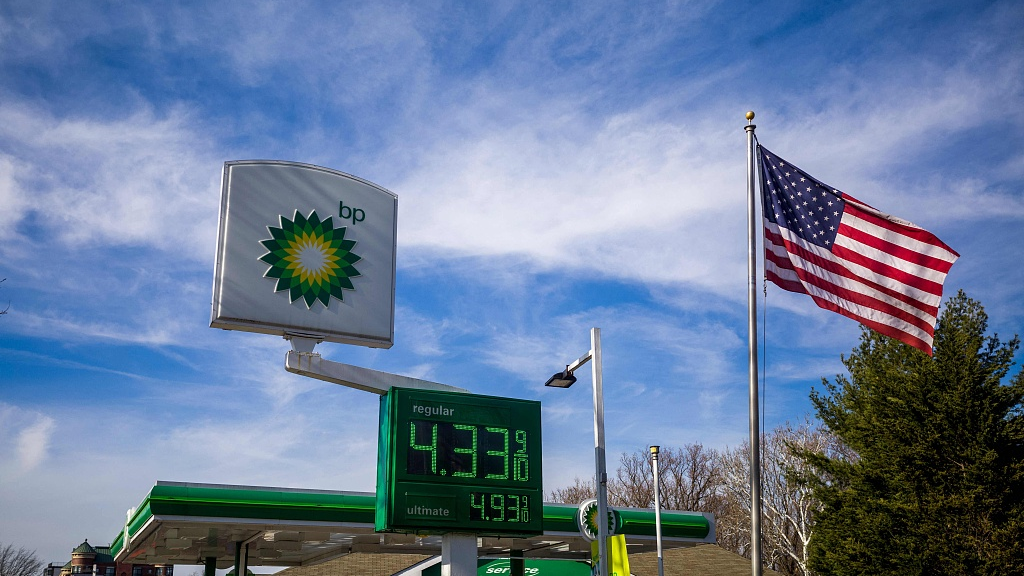
A sign shows the price of gas outside a gas station as prices reach record highs in Washington, D.C., U.S., March 8, 2022. /VCG
Editor's note: Thomas W. Pauken II is the author of the book "U.S. vs. China: From Trade Wars to Reciprocal Deal" and a consultant on Asia-Pacific affairs and geopolitical commentator. The article reflects the author's opinions and not necessarily those of CGTN.
U.S. President Joe Biden announced on March 31 that the White House has ordered the release of 180 million barrels of oil from the nation's strategic petroleum reserve for the next six months, which would average about one million barrels per day (mbd). Apparently, President Biden is taking desperate measures to boost the chances of his Democrat Party staying in majority control of the U.S. Congress and Senate after the upcoming mid-term elections this November.
Nevertheless, Biden's executive order stands as an emergency tactic that could very well lead to catastrophic results regarding U.S. energy security planning. Before the unprecedented decision, the U.S. had stockpiled over 600 million barrels that could meet American energy demand for almost a month. The reserves were set for release only in cases of dire emergencies, according to U.S. legislation established in response to the 1973 oil embargo led by Saudi Arabia and other Arab states.
Releasing oil from the strategic reserves to help the ruling Democrat Party win favor with American voters should never have been the real purpose. Meanwhile, Biden's actions could fail to lower oil and gas prices for the next few months and the rest of the year. One mbd only accounts for 5 percent of U.S. daily energy demand, while Russian oil imported to the U.S. was delivered at three mbd before Biden announced the Russian oil and gas ban for the U.S. market.
The numbers are not adding up for Team Biden
Shortly after Russian President Vladimir Putin announced Russia's "special military operations" in Ukraine on February 24, the U.S., European Union (EU), United Kingdom, and North Atlantic Treaty Organization (NATO) were quick to issue immediate public condemnations against the Kremlin, with Brussels, London and Washington taking decisive action to impose harsh economic sanctions against Moscow. Yet amid the anti-Russia hysteria, the Biden administration appeared disorganized about how to address the overall impact of their sanctions on Russia.
Hence, gas prices have been skyrocketing. According to the American Automobile Association, the average cost of retail gas for drivers in the U.S. is $4.23 a gallon, up from $2.87 a year ago. U.S. drivers could very well see $5 to $6 per gallon of gas since the summer driving season is coming soon. Don't be surprised to see gas prices go even higher this summer and beyond and natural gas and heating to hit astronomic heights by the end of the year.
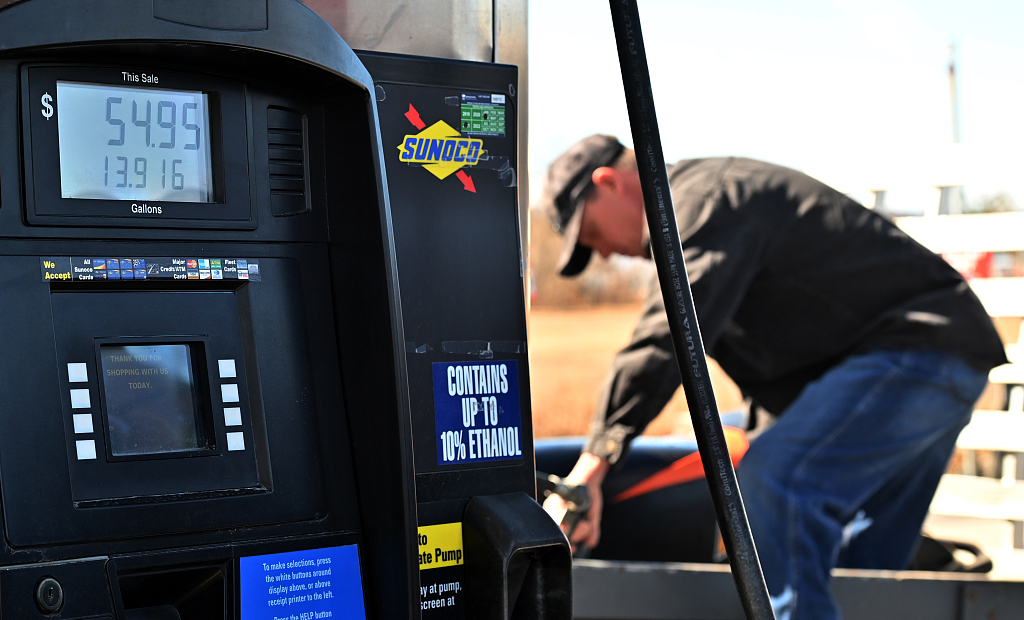
A Sunoco gas pump reading shows more than $54 as a man pumps gas, March 3, 2022. /VCG
To avoid severe energy shortages and widespread rolling blackouts, Biden should change course on his current policy by boosting domestic oil exploration and production levels that have dropped during the pandemic. The U.S. could soon be confronting severe energy shortages and widespread rolling blackouts if Biden fails to change course on his current energy policy.
The Band-Aid won't fix it
Biden is counting on no new international crisis to erupt between now and the midterm elections, which explains his strategic petroleum reserves gamble. But that sort of thinking exposes the current weaknesses of the U.S. Should gas prices keep rising, Americans will vent their anger at Biden, whose approval ratings are already very low, averaging about 39 percent in February.
Biden supports a "transition from the oil industry," but European states still have to rely on Russian oil and gas.
However, Brussels, London and Washington remain unlikely to change their present-day stands on the economic sanctions against Russia, and Putin has added a new twist by requiring 48 "hostile nations" to purchase oil and gas in Russian rubles. Almost all of Europe will be directly impacted by it.
That's why Scott Sheffield, chief executive of Pioneer Natural Resources, believes that Biden's release of oil from its reserves will not be the right solution. He is quoted by New York Times as saying, "It will lower the oil price a little and encourage more demand. But it is still a Band-Aid on a significant shortfall of supply."
And as the saying goes, "Desperate times deserve desperate measures." Biden is failing the American public by acting like an ostrich sticking his head in the sand and thinking the problems will just disappear on their own. Washington must show more boldness, such as temporarily halting the federal gas tax, opening up federal lands for drilling and issuing new government permits for offshore drilling and exploration.
The solutions will not fix the rising gas prices overnight, but at least they are a step in the right direction. If Washington can't maintain its energy security, how can the U.S. be trusted when resolving future global financial crises, tackling high-flying inflation worldwide and coming to the rescue on severe international supply chain disruptions? We are seeing the U.S. in panic mode, and it's starting to get very ugly.
(If you want to contribute and have specific expertise, please contact us at opinions@cgtn.com. Follow @thouse_opinions on Twitter to discover the latest commentaries on CGTN Opinion Section.)
