- Home
- China
- World
- Asia-Pacific
- Americas
- Europe
- Middle-East and Africa
- Politics
- Business
- Opinions
- Tech & Sci
- Culture
- Sports
- Travel
- Nature
- Picture
- Video
- Live
- TV
- Radio
- Specials
- Learn Chinese


Share







Copied
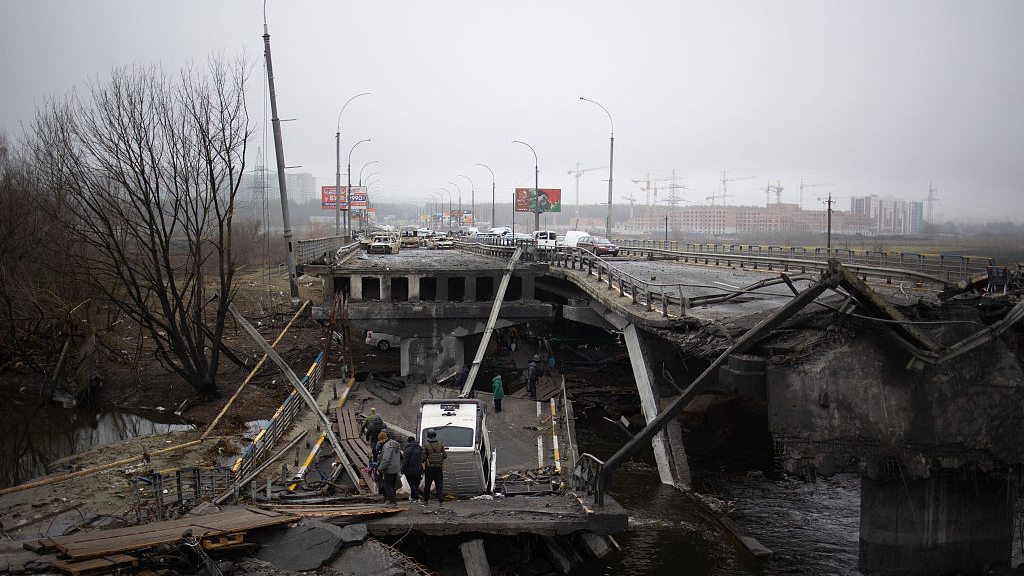
The situation in the eastern, northern and southern areas of Ukraine is becoming increasingly dire. Access to food, water, medicine and other basic necessities remains severely restricted. In the Luhansk region, the governor says a tank holding nitric acid was hit by a Russian strike on Tuesday in the city of Rubizhne. A team from the International Committee of the Red Cross, which has been trying since Friday to enter the city of Mariupol to lead an evacuation, says it won't try to enter the city on Tuesday. Over 3,300 people were evacuated from Ukraine via humanitarian corridors on Monday. The United Nations says 1,430 civilians have been killed in the conflict so far.
In less than six weeks, the civilian death toll from Russia's military operation has surpassed the civilian deaths from the last seven years of armed conflict in eastern Ukraine. The actual number of civilian casualties across Ukraine is likely much higher and will continue to rise as fighting intensifies in the eastern and southern parts of the country.
The Ministry of Economy says Ukraine's economy shrunk by 16 percent between January and April this year, projecting a 40-percent decline by the end of 2022 – double the recent projection issued by the European Bank for Reconstruction and Development. On the Russian side, in response to more sanctions from the West, President Vladimir Putin signed a decree on Monday introducing visa restrictions for citizens of countries that Moscow deems "unfriendly." The decree suspends Russia's simplified visa system with some EU countries, as well as Norway, Switzerland, Denmark and Iceland.
On negotiations, Ukrainian President Volodymyr Zelenskyy has signed a decree to approve a Ukrainian delegation for talks with Russia. Though Russia hasn't commented on the coming peace talks yet, Russian Foreign Minister Sergei Lavrov said the country wants Ukraine to be guided by its national interests and to stop listening to foreign advisers.
