- Home
- China
- World
- Asia-Pacific
- Americas
- Europe
- Middle-East and Africa
- Politics
- Business
- Opinions
- Tech & Sci
- Culture
- Sports
- Travel
- Nature
- Picture
- Video
- Live
- TV
- Radio
- Specials
- Learn Chinese


Share







Copied
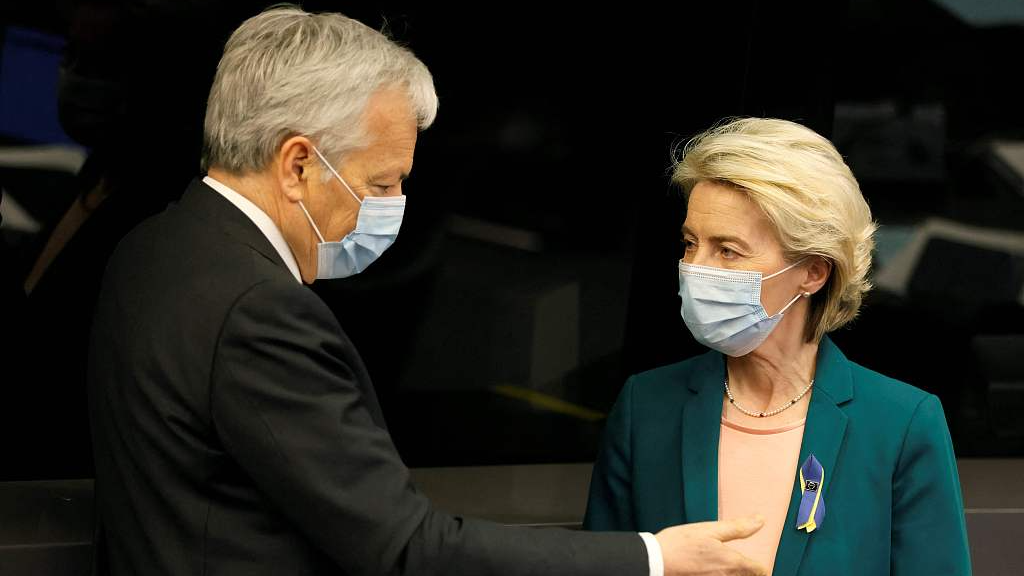
European Commission President Ursula von der Leyen (R) and European Commissioner for Justice Didier Reynders talk ahead of a meeting of the commission at the European Parliament in Strasbourg, France, April 5, 2022. /CFP
Editor's note: Danil Bochkov is an expert with the Russian International Affairs Council. He graduated cum laude with a master's degree in economics from MGIMO-University under the Ministry of Foreign Affairs of Russia and a master's degree in world economy from the University of International Business and Economics in China. The article reflects the author's opinions and not necessarily the views of CGTN.
The ongoing "military operation" by Russia against Ukraine has not only upended the relation between both states but also made Moscow an outcast of the Western political system. If U.S. President Joe Biden was among the first to proclaim his intent to make Russian President Vladimir Putin "a pariah" on the world stage right on the day the operation commenced, the European allies took over this narrative with British Foreign Minister Liz Truss repeating after the American president about a week later.
However, the EU and UK went further than the U.S. in practical terms, imposing more economic sanctions against Russia, which together with the American ones target over 1,000 individuals and businesses.
Still, economic pressure is not the only tool utilized by the Western powers to force Russia into more obedient behavior. Many of the European states have recently gone on a diplomatic demarche to prosecute Russia over escalation of the Ukrainian conflict.
In 48 hours about 200 Russian diplomats were expelled across Europe on the alleged accusations of the mass civilian fatalities in the Ukrainian suburban town of Bucha – the claims that were dispelled by the Russian authorities as "a staged provocation." Nevertheless, the incident has sparked a new round of diplomatic saber-rattling between Moscow and the West. Russia has recently rebuked the EU's sanction policy as "overstepping all limits."
In April last year I wrote for CGTN that Russia-U.S. relations hit the bottom with a vague way out from the deadlock, noting that the "most alarming sign of the degradation of bilateral ties [was] … the U.S.' decision to expel Russian diplomats."
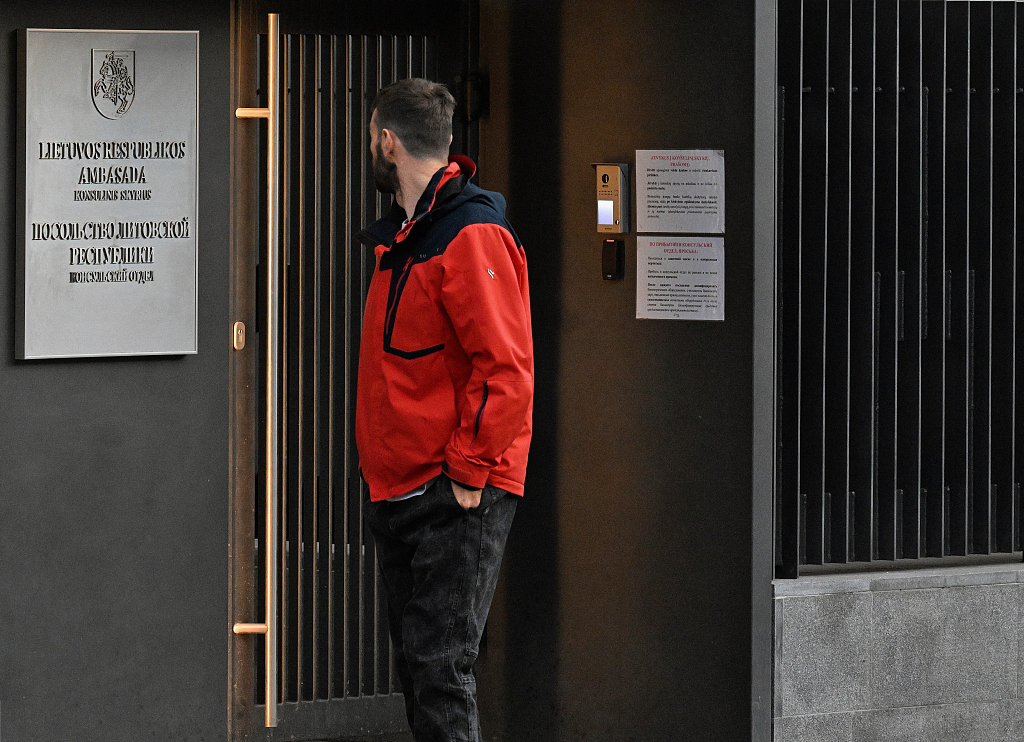
The Embassy of the Republic of Lithuania in Moscow, Russia. /CFP
At that moment Russia also introduced its novel diplomatic instrument known as an "unfriendly state" list which was first presented on May 13 of last year, with the U.S. and Czech Republic on it. After all the U.S. allies introduced sanctions against Russia, Moscow reciprocated on March 5 with the extension of the list to encompass 48 countries including all the EU member-states.
So now it becomes clear that Russian relations with the EU have become more a reflection of the similarly dire relations with the U.S., with the only difference being that the Russia-U.S. breakup happened much earlier. Germany and France expelled the largest number of Russian diplomatic personnel out of all the EU states, which is a significant blow to their bilateral contacts with Moscow.
Traditionally the most ardent critics of Russia within the EU – Latvia and Estonia – closed two Russian consulates and recalled diplomatic staff. Russian authorities have also noted "an explosion of anti-Russian hysteria" following a car crash into the Russian embassy gate in Romania on April 6, the same day the Kremlin's spokesperson Dmitry Peskov indicated that Russia did not rule out the severing of diplomatic contacts with the Western states if they continue expelling Russian diplomats.
In order to offset the negative impact of economic and political pressure emanating from the West, Russia may try to refocus some of its priorities to Asia. As I have recently argued for the South China Morning Post: there is the "reluctance of many countries, including heavyweights like India, to support U.S. sanctions on Russia," which "points to a new, more fragmented world order" formation under way.
Of course, now Russia could see more prospects in embracing closer ties with the Middle Eastern powers, South and East Asia states, BRICS countries and others, but the geographical location of Russia makes the rupture of ties with Europe very disadvantageous.
Now, with NATO becoming as united as it was in the Cold War era, many European states have announced plans to increase expenditures for military. Germany said that it would allocate more than 2 percent of its GDP for defense, which will be a double increase from last year's spending of 47 billion euros ($51.3 billion).
In response to the growing fears around fragility of the European security architecture, the EU is torpedoing the idea of establishing a rapid reaction force with up to 5,000 troops. Such tendencies mean that Moscow will have to tremendously reinforce its Western flank, which would require huge financial and manpower resources – the assets that are becoming less plentiful following increasing costs for a national economy infused by sanctions on Russia.
(If you want to contribute and have specific expertise, please contact us at opinions@cgtn.com. Follow @thouse_opinions on Twitter to discover the latest commentaries in the CGTN Opinion Section.)
