- Home
- China
- World
- Asia-Pacific
- Americas
- Europe
- Middle-East and Africa
- Politics
- Business
- Opinions
- Tech & Sci
- Culture
- Sports
- Travel
- Nature
- Picture
- Video
- Live
- TV
- Radio
- Specials
- Learn Chinese


Share







Copied
World Health Day falls on April 7, and this year's theme is "Our planet, our health." World Health Organization (WHO) is issuing an urgent call for accelerated action by leaders and all people to preserve and protect health and mitigate the climate crisis.
WHO estimates that more than 13 million deaths around the world each year are due to avoidable environmental causes. This includes the climate crisis which is the single biggest health threat facing humanity.
In recent years, we have experienced temperature rise, extreme weather, polluted air, sea level rise and so on. These environmental changes also directly or indirectly affect our human health.
How does climate change affect our health?
Climate hazards are increasingly contributing to a growing number of adverse health outcomes in multiple geographical areas, according to Intergovernmental Panel on Climate Change's (IPCC) report "Climate Change 2022: Impacts, Adaptation and Vulnerability."
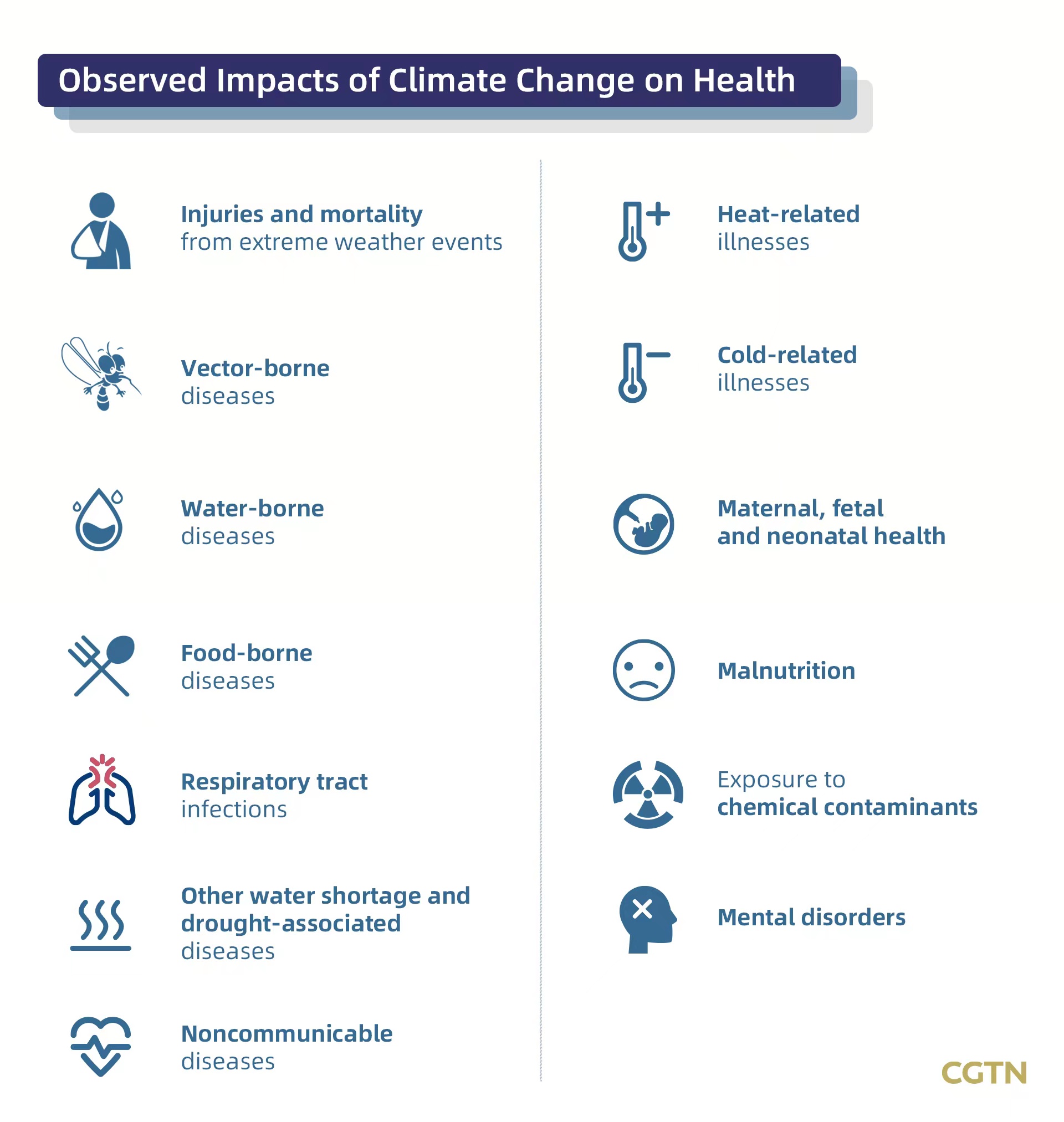
Observed impacts of climate change on health based on IPCC's report "Climate Change 2022: Impacts, Adaptation and Vulnerability." Feng Yuan/CGTN
Climate change impacts health in a myriad of ways, including by leading to death and illness from increasingly frequent extreme weather events, the disruption of food systems, increases in food, water and vector borne diseases, and mental health issues. Furthermore, climate change is undermining many of the social determinants for good health, such as livelihoods, equality and access to health care and social support structures.
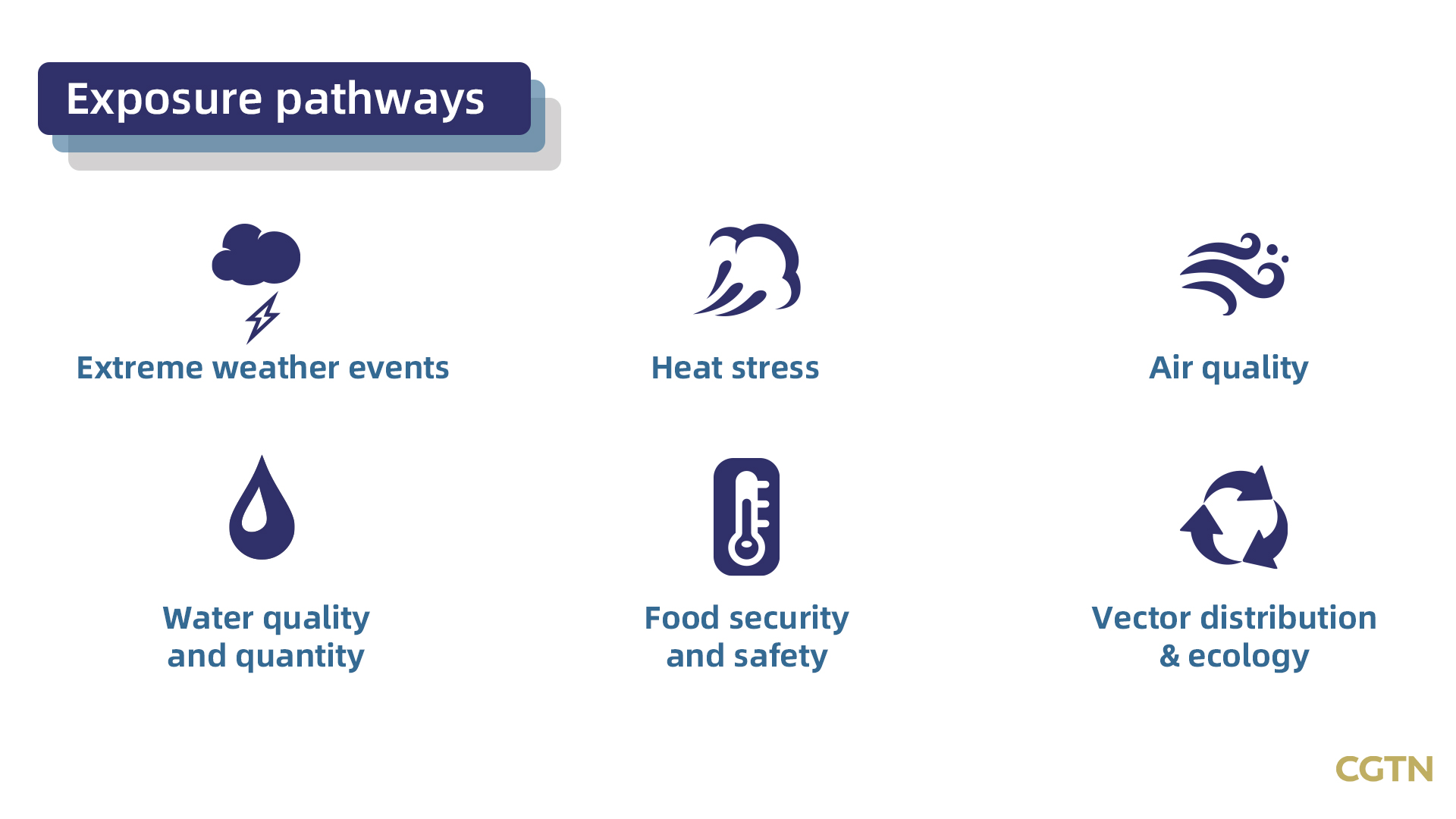
Climate-sensitive health risks' exposure pathways, WHO. /Designed by CGTN's Feng Yuan
IPCC noticed that climate change is expected to significantly increase the health risks resulting from a range of climate sensitive diseases and conditions, with the scale of impact depending on emissions and adaptation pathways in coming decades. Studies show that there will be an additional 250,000 deaths per year by mid century due to climate-sensitive diseases and conditions, and under high-emissions scenarios, over 9 million additional deaths per year by 2100.
The climate crisis is also a health crisis.
The impacts will be determined mainly by the vulnerability of populations, their resilience to the current rate of climate change and the extent and pace of adaptation. More importantly, actions should be taken to reduce emissions and avoid the breach of dangerous temperature thresholds to respond to the health crisis.
(Cover image via VCG)
(If you want to contribute and have specific expertise, please contact us at nature@cgtn.com.)
