- Home
- China
- World
- Asia-Pacific
- Americas
- Europe
- Middle-East and Africa
- Politics
- Business
- Opinions
- Tech & Sci
- Culture
- Sports
- Travel
- Nature
- Picture
- Video
- Live
- TV
- Radio
- Specials
- Learn Chinese


Share







Copied
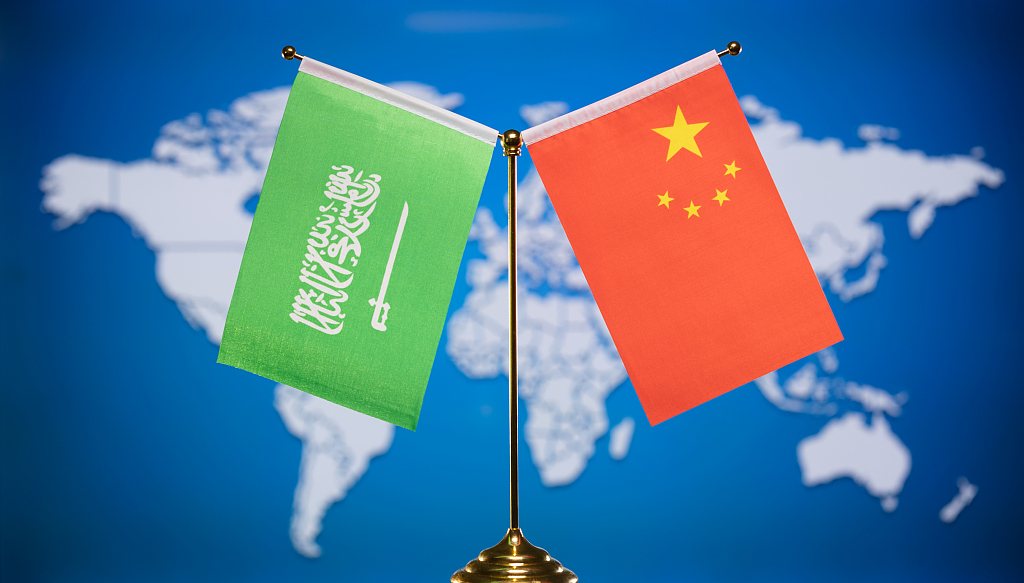
National flags of China and Saudi Arabia. /CFP
Editor's note: Hannan Hussain is a foreign affairs commentator and author. He is a Fulbright recipient at the University of Maryland, and a former assistant researcher at Islamabad Policy Research Institute. The article reflects the author's opinions and not necessarily the views of CGTN.
On April 15, Chinese President Xi Jinping held a phone conversation with Saudi Arabia's Crown Prince Mohammed bin Salman, underlining the merits of deepening comprehensive strategic partnership, and aligning flagship development initiatives. "Saudi Arabia-China ties have seen great progress in various fields and China has provided a model of economic development and political stability for countries worldwide," said the Crown Prince.
Prospects of a synergy between China's Belt and Road Initiative (BRI) with Riyadh's flagship Vision 2030 have several merits. First, both initiatives continue to attach significance to scalable infrastructure and regional connectivity, and that aspiration is bolstered by Riyadh's "Look East" policy and its status as a key BRI participant in the Middle East.
Riyadh also sees Vision 2030 as a way of diversifying its economy from core energy-driven revenue. That indicates some commonalities in strategic planning, as Beijing – even in the face of a recurring global pandemic – remains committed to opening its economy and uses the BRI as a way of encouraging economic recovery and spurring the connectivity potential in the wider region.
From a multilateral view, Beijing has also struck a promising relationship with the Gulf Cooperation Council (GCC). The six-member group has been at the center of efforts to conclude years of China-GCC negotiations on a Free Trade Agreement, and both sides have shared views on finalizing its arrangements. On a side note, it was only in recent years that Beijing emerged as the GCC's largest trading partner.
Present GCC aspirations to leverage rapid transport and infrastructure logistics between Gulf States is also an encouraging sign for what President Xi characterized as a "high-level cooperation pattern" and what Mohammed affirmed as being a better synergy between Vision 2030 and the BRI.
Interestingly, Saudi participation in the Global Development Initiative – as indicated by President Xi – provides yet more impetus to bolster ties as Riyadh pursues its own sustainability endeavors through the Middle East Green Initiative. Both nations thus continue to make headway on sustainability interventions.
Several of China's ministries published a crucial policy document that advances the BRI's case to serve as a catalyst for green investments overseas. Riyadh, in the process of expanding hundreds of kilometers worth of internal connectivity tracks linked with the wider GCC network, has its eye on similar move in the long-term. Together, these trajectories show the promise of synergizing development paths, particularly when past cooperation in transportation, economy, trade and infrastructure has proven mutually beneficial.
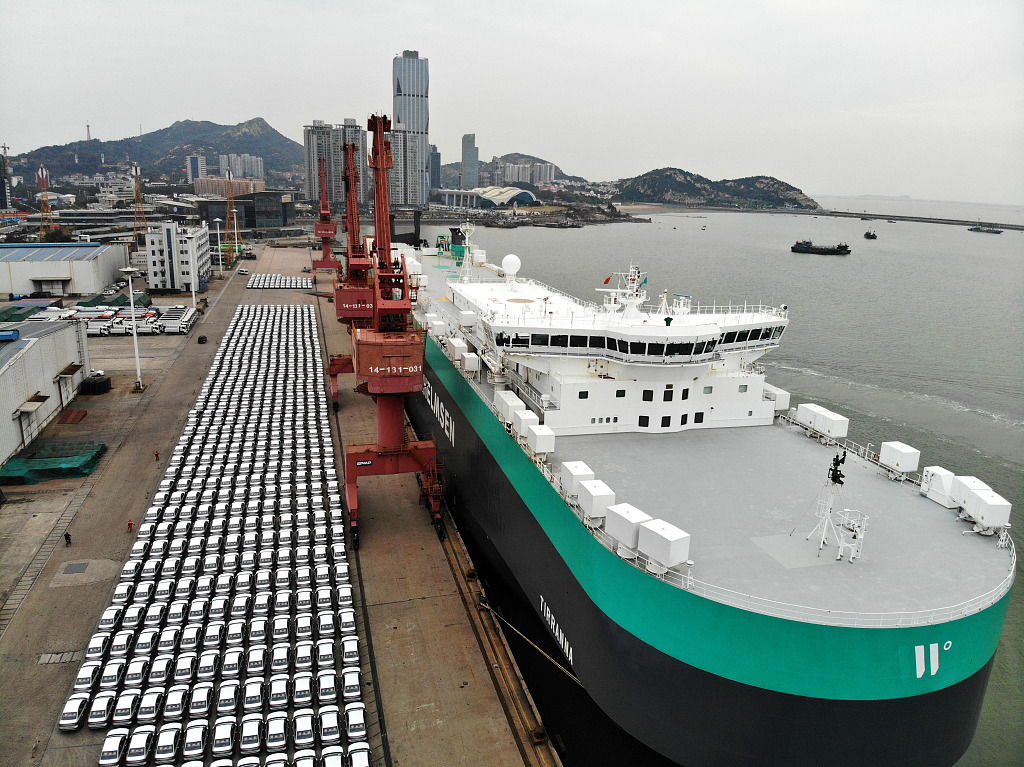
Vehicles were shipped for export to Saudi Arabia in Lianyungang Port, east China's Jiangsu Province, October 20, 2020. /CFP
It's worth noting that President Xi and and Crown Prince bin Salman's call for stronger cooperation arrives at a time when the China-Saudi comprehensive strategic partnership is becoming increasingly suited to future elevation. Beijing, also Saudi Arabia's biggest trading partner, has prioritized the relationship even through a broader outreach to the Islamic world, as witnessed at a key Organization of Islamic Cooperation (OIC) meeting last month. Riyadh was also at the center of several high profile energy and trade agreements signed with China in 2019, underscoring the "great importance" attached by the Crown Prince to flourishing bilateral ties with Beijing.
On the geopolitical front, both nations remain acutely aware of the profound and complex international situation, highlighting the need to drive that sense of vigilance towards optimal China-Saudi initiatives on energy, trade, transportation, infrastructure and economic cooperation.
An unwavering commitment to respecting each other's sovereign interests has also been a hallmark of bilateral ties. Beijing has put its weight behind Riyadh's sovereignty, security and stability, and President Xi made it clear that such support will accompany Saudi Arabia's pursuit for an independent development path.
Riyadh also showed unwavering commitment to the "One China Principle", and in the Crown Prince's own wording, "will continue to staunchly support China's legitimate positions on such issues concerning core interests, resolutely oppose any interference in China's internal affairs, and firmly safeguard the rights of all countries to independently choose their own political and human rights paths." Thus understood, both sides will not budge and give any room for external elements to interfere in any way.
Ultimately, firm belief in respecting one another's internal matters, and a shared aspiration to synergize development strategies for regional benefit, make the elevation of China-Saudi ties promising for the future. Rather critically, this would also contribute to building "a China-Arab community" for the new era, driven by a shared future.
(If you want to contribute and have specific expertise, please contact us at opinions@cgtn.com. Follow @thouse_opinions on Twitter to discover the latest commentaries on CGTN Opinion Section.)
