- Home
- China
- World
- Asia-Pacific
- Americas
- Europe
- Middle-East and Africa
- Politics
- Business
- Opinions
- Tech & Sci
- Culture
- Sports
- Travel
- Nature
- Picture
- Video
- Live
- TV
- Radio
- Specials
- Learn Chinese


Share







Copied
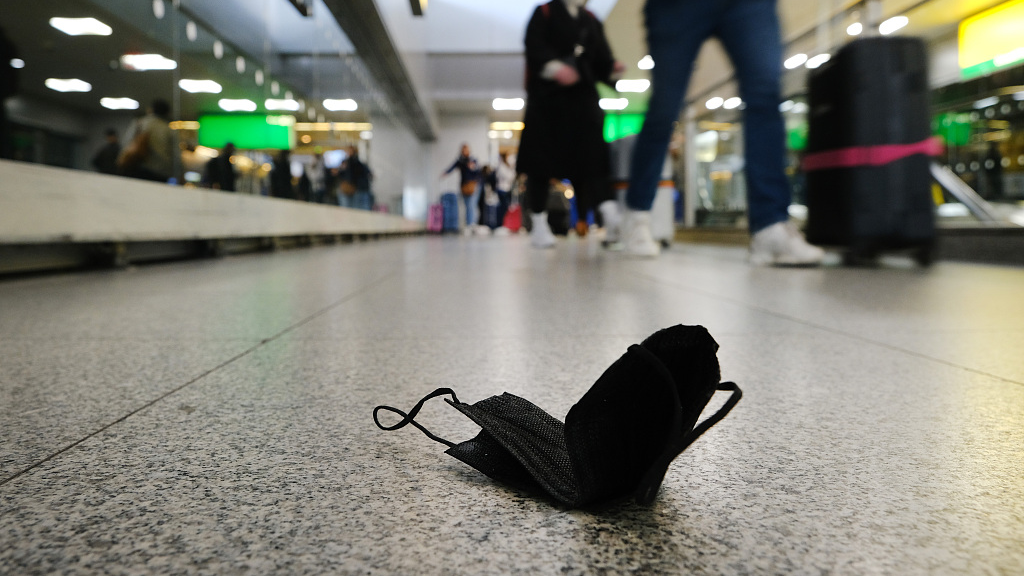
A mask is seen on the ground at John F. Kennedy Airport in New York City of the United States, April 19, 2022. /CFP
As the number of COVID-19 cases grow in the United States over the past weeks, experts worry that the number is far off as COVID-19 tests are being done in non-traditional settings, like at homes.
CNN reported that only 7 percent of positive COVID-19 cases in the U.S. are being detected, citing models estimated by the Institute for Health Metrics and Evaluation, which can be translated to 14.5 times higher than officially reported cases.
The United States is now averaging about 35,000 new infections daily, up 19 percent from the previous week and 42 percent from two weeks prior, according to the latest data from the U.S. Centers for Disease Control and Prevention (CDC).
Cases have long been undercounted in the U.S., and the rising use of at-home tests could lead to unreported results, according to Ali Modak, professor and chief strategy officer of population health at the institute.
"They don't even know to take a test," Modak told CNN as most people infected with the Omicron coronavirus variant won't show any symptoms.
How are different test results recorded
Only diagnostic and screening test results at lab-based COVID-19 testing sites – where nucleic acid tests are performed – are required to report to state or local public health authorities. However, these tests are taken voluntarily or required by employers for unvaccinated people as a proof to go back to the work place.
As for individuals who get self-tested, the federal government has not issued any mandatory guidance on reporting the results, which lead to gaps in data.
At-home test manufacturers, though, have to comprise a mobile phone app or website "to further facilitate results reporting by the individual" using the at-home test per requirement from the U.S, Food and Drug Administration. Yet still, the problem lies within whether people are willing to report or even use the digital assistance.
Researchers at the University of Massachusetts and other U.S. institutions found that only about 8 percent of those who use at-home COVID-19 tests would also use the "digital assistant" or app that comes with it, according to a study published this month. Of those who used the app, about 25 percent chooses not to report their results to their state public health authorities, particularly if they had a positive test result.
The researchers noted that people are not educated enough about the importance of reporting testing results, which may be result in the overall low usage of the app.
Why is the number important
When it comes to a pandemic like COVID-19, case number is an indicator for people within a certain area to know ahead when to take actions to protect them from getting sick and from spreading the virus as most states in the U.S. have dropped many mandatory protection measures.
Testing is also important at an individual level as it tells them if they need to seek COVID-19 treatments, which work best when the illness is caught early.
Jennifer Nuzzo, an epidemiologist and professor at Brown University, told CNN that more needs to be done to monitor the pandemic to make up for the lack of data.
"We're going to see a signal. It's just going to be harder to interpret and know what to do about it," said Nuzzo, who is also the director of the Center for Pandemic Preparedness and Response at Brown.
"If people are getting sick in the grocery store, then you need to know that so you encourage people to wear masks. If it is 5-year-olds, you can take measures there," she said.
Testing expert and a professor of practice in the College of Health Solutions at Arizona State University Mara Aspinall noted the importance of reporting test results when interviewed by CNN. "We have to always stay ahead of this and not just hope it's gone away," Mara said.
