- Home
- China
- World
- Asia-Pacific
- Americas
- Europe
- Middle-East and Africa
- Politics
- Business
- Opinions
- Tech & Sci
- Culture
- Sports
- Travel
- Nature
- Picture
- Video
- Live
- TV
- Radio
- Specials
- Learn Chinese


Share







Copied
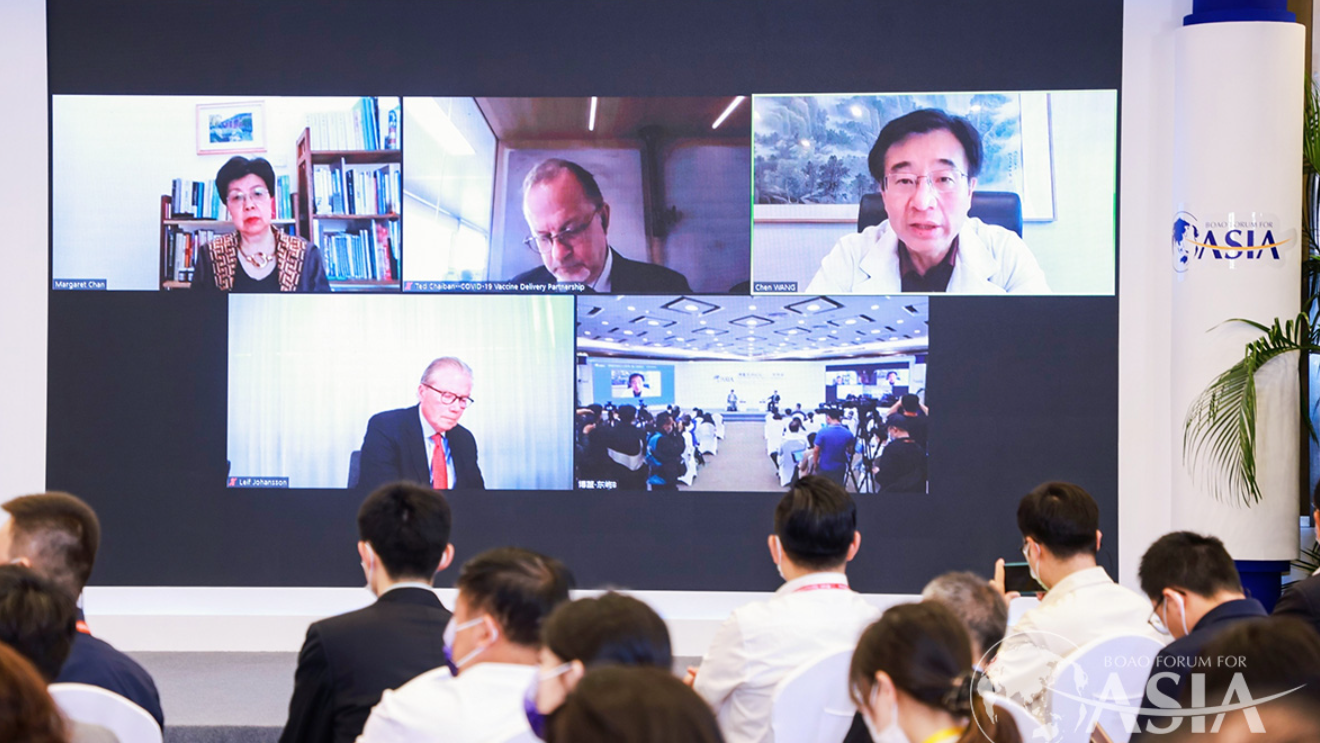
A session titled "Narrowing the Vaccine Gap" took place on April 20 during the 2022 Boao Forum for Asia in south China's Hainan Province. /Boao Forum for Asia
Experts called Wednesday for a strengthening of international cooperation to narrow the COVID-19 vaccination gap between rich and developing nations at the Boao Forum for Asia in the Chinese island province of Hainan.
Gao Fu, director of the Chinese Center for Disease Control and Prevention, opened a discussion titled "Narrowing the Vaccine Gap" by reminding the audience that a wide gap exists in vaccination rates between high- and low- and middle-income countries.
One-third of the global population has not received the first dose of a COVID-19 vaccine, said former UK Prime Minister Gordon Brown via a video link. He said the rate in developed countries had surpassed 80 percent, but 84 percent of the African population remained unvaccinated.
Although the current global vaccine production is enough for everyone, less than 50 percent of people in low- and middle-income countries have received one shot, Brown said.
In addition to the inequality of vaccine accessibility, the session also looked at the immune gap globally.
Margaret Chan Fung Fu-chun, former director-general of the World Health Organization, who also joined the session through video link, said that the elderly in Africa and other areas around the world face a high risk of death from COVID-19 infection.
In her view, bridging the immune gap so that the elderly populations of more countries and regions can get vaccinations at an affordable cost requires greater attention.
Chan said that developing countries should be encouraged to acquire production capacity to narrow the vaccine gap. These countries need more than just money and donations but help to build effective health systems.
Deng Boqing, vice chairman of the China International Development Cooperation Agency, said that the current global immunity gap, which some populations having low natural immunity, is not directly equivalent to the vaccine gap, and involves at least four aspects: vaccine production capacity, vaccine accessibility, the ability to be vaccinated and the willingness to be vaccinated. For example, vaccination capacity is relatively limited in many countries for a variety of reasons, he added.
Brown said that narrowing the immunity gap will require more vaccination programs worldwide, especially in low- and middle-income countries, more equipment, facilities and materials, and a long-term goal to promote global access.
Deng added that China is willing to work with developed countries and international organizations to make contributions to closing the immune gap.
