- Home
- China
- World
- Asia-Pacific
- Americas
- Europe
- Middle-East and Africa
- Politics
- Business
- Opinions
- Tech & Sci
- Culture
- Sports
- Travel
- Nature
- Picture
- Video
- Live
- TV
- Radio
- Specials
- Learn Chinese


Share







Copied
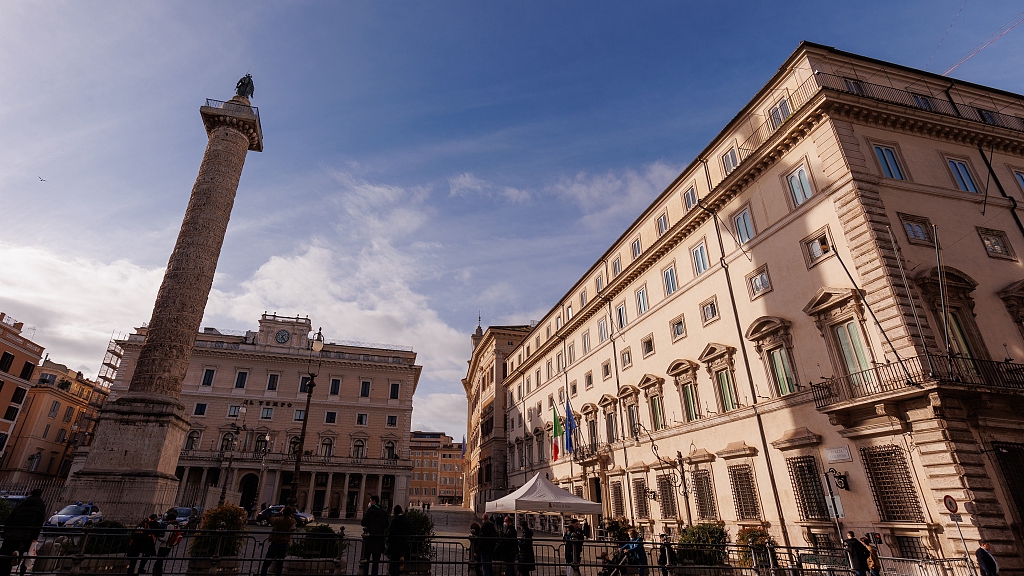
A view of Palazzo Chigi, seat of the Italian government in Rome, Italy, December 29, 2021. /VCG
Italy plans to limit air conditioning in government buildings starting next month in a bid to save energy and reduce the country's heavy reliance on imported Russian gas.
Public buildings, including schools, post offices and other government buildings, will be asked not to turn the air conditioning below 25 degrees Celsius over the summer, warmer than is usually the norm in a country where temperatures often top 40 degrees.
They will also be asked to keep heating under 19 degrees Celsius in the winter.
Dubbed "Operation Thermostat," the initiative is due to enter into force on May 1 and last until March 31, 2023.
The government added it hoped private companies and individuals would follow suit, although it is not clear how the new rules will be enforced.
Undersecretary of Defense Giorgio Mule told La 7 Television on Wednesday that the measure was aimed at using less energy as a way to reduce the country's dependence on gas imports from Russia.
Earlier this month, Prime Minister Mario Draghi called for a collective sacrifice in the wake of the crisis in Ukraine, asking his fellow Italians: "Do we want to have peace or do we want to have the air conditioning on?"
"We do not want to depend on Russian gas any longer, because economic dependence must not become political subjection," Draghi added in an interview with the Corriere della Sera daily on Sunday.
"Diversification is possible and can be implemented in a relatively short amount of time – quicker than we imagined just a month ago."
Besides "Operation Thermostat," Italy penned a deal on Wednesday to ramp up gas supplies from Angola. This follows agreements with Algeria and Egypt in recent weeks.
About 45 percent of Italian gas currently comes from Russia.
According to media reports, Minister of Public Administration Renato Brunetta said the air conditioning plan would save at least 2 billion cubic meters of gas per year.
(With input from Xinhua, AFP)
