- Home
- China
- World
- Asia-Pacific
- Americas
- Europe
- Middle-East and Africa
- Politics
- Business
- Opinions
- Tech & Sci
- Culture
- Sports
- Travel
- Nature
- Picture
- Video
- Live
- TV
- Radio
- Specials
- Learn Chinese


Share







Copied
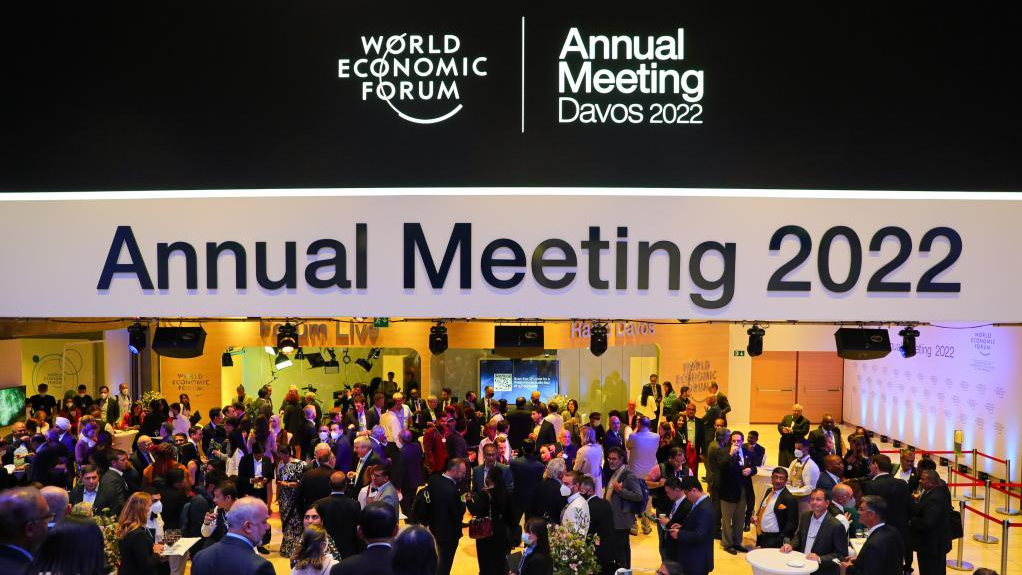
The welcome reception in the Congress Center for the World Economic Forum 2022 Annual Meeting in Davos, Switzerland, May 22, 2022. /Xinhua
Editor's note: Wang Yaojing is an assistant professor at the School of Economics, Peking University. The article reflects the author's opinions and not necessarily the views of CGTN.
The World Economic Forum Annual Meeting 2022 is taking place in Davos, Switzerland. It is the first time this forum happens in person in two years after the COVID-19 outbreak in 2020. The key issues to be discussed in Davos include topics like inflation, job creation, sustainable recovery, climate change and other important matters related to government policies and economic growth.
It is applaudable that political and business leaders from around the world can get together and try to find collective solutions to global challenges. Such a solution has happened in previous Davos summits, such as Gavi, the global vaccination alliance. Gavi is an excellent example of a public-private global partnership joining forces from the public side of UNICEF, WHO and private partners such as the Bill & Melinda Gates Foundation and other organizations and manufacturers. Since 2000, Gavi has helped more than 888 million children and prevented more than 15 million deaths through its support for immunization programs. What beautiful things humankind can achieve when they unite! Will it happen again over this week in Davos? I do hope so, but rationally speaking, it will be challenging.
Those who are attending even said it themselves. According to Borge Brende, the president of the World Economic Forum, "such a polarized world" makes it "more difficult" for them to find solutions to "the most pressing challenges that we are facing." It's not surprising, given that the COVAX program is experiencing such a difficult time. This program strives to provide globally equitable access to COVID-19 vaccines, only to find "a handful of rich countries gobbling up the anticipated supply as manufacturers sell to the highest bidder, while the rest of the world scrambles for the scraps." The COVAX program is every bit the same as Gavi (in fact, it's co-led by Gavi and the WHO), except for one dimension: there are "not enough" COVID-19 vaccines to spare.
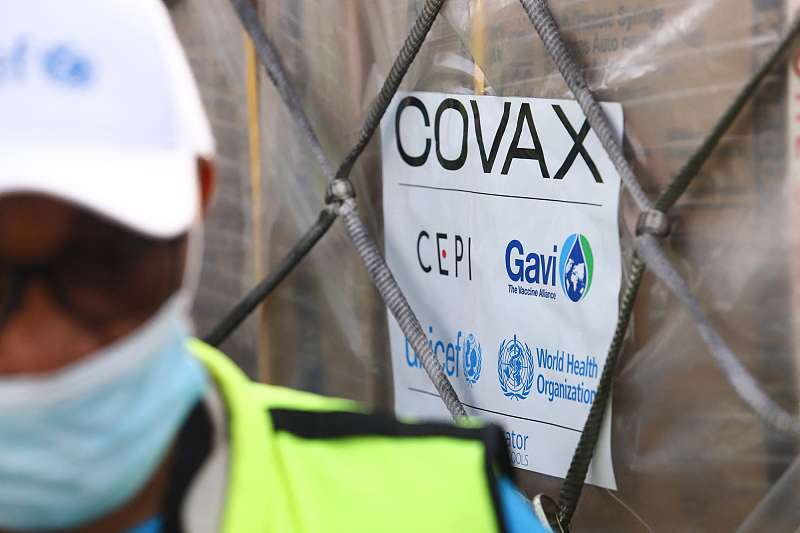
A shipment of COVID-19 vaccines from the COVAX global COVID-19 vaccination program at Kotoka International Airport in Accra, capital of Ghana, February 24, 2021. /CFP
Scarcity! Economists' favorite word. After all, economics is the study of the allocation of scarce resources. Any undergraduate economics textbook would tell you the policy responses to inflation, trade barriers, goods with positive externalities (e.g., vaccine), and goods with negative externalities (e.g., pollution) to increase social welfare: cautious monetary policy, low tariffs, subsidizing vaccines, taxing pollution. Why don't we always see those good policies implemented?
In neoclassical economics, a Pareto improvement refers to a situation where it is possible to make one party better off without negatively affecting another party. Helping lower-income country children with DTP3 vaccines (what Gavi does) is a Pareto improvement as giving out these vaccines does not hurt the giver. Pareto improvements are no-brainers, and that's why Gavi has been so successful. COVAX, however, is not a Pareto improvement. The lower-income countries cannot get more COVID-19 vaccines unless the originally "abundant" countries cut back on theirs (to improve one party's welfare requires the other party to be worse off). If the originally well-off party acts in a self-interested way, there is no good solution to such a situation. Different rules would apply then, political or even military. I'm no expert in politics, but the current COVAX allocation reveals the answer: scarce resources are allocated by the positions of strength.
This is not COVID-specific. In 2010, then U.S. President Barack Obama addressed in an interview with ABC news how the earth cannot sustain the environmental consequences of over a billion Chinese people having the same living patterns as Americans and Australians. He went on to talk about how China needs to find a new sustainable growth model. Note what came after that. Obama said it was "understandable" that developing countries would want Australians and Americans to deal with the environmental problems first while they catch up a little bit on their standard of living. However, his response was, "we can't allow China to wait." Effectively, President Obama acknowledges economic growth as a scarce resource and must be allocated by the position of strength. This "win-lose" unilateralism mindset has dominated the U.S. international policies over the past decade.
But this is not the time for winning or losing. This is "history at a turning point," as indicated by the theme of this year's event. It is the time to stop unilateralism and embrace multilateralism, to work together against all odds. The forum was built to enhance constructive discussions on important issues, but no single country's policy will work well unless we all head in the same direction. Only when everyone can set aside the "you win, I lose" mindset can we genuinely reach an agreement on how to recover from the losses caused by the pandemic and worsened economic situations.
(If you want to contribute and have specific expertise, please contact us at opinions@cgtn.com. Follow @thouse_opinions on Twitter to discover the latest commentaries in the CGTN Opinion Section.)
