- Home
- China
- World
- Asia-Pacific
- Americas
- Europe
- Middle-East and Africa
- Politics
- Business
- Opinions
- Tech & Sci
- Culture
- Sports
- Travel
- Nature
- Picture
- Video
- Live
- TV
- Radio
- Specials
- Learn Chinese


Share







Copied

CFP
Editor's note: Emilia Fernandez, a security and political analyst with a focus on South Asian geopolitics, is a Ph.D. researcher at the University of Lucerne, Switzerland. The article reflects the author's views and not necessarily those of CGTN.
The world has been divided into two groups since U.S. President Joe Biden officially announced his long-awaited Indo-Pacific Economic Framework (IPEF), a instrument to push the U.S. Indo-Pacific strategy in the economic field and contain the growing Chinese influence in Asia. While the proponents of the IPEF are trumpeting that it will bring prosperity in the region and is a starting point for greater U.S. engagement in the Asia-Pacific, its critics argue that the underlying purpose is to advance America's Indo-Pacific strategy.
Also, they add, it will act as a platform to serve the key interests of the U.S. instead of accelerating post-pandemic economic recovery, development, and peace and prosperity.
The IPEF is basically designed not only to serve as an important tool to counterbalance China but also to aid the U.S. in its economic and geopolitical competition against China. In the long run, it will make the regional economy more fragmented as the U.S. has already created several economic blocs that exclude China and divide Asia. This will subsequently lead to disorder in the Asia-Pacific.
When a country joins any economic bloc, it desires to have duty-free market access or tariff concessions and is also ready to grant reciprocal access. But the IPEF has no market access opportunities or tariff reduction provisions and will not be able to ensure the kind of economic benefits, in terms of market access, that the countries in the region expect. This is why experts say it will not be able to create mutually beneficial relationships and ensure win-win situations for all of its initial 13 member states except for the giant economies like the U.S., Japan and Australia.
Through the IPEF, Washington is also trying to dominate digital technology rules and regulations. The so-called high standards set by the framework in the fields of digital economy, labor rights, environmental protection, market supervision and anti-corruption are higher than those set by domestic laws, and even by international conventions in some cases. This demonstrates that it is a "club of rich countries" that will widen the division between developed and underdeveloped economies.
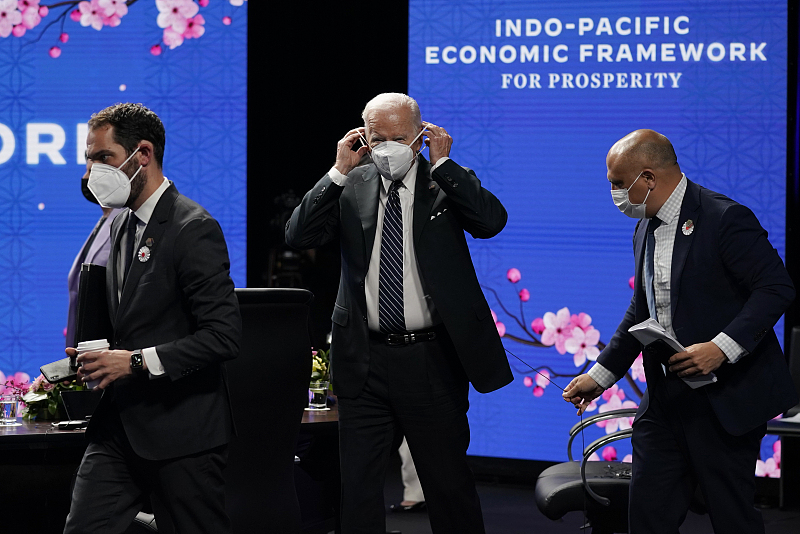
U.S. President Joe Biden puts his mask on after participating in the Indo-Pacific Economic Framework related event at the Izumi Garden Gallery in Tokyo, Japan, May 23, 2022. /CFP
Notably, the Biden administration has not made it clear whether Washington will provide sufficient economic and political capital for the IPEF and how they will do it. Also, the IPEF is yet to be approved by the U.S. Congress, which raises doubts about its sustainability.
Besides, Biden and his Democratic Party will face intense challenges in the 2024 elections and may not be re-elected. If the government changes, what is the guarantee that its Republican successor will continue this initiative started by the Democrats?
This is a valid question as we have the precedent of Donald Trump withdrawing the U.S. from the Trans-Pacific Partnership trade agreement signed by his Democrat predecessor Barack Obama. The allies of the U.S. understand very well that the Democratic Party is not politically stable.
Therefore this leads to another question: Why undertake this initiative despite knowing that the Democrats may not come to power again? The answer is obvious: To serve the foreign policy objective of the U.S. and provide some extra points in its geopolitical game in the Asia-Pacific region as long as the Democrats remain in power. These reasons explain why few countries in Asia have expressed interest in joining the IPEF so far.
It is evident that the main motive of the IPEF is to encircle China to disrupt its rise and serve the U.S. foreign policy agenda in the region. The U.S. will use the IPEF to supplement its Indo-Pacific strategy, a strategy to create division, to incite confrontation and to undermine peace. Besides, it will also help the U.S. to create an economic cooperation agreement that is unilaterally dominant and not a true free trade agreement.
Like other parts of the world, the Asia-Pacific region is also going through a rough patch due to the pandemic, the Ukraine crisis, high inflation and an energy crisis. Under these circumstances, inclusive regional cooperation is needed to give momentum to economic recovery.
As the IPEF seeks to promote division by giving countries a highhanded option to choose between Washington and Beijing to serve U.S. geopolitical interests and isolate China, the largest trading partner of almost all Asian countries, it is going to be a bane, not a blessing for the Asia-Pacific.
(If you want to contribute and have specific expertise, please contact us at opinions@cgtn.com. Follow @thouse_opinions on Twitter to discover the latest commentaries in the CGTN Opinion Section.)
