- Home
- China
- World
- Asia-Pacific
- Americas
- Europe
- Middle-East and Africa
- Politics
- Business
- Opinions
- Tech & Sci
- Culture
- Sports
- Travel
- Nature
- Picture
- Video
- Live
- TV
- Radio
- Specials
- Learn Chinese


Share







Copied
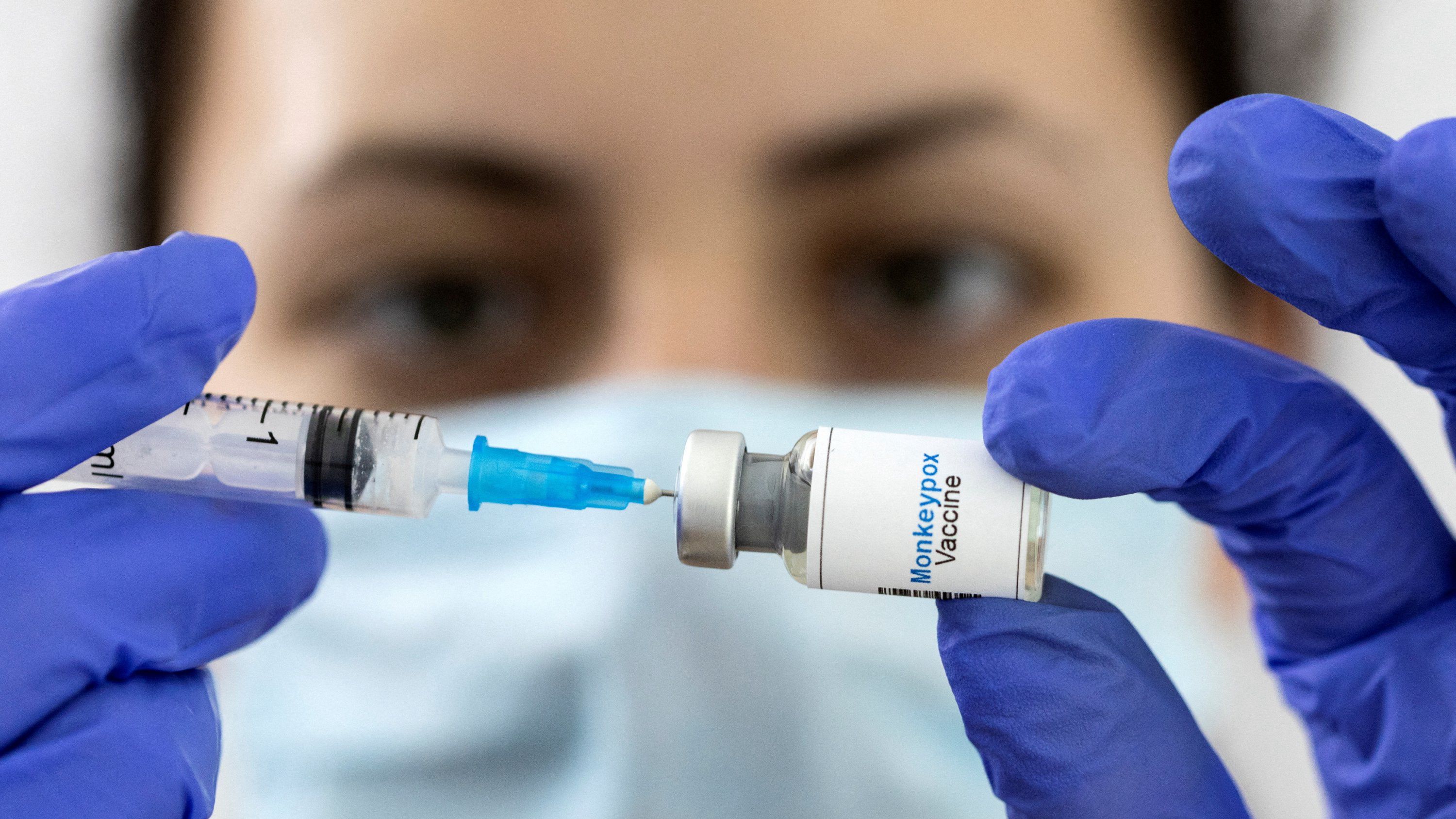
A woman holds a mock-up vial labeled "Monkeypox vaccine" and a medical syringe in this illustration created May 25, 2022. /Reuters
"We must have one connected global response to monkeypox to avoid it becoming endemic in more countries," Dr Matshidiso Moeti, head of World Health Organization (WHO) Africa, said in an online briefing on Thursday.
As countries in the developed world find ways to limit the spread of monkeypox, "it is very important that ... we make sure that we share those tools, we build capacities all over the world to respond to these outbreaks," she said.
"What is extremely important now is to avert any potential for a repeat of the inequitable access to COVID-19 vaccines experienced by African countries early in the pandemic."
Monkeypox recently has been discovered in more than 30 countries where the virus is not endemic, including Britain, Spain, Portugal, Italy, Switzerland, the United States, Israel and Australia. More than 550 confirmed cases have been reported, WHO chief Tedros Adhanom Ghebreyesus said at a briefing on June 1.
More than 1,400 suspected monkeypox cases and 63 deaths have been reported in African countries where the disease is endemic, according to the Africa Centers for Disease Control and Prevention.
But only 44 of those suspected cases have been confirmed, said Dr Fiona Braka, who leads emergency operations at WHO Africa's office in Brazzaville, Republic of Congo.
Part of the reason for the wide gap between suspected and confirmed cases is the limited testing capacity in African countries, said Braka. Just 10 countries in Africa are able to test for the disease, she said.
Monkeypox is in the same family of viruses as smallpox, and smallpox vaccines are estimated to be about 85 percent effective against monkeypox, according to the WHO.
Countries in the developed world have started using smallpox vaccines and are considering the use of antivirals to battle their outbreaks of the disease. Doctors in Africa say those resources should also be available to help them.
"It is important that we do all that we can to stop this," said Dr Ifedayo Adetifa, head of Nigeria's Center for Disease Control and Prevention," We are in a globally connected world … We are not safe until everybody is safe."
(With input from AP)
