- Home
- China
- World
- Asia-Pacific
- Americas
- Europe
- Middle-East and Africa
- Politics
- Business
- Opinions
- Tech & Sci
- Culture
- Sports
- Travel
- Nature
- Picture
- Video
- Live
- TV
- Radio
- Specials
- Learn Chinese


Share







Copied
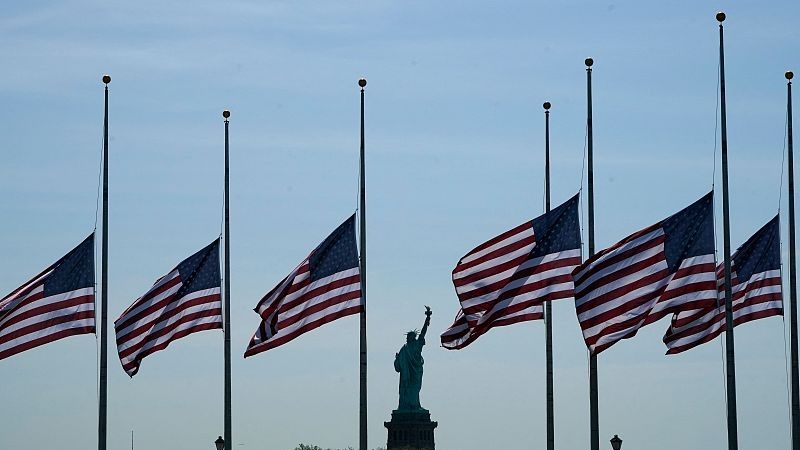
U.S. flags, across New York Bay from the Statue of Liberty, fly at half-mast at Liberty State Park in Jersey City, New Jersey, May 25, 2022. /VCG
Editor's note: Xin Ping is a commentator on international affairs. The article reflects the author's opinions and not necessarily the views of CGTN.
America – the mention of the name often conjures up the image of Lady Liberty lifting her torch to light the way to freedom. While the bronze statue appears magnificent in travel brochures and advertisements, it turns out to be a disappointment – made to look meager by the background skyscrapers – for many who come all the way to see it in person.
The same kind of disillusion can be found in those who rush to the "land of freedom" to pursue the American Dream, as they discover that American-style freedom fails to stand up to close scrutiny.
While the United States enjoys overwhelming economic, political and military power, the American people are increasingly insulated from everyday decision-making and there is a strong public desire for change. As Aziz Rana observed in his book The Two Faces of American Freedom, "Although politicians ritualistically invoke words like 'liberty' and 'democracy,' the current mood is one of ambivalence about what such words mean and how they could be achieved."
The meaning of freedom has changed over time, with each generation having their own understanding of and struggling with the term. But there is an inherent paradox of American freedom – it has been unequally distributed and limited to certain groups only. Throughout U.S. history, liberty and subordination have been bound together. While some are entitled to do what they want, others are treated in harmful ways and left out of the journey toward "life, liberty, and the pursuit of happiness."
The Mayflower brought hope and fortune to the pilgrims but also a nightmare to the American Indians. When the revolutionary patriots rose up against British rule and brought forth a new country "conceived in liberty," many remained in the shackles of slavery.
Having come a long way in the pursuit of freedom, American society today is still haunted by entrenched problems of money politics, social polarization, racial tensions and hate crimes. Minority groups still suffer from "glass ceiling" discrimination and struggle on the margins of American life.
The liberal ideal of unfettered market competition has led to unchecked growth of capital and a system rigged against the majority, where the rich are free to funnel money to the top. This has resulted in extreme inequality and given birth to a nation "of the one percent, by the one percent, for the one percent."
Lately, the individualist sense of liberty was laid bare in the anti-mask protests. The U.S. death toll from COVID-19 has surpassed one million amid fierce debate over mask-wearing and vaccination. Anthony Fauci, the top U.S. infectious disease expert, said in an interview that it is "incredibly tragic" and added that "many of those deaths were avoidable." It is indeed tragic that in pursuing unbound freedom, people forgot one basic prerequisite of freedom – one cannot be free to do harm to another, and a mask is for the sole purpose of preventing infection.
There is an interesting phenomenon related to American-style freedom: government regulation is disdained by the public and mired in a political culture of "vetocracy." A national consensus is out of the question on almost everything. A society sharply divided by identity means that the "melting pot" has broken into pieces.
Like it or not, American-style freedom has mutated into a high-sounding publicity stunt, a weapon to attack disagreeing voices, and an obsession to have one's own way no matter what.
Despite its regrettable record at home, the U.S. is busy exporting its fraudulent practice of freedom to other countries. In the name of freedom, democracy and human rights, the U.S. has indulged itself in changing the systems of countries that it found disagreeable and modeling them after its own image. It also has an inclination to deny other countries' right to experiment with their own approaches to promoting freedom and development. These U.S. practices have resulted in ceaseless civil strife and humanitarian crisis in other countries as has happened in Libya, Syria, Iraq and Afghanistan, which have subsequently spilled over to their neighborhood and America's "values-based" partners in Europe.
There is no denying that freedom is a common value shared by humanity. Every nation has the right to pursue this ideal and pursue it through ways suited to its circumstances. America's liberal way of life is only one of many that exist among humanity. True freedom should be inclusive and beneficial for all – or at least the vast majority of the people of a country. It should in no way degenerate into a pretext for selfish or hegemonic action. Our world will be a better place if no one seeks to dictate the criteria of freedom or use this noble concept as a tool for power politics.
(If you want to contribute and have specific expertise, please contact us at opinions@cgtn.com. Follow @thouse_opinions on Twitter to discover the latest commentaries in the CGTN Opinion Section.)
