- Home
- China
- World
- Asia-Pacific
- Americas
- Europe
- Middle-East and Africa
- Politics
- Business
- Opinions
- Tech & Sci
- Culture
- Sports
- Travel
- Nature
- Picture
- Video
- Live
- TV
- Radio
- Specials
- Learn Chinese


Share







Copied

The Shangri-La Dialogue – the Asia-Pacific's top security meeting – is back this year after a two-year absence due to COVID-19. And it seems the Americans came with a plan to spread their so-called "China threat theory."
During a speech at the Shangri-La Dialogue on Saturday, U.S. Secretary of Defense Lloyd J. Austin III accused China of "undermining security and stability" in the Indo-Pacific region, and growing "provocative" activity near the Taiwan region.
Such accusations are not new. The U.S. have been pointing its fingers at China in recent months, while it gets more active in attempting to join hands with its allies to hype up the hostility against China.
In a February update on what the U.S. called its "Indo-Pacific Strategy," Washington labeled China the primary source of challenges for the region. It said China's "coercion and aggression" spans the globe, and it's most acute in the Indo-Pacific. The U.S. also took aim at Beijing's one-China principle – which insists Taiwan is part of China – by stressing it would work with partners to maintain what it called "peace and stability" in the Taiwan Straits. This included supporting Taiwan's "self-defense" capabilities, the U.S. said.
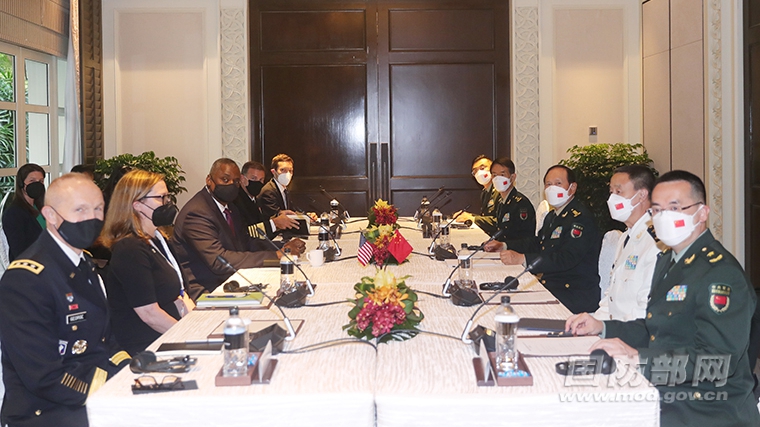
Chinese State Councilor and Defense Minister Wei Fenghe (3rd R) and U.S. Defense Secretary Lloyd Austin (3rd L) hold talks in Singapore, June 10, 2022. /China's Ministry of National Defense
To maintain peace and stability in the Indo-Pacific? Is this really what the U.S. strategy is about? Many have their doubts.
Zhang Chi, associate professor from National Defense University in Beijing, said on the sidelines of the dialogue that the purpose of the Indo-Pacific strategy is not to maintain peace and stability in the region, but to contain the rise of China.
"By exaggerating the China threat theory, the U.S. wants to shape China into a so-called 'public enemy' of regional countries, so it can take the moral and commanding high ground, and mobilize regional allies and partners to go against China," Zhang said.
Chinese President Xi Jinping has said on many occasions that the Pacific Ocean is big enough to accommodate the development of both China and the U.S. For reasonable and educated people across the world, such a concept should be pretty simple to grasp. So, why are we seeing an increasing number of American politicians, including the U.S. defense secretary, go head-to-head with China?
Zhang said there are two main reasons, and the first is America's deep-rooted Cold War mentality.
"During the Cold War, the U.S. successfully defeated the Soviet Union through its Cold War mentality and containment strategy," he said. "Therefore, the U.S. has got cognitive inertia on how to deal with issues like this, and will continue to use the methods of the past to deal with the rising China of today."
Secondly, Zhang added, there have been some changes in ideological trends in the U.S. since former president Donald Trump came to power, and the most prominent one is populism.
"It has triggered panic and anxiety about the rise of China. More and more Americans have got a negative view of China," Zhang said.
In such an environment, the U.S. is finding it difficult to stay rational and objective, and, it seems, its China policy is suffering because of that. Their rather wild and illogical Indo-Pacific strategy bears testament to this. It shows that the Americans don't truly understand Beijing's own strategy in the region.
The way out for China, Zhang pointed out, is to stick to its fundamental principles. He emphasized that firstly the government has pledged to continue to reform and open up its markets, strengthen its economic and trade cooperation with other countries, and expand common interests and, in the process, narrow differences. Second, he said China will fight resolutely against the aggressive posture of the U.S. And third, China will adhere to the concept of dialogue and negotiation as means to manage and control crises.
"Communication cannot be interrupted at any time," Zhang said.
That is echoed by Zhao Jingfang, professor from National Defense University, who highlighted the importance of the Shangri-La Dialogue serving as a communication platform on the sideline of the dialogue.
"The Shangri-La Dialogue provides us with an important channel to publicize China's propositions, including the idea of a community with a shared future for mankind, a community with a shared future for Asia, and our concept of peaceful development and win-win cooperation," Zhao Jingfang said.
On Friday, the defense ministers of China and the United States met during the Shangri-La Dialogue. During the meeting, the Chinese defense minister reiterated Beijing's firm stance on issues such as Taiwan, the South China Sea, and internationally, Ukraine. As the spokesperson of the National Defense Ministry said, the talks were not long, but they went well.
Next, the two sides will discuss potential exchanges and cooperation between the two militaries. It's a solid step towards warming up the relations between the two militaries and the two countries.
