- Home
- China
- World
- Asia-Pacific
- Americas
- Europe
- Middle-East and Africa
- Politics
- Business
- Opinions
- Tech & Sci
- Culture
- Sports
- Travel
- Nature
- Picture
- Video
- Live
- TV
- Documentary
- Radio
- Specials
- Learn Chinese


Share







Copied
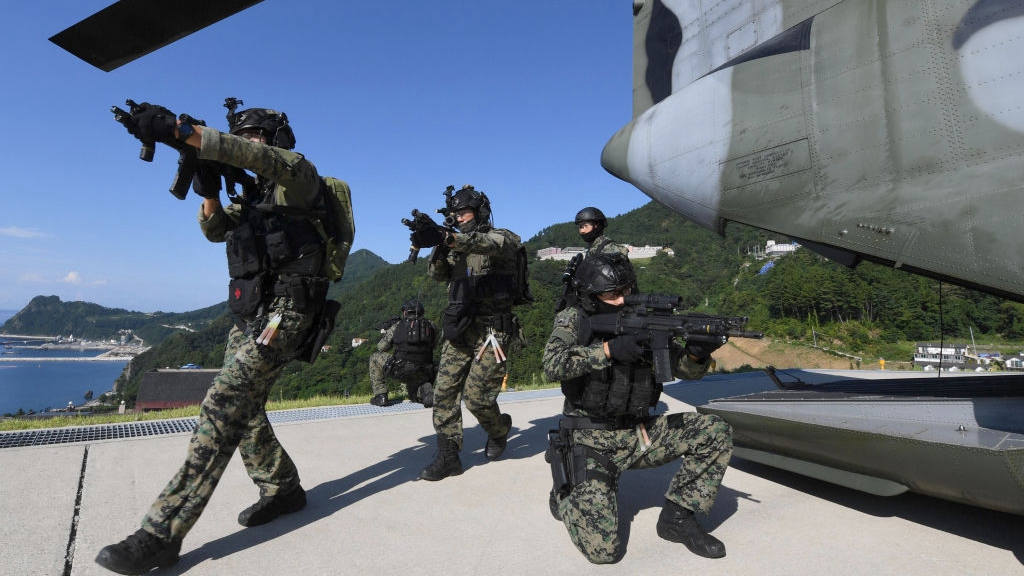
ROK's special army forces participate in a drill on the Dokdo islets (called Takeshima by Japan), August 25, 2019. /Getty
Editor's note: Xin Ping is a commentator on international affairs who writes regularly for CGTN, Xinhua, and Global Times. The article reflects the author's opinions and not necessarily the views of CGTN.
On May 29, it was reported that a research vessel from the Republic of Korea (ROK), Hae Yang 2000, was found conducting a marine survey near the waters of the disputed Liancourt Rocks (known as Dokdo in ROK and as Takeshima in Japan) within Japan's self-claimed Exclusive Economic Zone. Tokyo lodged protests with the ROK government and demanded an immediate halt of its maritime activities in the area.
The ROK side, however refuted that its activity was legitimate and persisted on with its survey. As the war of words between the two countries continue escalating, the dispute has cast a shadow over the Fumio Kishida cabinet's intention to improve ties with the new ROK government.
Over the decades, the Liancourt Rocks dispute has been a thorn between the two neighbors, reflecting the dark history of Japan's invasion and colonization against its Asian neighbors. In 1905, after invading the Korean Peninsula, the Imperial Japanese government declared its sovereignty over the Liancourt Rocks.
As the Imperial Japan surrendered, it was stipulated in Article 8 of the Potsdam Declaration that the legal territory of Japan, which is "limited to the islands of Honshu, Hokkaido, Kyushu, Shikoku and such minor islands as we determine." The Liancourt Rocks do not fall within the scope of Japan's territory. It is illegal for Tokyo to claim sovereignty over the islets.
Nonetheless throughout the past decades, coveting the islets and more importantly the associated Exclusive Economic Zone, Japan has taken an opportunistic approach to pursue territorial expansion.
In 1953, taking advantage of the Korean War, Japan deployed troops to occupy the Liancourt Rocks (later recaptured by the ROK) and set up a territorial marker on the islet. In 2005, the Shimane prefectural government unilaterally designated February 22 as "Takeshima Day."
In 2008, the Japanese Ministry of Education referred to the Liancourt Rocks as a Japanese territory in that year's guidelines of history education for junior high school. In 2021, the map used by the Tokyo Olympic Organizing Committee included the Liancourt Rocks in Japan's territory. And in the same year, Japan's middle school textbook stated that the islets have "never been anything but Japanese territory."

Japanese Prime Minister Fumio Kishida attends a press conference at the Prime Minister's official residence after an extraordinary Diet session in Tokyo, Japan, December 21, 2021. /Getty
Not only with the ROK, in its territorial disputes with China and Russia, Japan is masterful of "unilaterally changing status quo" through deception. From illegitimately setting up territorial markers, secretly changing maps, to revising textbooks, Japan has kept stirring up and manipulating territorial and maritime disputes.
Like many other controversies such as the Yasukuni Shrine, "comfort women" and forced labor, Tokyo's claim over the sovereignty of disputed islets is whitewashing its war of aggression.
Obsessed with glorifying its dark militarist past, Japan is creating tensions with its neighbors and undermining the public trust for bilateral relations. According to the Japan Press Research Institute's public opinion survey, only 26.3 percent of the Chinese and 31.2 percent of the people in ROK feel close to Japan.
Another opinion survey conducted by the Asia Research Institute at Seoul National University indicated that less than a third of the people in ROK surveyed showed a willingness to improve ties with Japan. Only 3.1 percent of those surveyed spoke positively of bilateral relations. Apparently, Japan has been a "distant" neighbor of the ROK.
Human-beings can be both forgiving and intolerant, but for a reason. Germany, another defeated country in World War II, chose to face its fascist past and apologize for the sufferings it had wrought to the world. Now it is embraced by Europe and has emerged as a leading power in the EU. On the contrary, Japan has yet to admit its past wrongdoings, as well as make sincere apologies to its Asian neighbors.
Hurting the national feelings of its neighbors again and again by distorting history will only press the thorn deeper into Japan's relations with its neighbors. That is not the right manner to win respect and keep friends.
(If you want to contribute and have specific expertise, please contact us at opinions@cgtn.com. Follow @thouse_opinions on Twitter to discover the latest commentaries on CGTN Opinion Section.)
