- Home
- China
- World
- Asia-Pacific
- Americas
- Europe
- Middle-East and Africa
- Politics
- Business
- Opinions
- Tech & Sci
- Culture
- Sports
- Travel
- Nature
- Picture
- Video
- Live
- TV
- Documentary
- Radio
- Specials
- Learn Chinese


Share







Copied
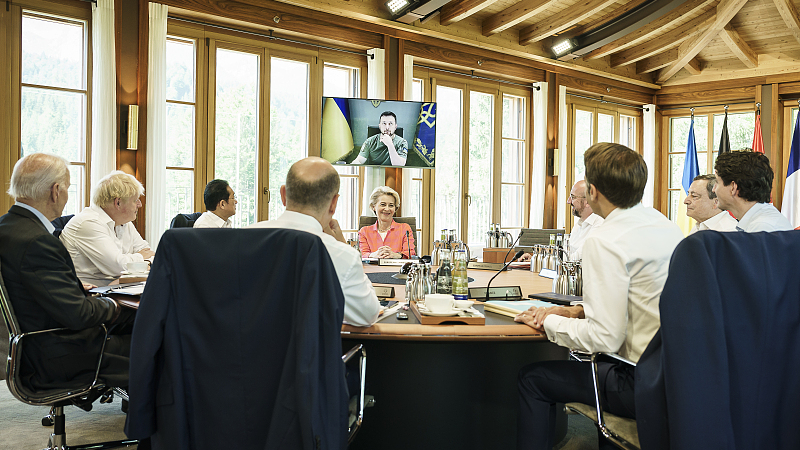
U.S. President Joe Biden, UK Prime Minister Boris Johnson, Prime Minister of Japan Fumio Kishida, European Union Commission President Ursula von der Leyen, European Union Council President Charles Michel, Prime Minister of Italy Mario Draghi, Prime Minister of Canada Justin Trudeau, President of France Emmanuel Macron and German Chancellor Olaf Scholz listen to Ukrainian President Volodymyr Zelenskyy on a video link during the G7 summit in Schloss Elmau in the Bavarian Alps, Germany, June 27, 2022. /CFP
Editor's note: John Wight is a writer and political commentator. He is the author of Edinburgh Trilogy. He has also written a memoir entitled Dreams That Die, telling of his experiences in Hollywood and his participation in the U.S. antiwar movement in the run-up to the war in Iraq. The article reflects the author's opinions and not necessarily the views of CGTN.
Ukraine's President Volodymyr Zelenskyy has waged a one-man struggle to maintain the support of the West in the conflict with Russia since the latter mounted its "special military operation" in Ukraine on February 24.
Between then and now, Ukraine's president has tirelessly addressed by video link parliaments, congresses, various international gatherings, this year's NATO summit, and most recently the gathering of the G7 in Germany.
He continues to make the case for increasing levels of military aid and more economic sanctions being imposed on Russia at a time when war fatigue has become a growing factor in the West. Here, the initial impassioned and non-critical support for Ukraine and disdain toward Russia has given way to growing anxiety over how to cope with the economic shock that has arrived in their midst due to Western governments delimiting their reliance on Russian energy as a way of supporting Ukraine.
On June 15, the European Council on Foreign Relations (ECFR) published the results of a poll on the question of pan-European support for the war, which makes for interesting reading, highlighting the sharp differences emerging when it comes to how people across Europe believe the war should end.
Dividing respondents into members of a "peace camp" and a "justice camp," the ECFR poll reveals that the former wants peace now even at the cost of Ukrainian concessions to Russia, while the latter believes that "only Russia's clear defeat can bring peace."
This emerging split runs between and within countries and, astonishingly, given the weight of pro-Ukraine and anti-Russia sentiment of European governments since the conflict began — reflected in news coverage from Western media — it reveals that a significant 10-point majority of those polled fall into the "peace camp."
This result and development should come as no surprise considering the grievous cost-of-living crisis that has swept across Western Europe over the course of the conflict. Inflation in the UK, for example, reached 9.1 percent in May, marking a 40-year high and sparking a wave of strikes across the public sector as the country's modern trade union movement gears up for a summer of discontent.
The Boris Johnson government has, in the face of growing public support for strike action, gone out of its way to use the conflict in Ukraine to push back against those workers who've reached the point where enough is enough in terms of their take-home pay having remained stagnant for far too long. Conservative Member of Parliament and Johnson supporter Tobias Ellwood even went so far as to issue a public warning that striking rail workers were "Putin's friends."
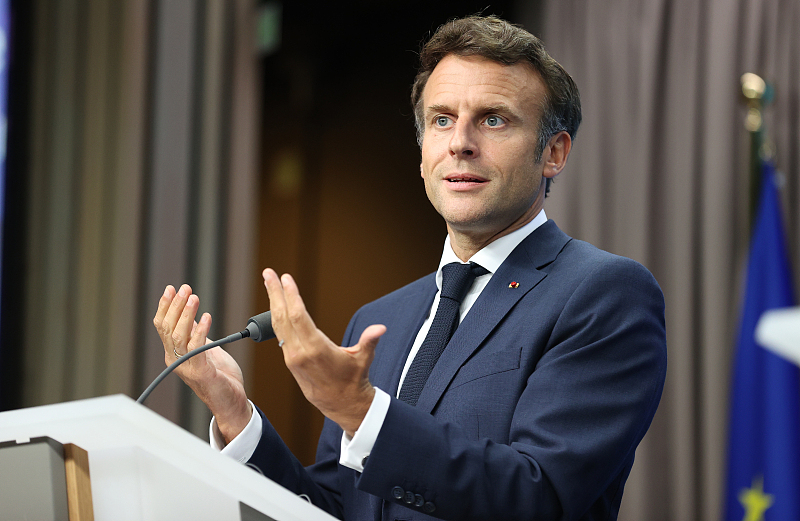
French President Emmanuel Macron speaks at a press conference after EU Leaders' Summit held in Brussels, Belgium, June 23, 2022. /CFP
Turning to France, Emmanuel Macron has found that despite his engagement on the issue of Ukraine — including his high-profile visits to the Kremlin to meet with Putin in February and likewise to Kyiv to meet with Zelenskyy in the same month and later in June — the French public are less than happy with his leadership at home. His centrist coalition recently suffered a humiliating defeat, failing to win a majority in a parliamentary run-off this month, thus plunging his government into gridlock. Inflation in France is predicted to reach 7 percent by the autumn, the highest it will have been since the mid-1980s.
Inflation in Germany, meanwhile, reached the highest level in nearly half a century in May, climbing to 8.7 percent to leave embattled Chancellor Olaf Scholz coming under increasing criticism at home for his handling of the country's economic woes and also abroad by the likes of President Zelenskyy for not doing enough to help Ukraine.
The conclusion to be drawn from the aforementioned economic travails, which the UK, France and Germany find themselves grappling with, is that the emotion with which they responded to Russia's war with Ukraine at the outset has proved incompatible with sound governance and leadership. Belligerency is no substitute for diplomacy matters of war and peace — and especially at a time when the global economy is interlinked to an extent it never has been.
The barrage of economic sanctions imposed on Russia by Western countries in response took little account of their likely impact on their own citizens, with the result that those citizens are now paying a heavy price in the form of an unprecedented cost-of-living crisis and its concomitant catalyzation of industrial and social disquiet.
Of course, the conflict has had a serious economic impact on Russia, too. Given the blitzkrieg of sanctions imposed by the West, how could it not? But this economic impact has not proved as devastating as hoped or anticipated.
The removal of Russian banks from the SWIFT international payments system initially saw the ruble nosedive, but since then it has recovered and rebounded to the point of becoming the world's best-performing currency this year. Much of this recovery is down to the lack of imports into the country in light of the sanctions, meaning that Russian importers no longer need to hold large amounts of foreign currency. However, it has also been achieved by the judicious decision by the Kremlin to demand payment for its oil and gas in rubles.
In terms of inflation, predictions of it reaching as high as 20 or 25 percent in Russia would normally make chilling reading. But the difference between the economic impacts on the West and Russia is the "rally round the flag" effect that the war and ensuing Western sanctions have had in Russia, which hasn't been replicated in the West — or at least certainly not anything like to the same extent.
The capacity and willingness of ordinary citizens to bear the costs of conflict is determined by their belief in their governments' leadership and credibility at any given point. What we are seeing now across Western Europe and in the U.S., given President Joe Biden's poll numbers, is a widening gap between the actions of its leaders and the support of those they are leading.
Here, in the West, the emotion of conflict is giving way to reality of its economic cost.
(If you want to contribute and have specific expertise, please contact us at opinions@cgtn.com. Follow @thouse_opinions on Twitter to discover the latest commentaries in the CGTN Opinion Section.)
