- Home
- China
- World
- Asia-Pacific
- Americas
- Europe
- Middle-East and Africa
- Politics
- Business
- Opinions
- Tech & Sci
- Culture
- Sports
- Travel
- Nature
- Picture
- Video
- Live
- TV
- Documentary
- Radio
- Specials
- Learn Chinese


Share







Copied
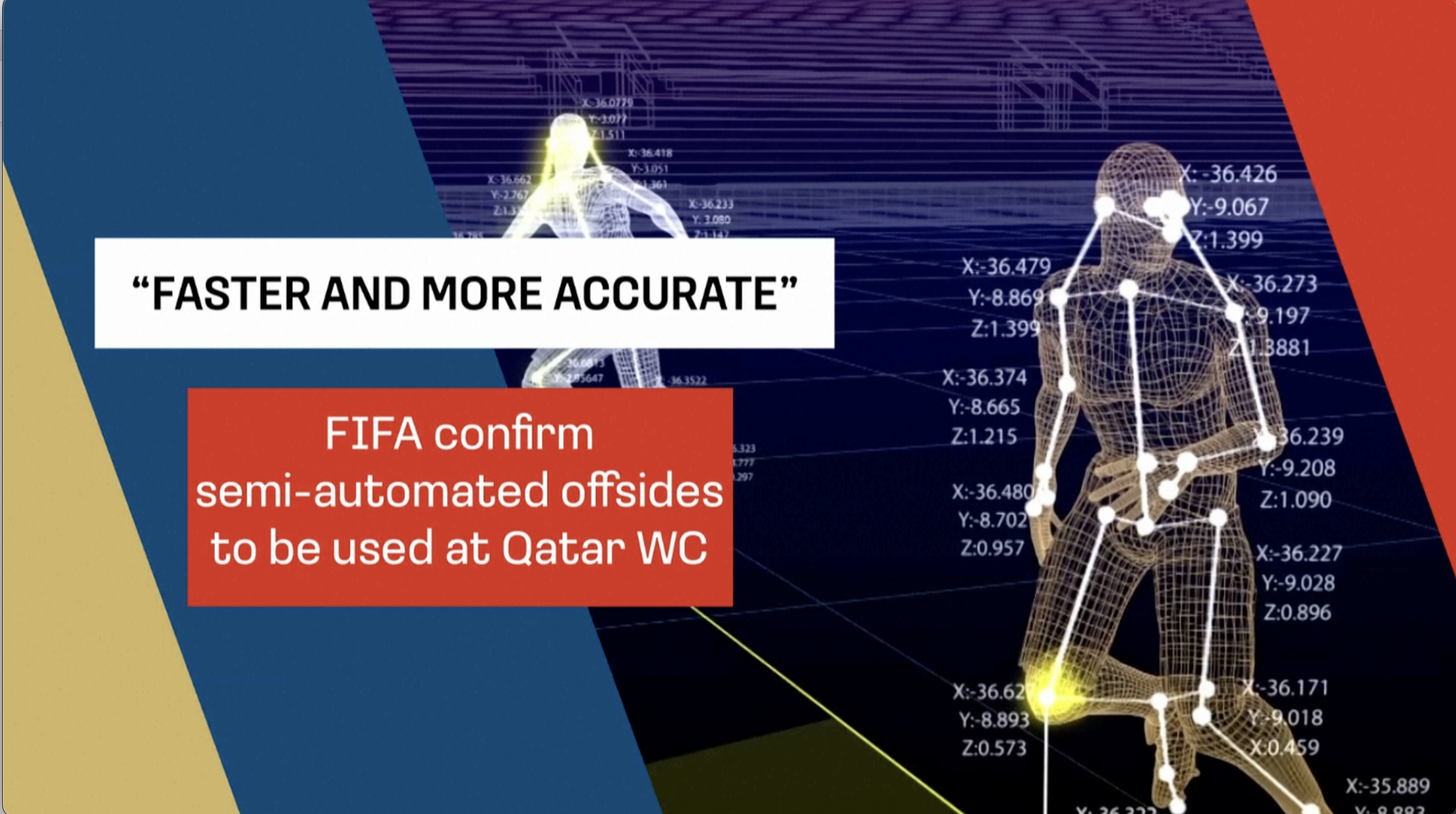
FIFA has announced that semi-automated offside technology will be used at the 2022 World Cup in Qatar starting in November. The technology, which was demonstrated in 2019 after a "very thorough" consultation and testing process, has already been trialled at the FIFA Arab Cup and Club World Cup last year.
It will offer support for the video match officials and on-field officials to help them make "faster and more accurate" decisions around offside calls, reducing decision-making time from a current average of 70 seconds to an aim of around 25 seconds.
The official World Cup ball will have a 500hz tracking sensor inside it which will track its movement 500 times per second. This combines with data from 12 motion cameras in each World Cup stadium, monitoring the movements of each player 50 times per second via 29 tracking points. This real-time data will then be analysed by Artificial Intelligence to alert the video match officials of any possible offside decisions.
Once possible offsides are validated by an offside replay operator, the on-field referee will be informed via an audio headset and a 3D animation of the incident will then be shown to the in-stadium and TV audiences during the next break in play.
FIFA hope the new technology will be as accurate as goal-line technology - which was approved for use across the game in 2012 - and accelerate the existing process where Video assistant referee (VAR) officials determine decisions using manual offside lines and crosshairs, while the ball's acceleration is measured ten times slower, at 50 times per second.
(With input from AP)
