- Home
- China
- World
- Asia-Pacific
- Americas
- Europe
- Middle-East and Africa
- Politics
- Business
- Opinions
- Tech & Sci
- Culture
- Sports
- Travel
- Nature
- Picture
- Video
- Live
- TV
- Documentary
- Radio
- Specials
- Learn Chinese


Share







Copied
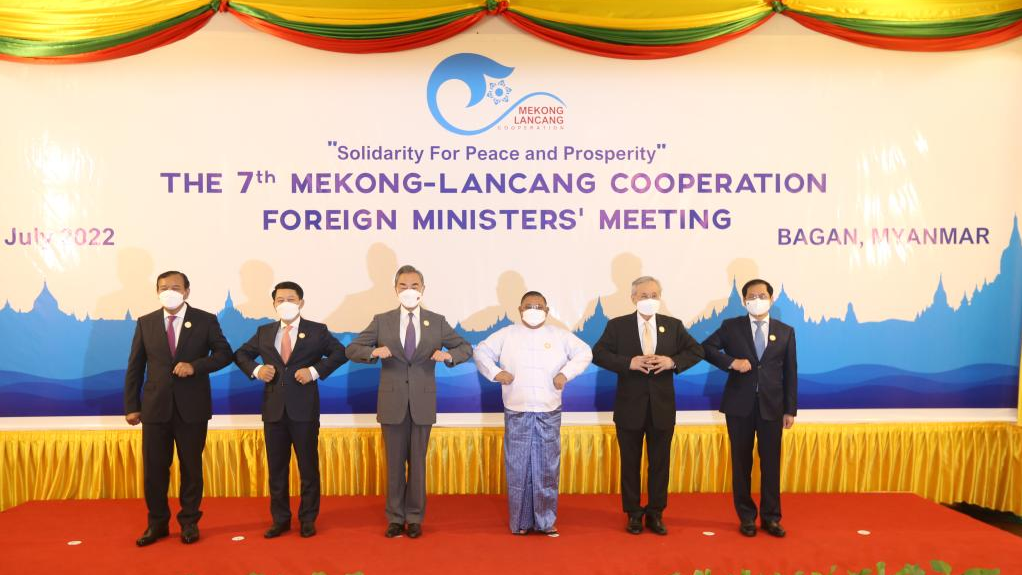
Chinese State Councilor and Foreign Minister Wang Yi, Myanmar's Foreign Minister U Wunna Maung Lwin, Lao Vice Premier and Foreign Minister Saleumxay Kommasith, Cambodian Deputy Prime Minister and Foreign Minister Prak Sokhonn, Thai Deputy Prime Minister and Foreign Minister Don Pramudwinai and Vietnamese Foreign Minister Bui Thanh Son attend the seventh Lancang-Mekong Cooperation (LMC) Foreign Ministers' meeting in Bagan, Myanmar, July 4, 2022. /Xinhua
Editor's note: Hannan Hussain is a foreign affairs commentator and author. He is a Fulbright recipient at the University of Maryland and a former assistant researcher at the Islamabad Policy Research Institute. The article reflects the author's opinions and not necessarily the views of CGTN.
On July 4, diplomats from the Lancang-Mekong Cooperation (LMC) countries gathered in Bagan to mark the seventh LMC Foreign Ministers' meeting, held under the theme "Solidarity for Peace and Prosperity." At the meeting, countries adopted the LMC's five-year action plan (2023-2027), echoed calls for stronger economic integration, and strengthened the case for elevating LMC's regional cooperation mechanism to a new level. What could LMC's new cooperation trajectory look like? A six-fold consensus – from integrated development to expansive agriculture cooperation in the region – gives compelling answers.
First, synergizing development plans of all six countries to produce a "demonstration zone" for high-quality Belt and Road engagement has the potential to bring tangible benefits for people in the region. It supports value-addition for over 500 livelihood projects that China has already supported under the LMC, preparing the ground for development and security "pilot zones" that put the Lancang-Mekong economic belt front and center of high-quality development. Moreover, the five-year action plan agreed among countries is informed by prior expectations of capacity-building and cross-border economic engagements. Both have been key identifiers of the Belt and Road's success with several Mekong countries, and hence, end up strengthening the case for an LMC development approach that is big on integrative styles.
Over the past six years, the LMC has served as a pioneering sub-regional cooperation mechanism inaugurated by all six member states along the Lancang-Mekong river. These members have reinforced their sense of unity through a combined effort to combat COVID-19, as well as the broadening of stakeholder participation through a new local level cooperation mechanism. Year-on-year trade between China and Mekong countries also shot up by 23 percent in 2021, and fresh pathways for intensive agricultural cooperation stand prioritized at the foreign ministers' meeting.
Beijing's latest commitments to introduce dozens of agricultural technology projects for shared benefits, and prepare a sweeping stretch of fertile farmland for Mekong countries, complements LMC's pivot towards a "new cooperation consensus" in the coming years. To genuinely step-up economic cooperation in the resource-rich region however, the LMC grouping also deserves to embrace parallel incentives for high-scale infrastructure growth. The continued opening of the China-Laos Railway, China-Laos-Thailand Railway construction, and evolving cooperation in the New International Land-Sea Trade Corridor, are all valuable propositions that can drive those incentives forward.
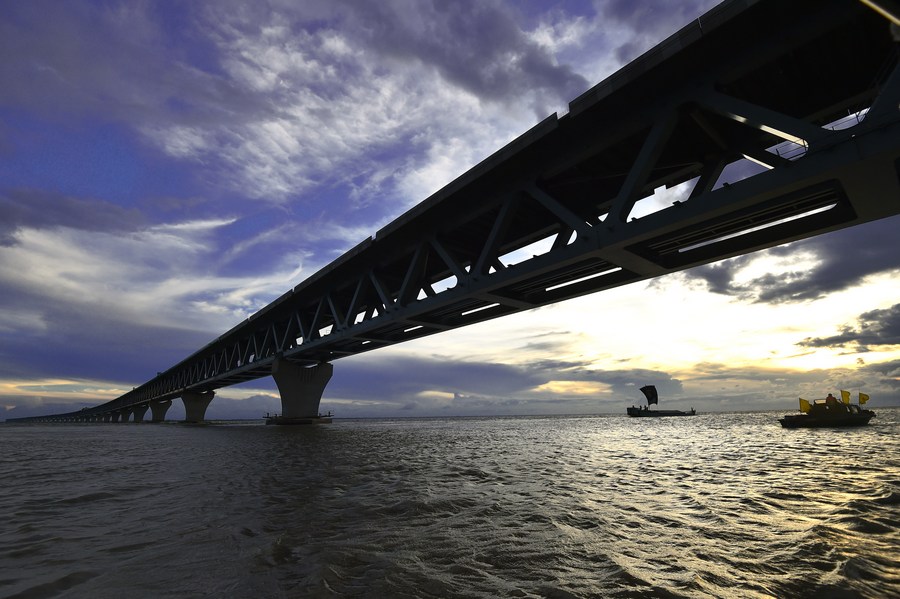
The China-built Padma Multipurpose Bridge under construction in Munshiganj on the outskirts of Dhaka, Bangladesh, September 12, 2021. /Xinhua
Interestingly, given the significant role that water resource management plays in the region's interests, China's proposed implementation of the Lancang-Mekong water resources plan is also a step in the right direction. First, it provides a stronger overall footing for the broader, multiyear action plan meant to manage the vital resource among nations. Second, the move is concrete evidence of China's willingness to further expand resource-oriented consultation and dialogue with its LMC counterparts. As Vietnamese Foreign Minister Bui Thanh Son himself pointed out, LMC engagement that is conducive to "economic growth and sustainable development" can deliver in the interests of the people in the post-pandemic era.
Finally, LMC all embraces the future of digital economy in the region. Chinese State Councilor and Foreign Minister Wang Yi's view that the meeting achieved "a host of new cooperation consensus" has firm basis: stronger collaboration potential on digital infrastructure, smart manufacturing, 5G, smart cities, raw material and automobile is basically an endorsement of LMC's 2021 consensus to "accelerate digital transition" in the region.
Taken together, the seventh LMC Foreign Ministers' meeting convincingly approves of the grouping's expanding cooperation on the digital, infrastructure and agricultural fronts, with more value-addition for the people of the Mekong. That continues to mark a distinct space for LMC, particularly in its treatment of all six partners on an equal-footing. It is also a testament to the sub-regional group's promotion of development at a time when external challenges continue to multiply.
(If you want to contribute and have specific expertise, please contact us at opinions@cgtn.com. Follow @thouse_opinions on Twitter to discover the latest commentaries in the CGTN Opinion Section.)
