- Home
- China
- World
- Asia-Pacific
- Americas
- Europe
- Middle-East and Africa
- Politics
- Business
- Opinions
- Tech & Sci
- Culture
- Sports
- Travel
- Nature
- Picture
- Video
- Live
- TV
- Documentary
- Radio
- Specials
- Learn Chinese


Share







Copied
CFP
Editor's note: Yan Zeyang is an assistant researcher at the Institute of Northeast Asian Studies, China Institutes of Contemporary International Relations. The article reflects the author's opinions and not necessarily the views of CGTN.
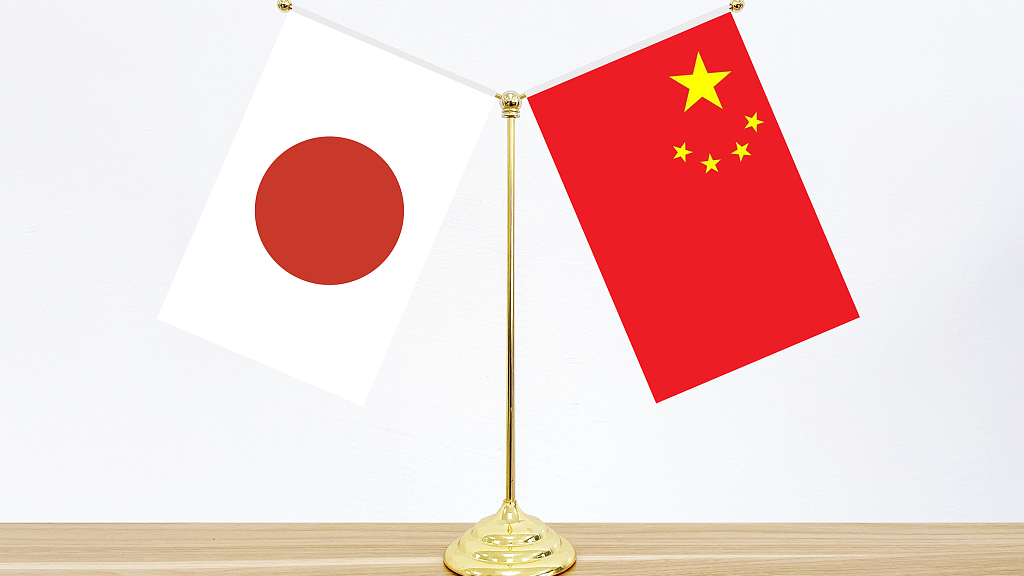
2022 marks the 85th anniversary of the Lugou Bridge Incident, also known as the July 7 Incident of 1937, and the 50th anniversary of the normalization of diplomatic relations between China and Japan. Looking back in history, from resistance war against Japanese aggression to the establishment of diplomatic relations, Sino-Japanese relations have experienced difficult periods and honeymoon periods.
Today, the two countries are interdependent and deeply integrated, and cooperation in various fields has reached an unprecedented depth. In particular, the bilateral trade volume has grown from $1 billion to $370 billion during the past half century, and both countries and peoples have benefited from the development of Sino-Japanese relations.
Achievements and challenges in bilateral ties
Over the past 50 years, Sino-Japanese relations have maintained the bottom line of peaceful cooperation and made significant contributions to the development of their respective countries and the well-being of their citizens, as well as peace and stability in Asia and the world. But at the same time, we also see that the challenges Sino-Japanese relations are now facing may be the most severe in 50 years. Especially with the escalation of tension in Sino-U.S. relations, Sino-Japanese relations have also been greatly affected.
First of all, some traditional issues in Sino-Japanese relations are still unresolved and are showing a trend of escalation. Traditional issues refer to historical issues, territorial issues and the Taiwan question that have long affected Sino-Japanese relations since the normalization of diplomatic relations. These issues are related to the political foundation of the two countries.
Second, the mutual security trust between China and Japan is seriously lacking. In recent years, Japanese official documents and media have repeatedly hyped up the "China threat." Since the conflict between Russia and Ukraine in February 2022, Japan has once again accelerated the pace of security policy adjustment by taking advantage of the issue. Affected by this, the national feelings of China and Japan have also deteriorated.
Third, Japan began to cooperate with the United States to contain China. Japan's "2022 Diplomatic Bluebook" believes that the international community is making changes, and has shifted to an era of full-scale competition among countries, notably between China and the U.S. Japan is at the forefront of the confrontation between China and the United States, and clearly defines China as a "major security threat."
How Sino-Japanese relations develop in the future is related to regional peace and stability. History has repeatedly proved that the good or bad of Sino-Japanese relations depends to a large extent on whether the contradictions and differences can be managed.
Since the normalization of diplomatic relations, China and Japan have issued four political documents, setting rules for dealing with major issues of principle such as history and the Taiwan question. In recent years, the two sides have also reached a four-point principled consensus on properly handling sensitive subjects such as sea-related issues.
To abide by these rules, principles, and consensus is a solemn commitment made by the two governments to each other, and it is also the fundamental principle that both sides must abide by in managing conflicts and differences. The two sides should earnestly honor their commitments, and properly handle major and sensitive issues in accordance with the principles of the four political documents between China and Japan, so as to ensure the stability and long-term development of Sino-Japanese relations.

A view of the Lugou Bridge in Beijing, China, January 16, 2022. /CFP
Future cooperation prospects
In the future, China and Japan can further expand cooperation in three aspects. The first is to strengthen cooperation between China and Japan under the multilateral framework. China and Japan are the two largest economies in Asia and have the responsibility to jointly safeguard the security of regional industrial and supply chains.
With the entry into force of the Regional Comprehensive Economic Partnership (RCEP), China and Japan need to work together to promote regional trade and investment facilitation, institutionalization, and regional economic development. China has applied to join the Comprehensive and Progressive Agreement for Trans-Pacific Partnership (CPTPP), which also requires Japan's support and cooperation to jointly add new momentum to the promotion of regional economic integration.
The second is to realize low-carbon and digital transformation of the economy. Japan has world-class energy and environmental protection technology, and China's market demand potential is huge. Both China and Japan are facing great pressure to reduce carbon dioxide emissions.
The two countries can strengthen exchanges and cooperation in energy conservation and emission reduction, the utilization of renewable energy, the development of clean energy such as hydrogen energy, nuclear power construction and security mechanisms.
In recent years, the cross-border e-commerce market between China and Japan has grown rapidly, and the two countries are seeing new cooperation opportunities and development space in areas such as information sharing, industrial upgrading, new energy vehicles, e-commerce, smart city construction, and digital infrastructure.
The third is to strengthen macroeconomic policy coordination. China and Japan are the largest foreign holders of U.S. Treasuries, and China is also a major buyer of Japanese Treasuries. The two countries share common interests in maintaining regional and global bond markets and financial stability. It is necessary for the two countries to communicate and coordinate macroeconomic policies and public debt management, and to strengthen exchanges and cooperation to jointly prevent financial and debt risks.
In a word, only by strategically holding the right course and finding more common interests can China and Japan reduce the interference of negative factors and achieve the stable development of bilateral relations. This year marks the 50th anniversary of the normalization of diplomatic relations, and it is also an opportunity for China and Japan to seriously learn from history and look to the future.
(If you want to contribute and have specific expertise, please contact us at opinions@cgtn.com. Follow @thouse_opinions on Twitter to discover the latest commentaries on CGTN Opinion Section.)
