- Home
- China
- World
- Asia-Pacific
- Americas
- Europe
- Middle-East and Africa
- Politics
- Business
- Opinions
- Tech & Sci
- Culture
- Sports
- Travel
- Nature
- Picture
- Video
- Live
- TV
- Documentary
- Radio
- Specials
- Learn Chinese


Share







Copied
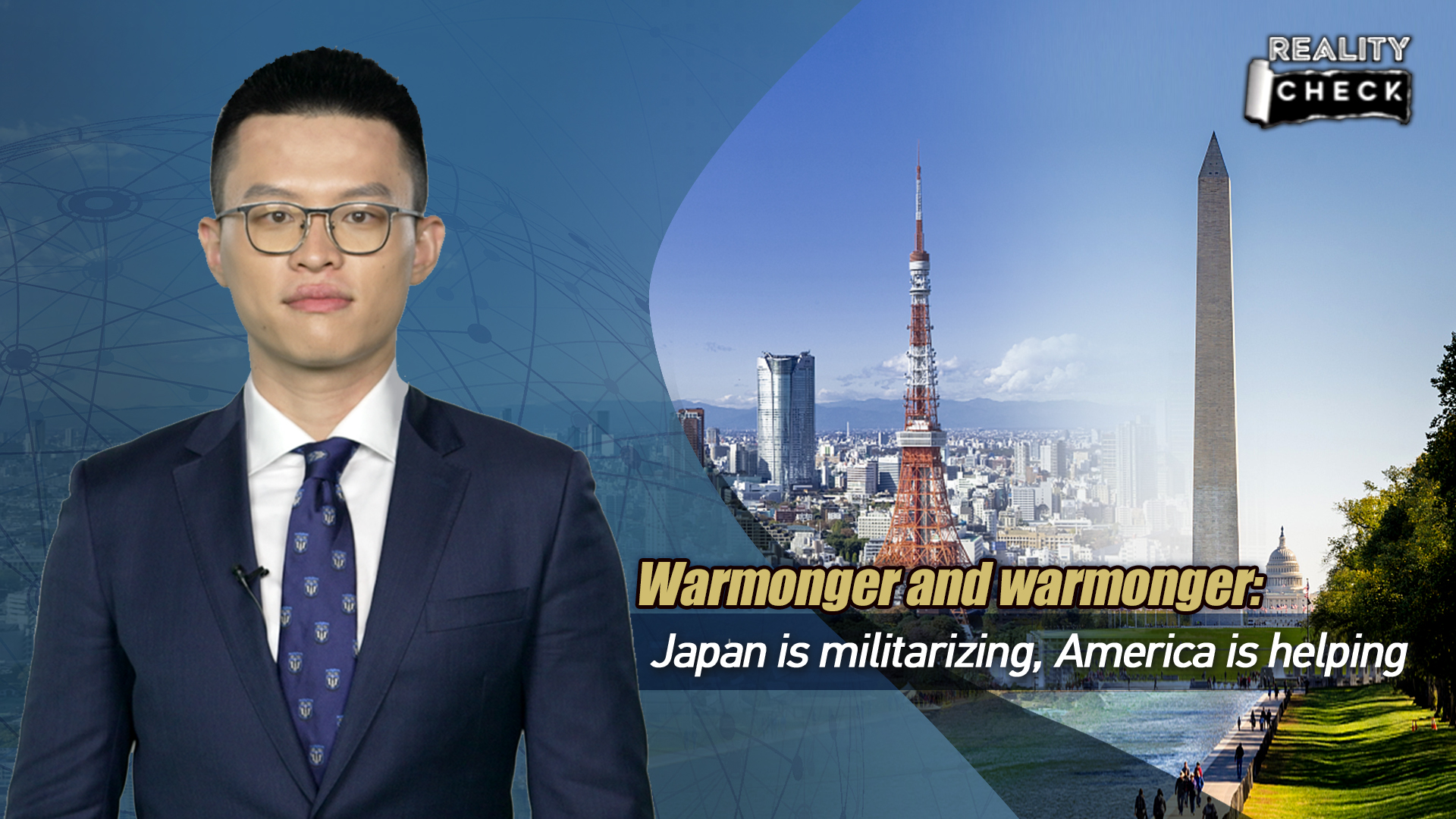
Editor's Note: As the Chinese people mark the 85th anniversary of the Lugou Bridge Incident, we are witnessing a Japan that's getting increasingly hawkish in its foreign and "defense" policies. Reality Check takes you through the process of Japan's militarization and breaks down the differences between historical and today's situations.
Welcome to Reality Check.
Japanese Prime Minister Fumio Kishida recently became the first Japanese PM to attend a NATO summit. He said Japan intends to upgrade its partnership with NATO significantly after the Ukraine conflict because security in Europe can’t be separated from security in Asia.
Translation: I'm with you on Russia. I want your support on China later. In even plainer terms: I need some firepower.
After it was defeated in WWII, Japan wasn't allowed any offensive military capabilities. Japan's constitution, drafted under America's supervision, only left room for self-defense. So, the Japan Self-Defense Forces, the JSDF, grew to become Japan's de facto military.
But JSDF didn't really remain "self-defense." It started with supportive roles. Like it did during Operation Enduring Freedom after 9/11 for reconstruction. Then in 2015, a vote in the National Diet broadened JSDF's scope, allowing it to defend other allies in cases of war. This year, Japan started to go after defense treaties. It signed one with Australia in January. And it's looking for similar pacts with the UK and France.
Now, you may ask: Why isn't the U.S. stopping Japan? Didn't America force Japan to be pacifist?
It did, then it didn't. Between 2016 and 2020, the United States accounted for 97 percent of Japan's "defense" equipment imports. In 2021, Japan is reported to have more than 900 warplanes, 48 destroyers including 8 Aegis missile-combat systems and 20 submarines. It has bought hundreds of F-35s including dozens of F-35Bs. F-35s and the Aegis systems are made by American arms company Lockheed Martin. In October 2021, U.S. Marine Corps F-35B operated off the Japan's aircraft carrier. Japan is the largest user of American stealth fighters outside of the United States.
Zhao Hai, Research Fellow at the Chinese Academy of Social Science, said in an interview that "In the past few years when the United States changed its diplomatic and strategic stance in the so-called Indo-Pacific, Japan also changed its position accordingly and has a grand, so-called 'Free and Open Indo-Pacific Strategy'." "At this point, Japan, again, wants to play an assisting role in some areas, even leading role, in the defense and security arena. And building more stronger coalition within the Quad or other bilateral security arrangement with the United States," Zhao stated.
This is the World Bank data on Japan's military expenditure. From 1961 to 2020, for almost half a century, Japan spent about 0.9 or 1 percent of its GDP on defense. This year, Japan's ruling party proposed to double it to 2 percent. It means giving Japan the world's third largest military budget.
Sounds not so pacifist, does it?
Japan has bandwagoned America's strategic goals and "China threat" to become a military powerhouse. And it is fidgeting even without full military autonomy. It is sending an active-duty military officer to China's Taiwan region. Kishida rejected calls to host U.S. nuclear weapons in Japan but then his government skipped the meeting of parties to UN Treaty on the Prohibition of Nuclear Weapons. There are reports about Japan considering a change in its constitution to allow "enemy base strike capabilities."
That is beyond self-defense. The last time Japan had a strong military, East Asia was consumed by it. In fact, 85 years ago on this very day, not far from this studio where I'm standing, it launched a war against China. There are many Chinese who are living today lived through it.
This time, Japan is getting support from the United States, the only country that deployed nuclear weapon in combat, a country that fought wars for 230 years out of its 246 years of existence.
Warmonger and warmonger. It looks very dangerous.
(If you want to contribute and have specific expertise, please contact us at opinions@cgtn.com. Follow @thouse_opinions on Twitter to discover the latest commentaries in the CGTN Opinion Section.)
