- Home
- China
- World
- Asia-Pacific
- Americas
- Europe
- Middle-East and Africa
- Politics
- Business
- Opinions
- Tech & Sci
- Culture
- Sports
- Travel
- Nature
- Picture
- Video
- Live
- TV
- Documentary
- Radio
- Specials
- Learn Chinese


Share







Copied

The LZ central detector in the clean room at Sanford Underground Research Facility in Lead, South Dakota, U.S. /Sanford Underground Research Facility
With over 1,000-day sensibility test, a group of global scientists completed a test run on the LUX-ZEPLIN (LZ), proving it to be the most sensitive detector for the mysterious dark matter so far, and the LZ team is getting ready to turn it on for operation.
The LZ, refers to two previous dark matter detects of Large Underground Xenon (LUX) and ZonEd Proportional Scintillation in Liquid Noble Gases (ZEPLIN). The LZ consists of a huge titanium tank filled with 7 tonnes of extremely pure liquid xenon which was chosen by the research team from over 1,200 materials.

The LZ Outer Detector which is used to veto radioactivity that can mimic a dark matter signal in Lead, South Dakota, U.S. /Sanford Underground Research Facility
When a particle from outside the tank hits a xenon atom, it creates a burst of light that is measured by a series of detectors surrounding the tank. The properties of that light can then be analysed to determine what type of particle caused it.
To shield the xenon from particles and radiation that we know don't come from dark matter, the tank is surrounded by an even larger tank of purified water and the whole thing is buried 1.5 kilometre underground in an old gold mine in South Dakota, U.S.
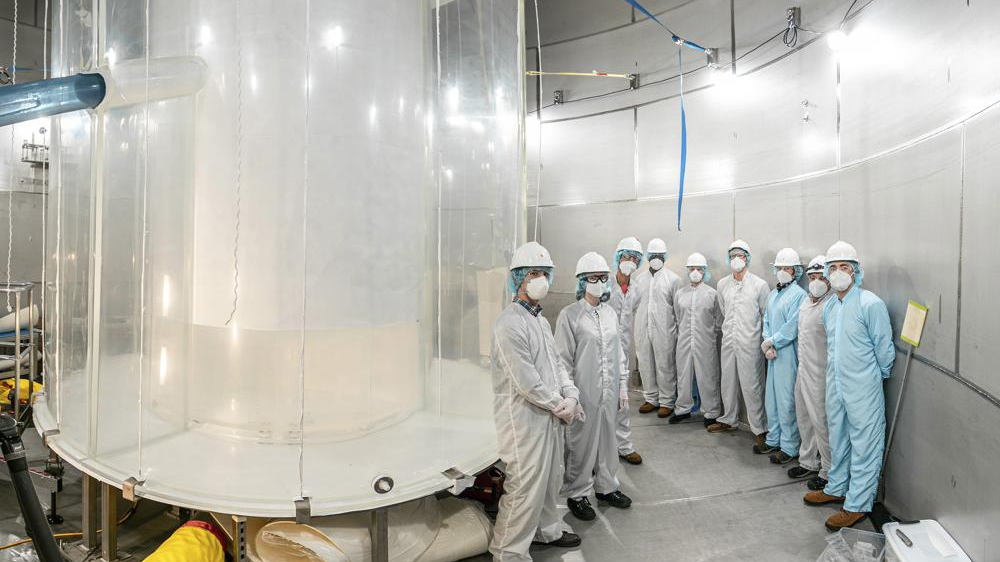
The LZ team in the LZ water tank after the outer detector installation in Lead, South Dakota, U.S. /Sanford Underground Research Facility
The LZ collaboration, includes 250 scientists, engineers and technicians from 35 institutions of countries such as the U.S., UK, Portugal, South Korea and so on.
Since the pilot operation started last December, the LZ team has collected 60 real-time data through more than 10 experiments in over 1,000-day sensibility test at the dark matter detector.
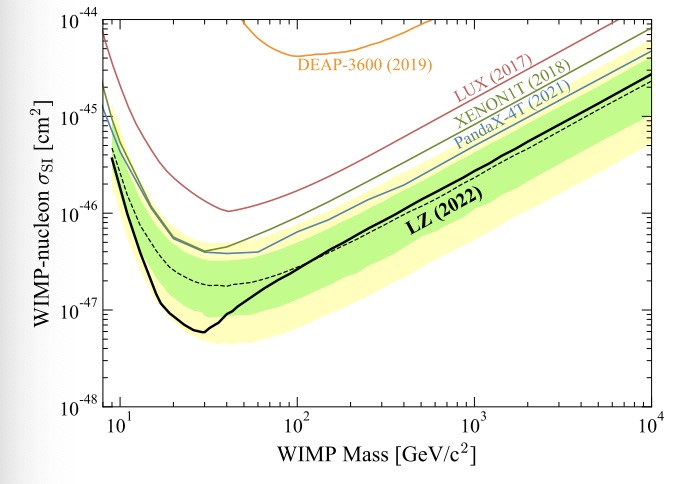
An illustration shows 90 percent confidence limit (black line) for the spin-independent WIMP cross section and WIMP mass. /LZ Research Team
Though there is little doubt that dark matter exists, there are lots of questions about what it is. The leading theory is that it involves things called WIMPs, weakly interacting massive particles, thus the LZ team is searching for WIMPs and has already set new detecting limits or the particles.
Uncovering the nature of dark matter is one of top priorities for global scientists, said LZ team member Chamkaur Ghag at University College London, noting that the LZ team has set a new world-limit on sensitivity and entered completed unexplored territory in the search for the missing mass of the Universe.
