- Home
- China
- World
- Asia-Pacific
- Americas
- Europe
- Middle-East and Africa
- Politics
- Business
- Opinions
- Tech & Sci
- Culture
- Sports
- Travel
- Nature
- Picture
- Video
- Live
- TV
- Documentary
- Radio
- Specials
- Learn Chinese


Share







Copied
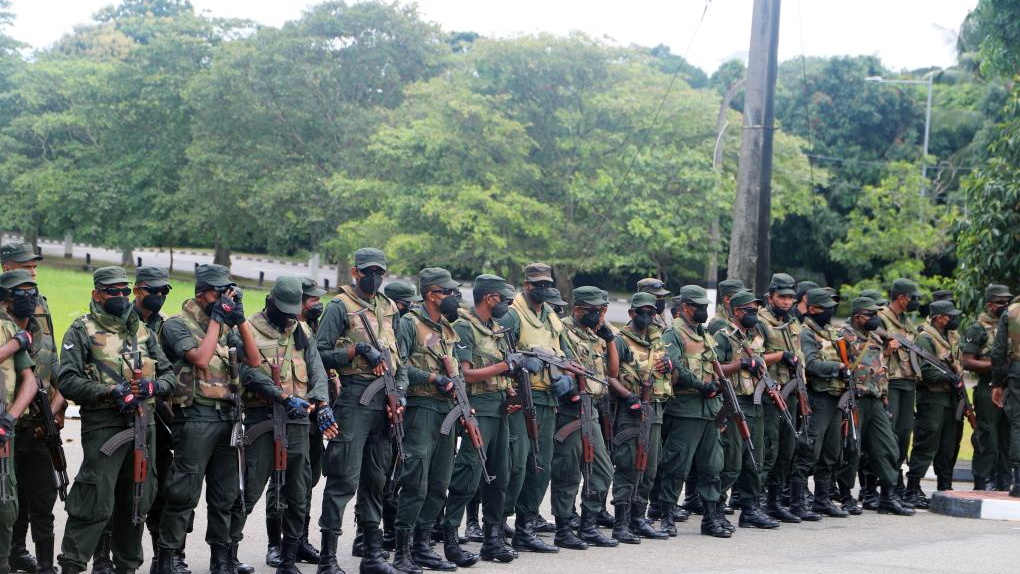
Security personnel are seen on duty near the parliament in Sri Jayawardenepura Kotte, Sri Lanka, July 13, 2022. /Xinhua
Editor's note: M.R. Narayan Swamy is a New Delhi-based veteran journalist and Sri Lanka watcher. He has authored three books on the island's ethnic conflict. The article reflects the author's opinions and not necessarily the views of CGTN.
When I first met Gotabaya Rajapaksa at an official banquet in New Delhi at the end of 2005, he was standing alone, almost lost, his eyes looking for someone he could relate to. We got talking soon, he gave me his visiting card, and said I could call him whenever I wished.
The journalist in me took full advantage of his generosity. We spoke many times long-distance on telephone when he, as defense secretary of Sri Lanka and the younger brother of President Mahinda Rajapaksa, led a ruthless war against the Liberation Tigers of Tamil Eelam (LTTE), a formidable insurgent group. Within two years of our first meeting, it was clear that Gotabaya Rajapaksa was a man possessed as far as the armed conflict was concerned.
He miraculously survived an assassination attempt in the very heart of Colombo. This was blamed on the LTTE. And when his chance came, Gotabaya saw to it that the LTTE and its leadership, both the military and political wings, were eliminated lock, stock and barrel. Ironically, it was this military victory in 2009 that proved to be the undoing of the Rajapaksas in the long run.
Compared to then, when the Rajapaksa brothers were masters of all that they surveyed in the island nation of Sri Lanka, it is unbelievable to see Gotabaya, who became the president of Sri Lanka in 2019, fleeing from his British-built President's House in Colombo and then the country itself, literally chased by thousands of people impoverished due to his faulty fiscal policies and lack of foresight so vital for good governance.
Sri Lanka is now on fire, with no one really appearing to know who can bring about an effective rescue from mass economic ruin and how. The anti-government protesters who have tasted unprecedented success, mirroring scenes from the Arab Spring, are highly unlikely to be satisfied if they feel that their months of being on the streets have only led to old wine in new bottle.
The crowds are unhappy that Prime Minister Ranil Wickremesinghe – who also they wanted out – has been named the acting president. If that wasn't enough, he has imposed a curfew in the Western Province (which includes Colombo) and ordered security forces to act tough with rioters. The protesters have come to believe that they will be able to oust Wickremesinghe with the tactics which succeeded in driving away Gotabaya.
Who are these protesters? While a large section of those who have taken to the streets in unceasing waves in recent months are simply angry citizens, particularly the young, the most organized groups among them are allied to the country's largest left-wing group, the Janatha Vimukti Peramuna (JVP or People's Liberation Front). Some also belong to the smaller Frontline Socialist Party (FSP), which was born after a split in the JVP.
The JVP, which carried out two brutal but failed insurrections in 1971 and 1987-1989 to capture power but has now publicly given up on violence, has made it abundantly clear that it will not tolerate "backroom deals" among Members of Parliament (MPs) from the mainstream parties. It wants a thorough shake-up of the Sri Lankan system – economic and political. None of the mainstream parties have come out against the JVP or its demands but they are unlikely to play second fiddle to the left-wing group.
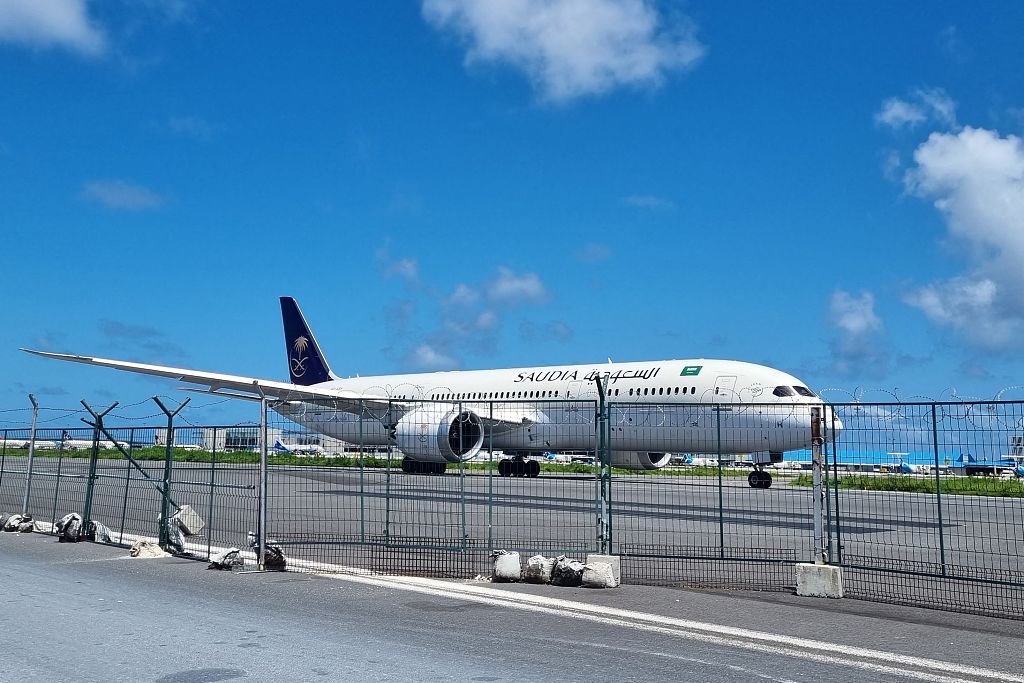
A Saudia airline Boeing 787 Dreamliner bound for Singapore and carrying Sri Lanka's fleeing president Gotabaya Rajapaksa, his wife and two bodyguards prepares to take off at the Velana International airport, July 14, 2022. /CFP
The JVP is determined to use the turmoil to denounce the right-wing economic policies pursued thus far in Sri Lanka and to rapidly expand its political footprint so as to make major gains in any parliamentary election. Precisely for this reason, the mainstream political parties would not want the JVP to get away with all the glory while they (the ruling and opposition parties) are blamed for the policies followed for decades that have now ruined Sri Lanka.
While the JVP may be popular, particularly among the Sinhalese and the younger generations, its baggage of failed insurrections and anti-business posturing puts off many Sri Lankans.
The JVP also does not inspire equal confidence among the Tamil and Muslim minorities. It is trying now to put its best foot forward, emphasizing that it regrets the earlier streaks of violence. It has also gone out of its way to say positive things about India (about which it used to be very critical earlier) and recently called on the U.S. ambassador in Colombo. But the path ahead won't be easy for the JVP.
A key factor in Sri Lanka today is the bloated military, which is lionized ever since it routed the LTTE. It is also the military which crushed the JVP insurrections in the past, and it is unlikely to be at home with the JVP's rising stature. The military also made its position very clear vis-a-vis the Rajapaksas, who did not mind suffering isolation by the West for letting the armed forces defeat the LTTE without caring for the terrible human cost.
When Mahinda Rajapaksa resigned as prime minister in May, the military gave him shelter in the eastern town of Trincomalee until he could head back to Colombo. More important, when President Gotabaya Rajapaksa realized he could not leave Sri Lanka through the civilian airport in July, the air force flew him out to the Maldives. Surprisingly, there was hardly any vocal criticism of the military in both instances.
Influential Buddhist monks who were otherwise part of the anti-government protests have now asked people to vacate the government buildings they have occupied in Colombo. There have already been clashes, albeit minor, among the demonstrators, leading to some people getting injured. It is highly unlikely that Sri Lanka's economic woes are going to be resolved any time soon, which means the anger on the streets will keep boiling.
In such a scenario, if acting President Wickremesinghe acts tough, there will be more trouble in Sri Lanka. The mainstream parties and the left-wing groups may split on what they want to achieve and how. What will the military do in such a scenario? Clearly, Sri Lanka is going to be in turbulence in the foreseeable future.
(If you want to contribute and have specific expertise, please contact us at opinions@cgtn.com. Follow @thouse_opinions on Twitter to discover the latest commentaries on CGTN Opinion Section.)
