- Home
- China
- World
- Asia-Pacific
- Americas
- Europe
- Middle-East and Africa
- Politics
- Business
- Opinions
- Tech & Sci
- Culture
- Sports
- Travel
- Nature
- Picture
- Video
- Live
- TV
- Documentary
- Radio
- Specials
- Learn Chinese


Share







Copied
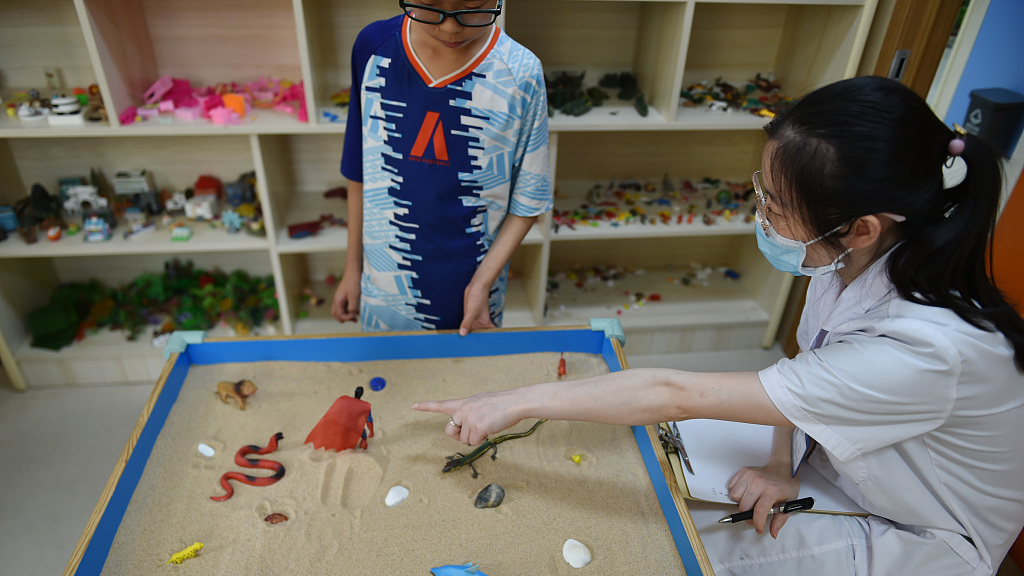
A therapist uses a sand tray with a child at Nanjing Tianyou Children's Hospital in east China's Jiangsu Province, August 24, 2021. /CFP
Indications are growing that the COVID-19 pandemic may represent the tip of a mental health iceberg for a generation of children, and now more Chinese parents are raising concerns as their kids begin the summer break.
A 2021 meta-analysis, published in Frontiers in Pediatrics in October last year, found that around 25 percent of children and adolescents in China have reported depression and anxiety problems since the COVID-19 pandemic began. The result was compiled from data extracted from five databases and 12 studies published between 2020 and 2021.
A nationwide survey, the results of which were announced by the Ministry of Education in October last year, suggested that 17.5 percent of children and adolescents aged 6-16 in China had reported mental disorders.
The results, which were based on data collected since the end of 2012, listed several prevalent diagnoses that included attention deficit hyperactive disorder (ADHD) at 6.4 percent, oppositional defiant disorder (ODD) at 3.6 percent, major depressive disorder (MDD) at 2 percent, conduct disorder (CD) at 1.9 percent and obsessive compulsive disorder (OCD) at 1.3 percent.
ADHD is one of the most common neuro-developmental disorders in childhood. Children with ADHD may have trouble paying attention or controlling impulsive behaviors, or be overly active.
Oppositional defiant disorder (ODD) is a type of behavior disorder. Children with ODD are uncooperative, defiant and hostile toward peers, parents, teachers and other authority figures. They are more troubling to others than they are to themselves.
Major depressive disorder (MDD) can have significant effects when onset occurs in childhood and adolescence. Some of the clinical symptoms include having trouble verbalizing feelings, low self-esteem, increased boredom, irritability, impulsivity or behavior changes, as well as feelings of wanting to run away and fear of death.
Conduct disorder is another type of behavior disorder, and is characterized by "antisocial" behavior among children – having difficulty following rules, respecting the rights of others, showing empathy and behaving in a socially acceptable way.
Obsessive-compulsive disorder (OCD) in childhood and adolescence is an impairing condition, associated with a specific set of distressing symptoms incorporating repetitive, intrusive thoughts (obsessions) and distressing, time-consuming rituals (compulsions).
In a study of the prevalence of depressive disorders and treatment in China, published in The Lancet Psychiatry, analysts found that at least half of adults diagnosed with mental disorders had their first attack before the age of 14.
Experts advise that it is necessary to have a preliminary understanding of common mental problems in order to seek professional help.
Adolescence is a critical stage for early diagnosis and interventions, according to Chen Zhiyan, a professor from the Institute of Psychology at the Chinese Academy of Sciences.
