- Home
- China
- World
- Asia-Pacific
- Americas
- Europe
- Middle-East and Africa
- Politics
- Business
- Opinions
- Tech & Sci
- Culture
- Sports
- Travel
- Nature
- Picture
- Video
- Live
- TV
- Documentary
- Radio
- Specials
- Learn Chinese


Share







Copied
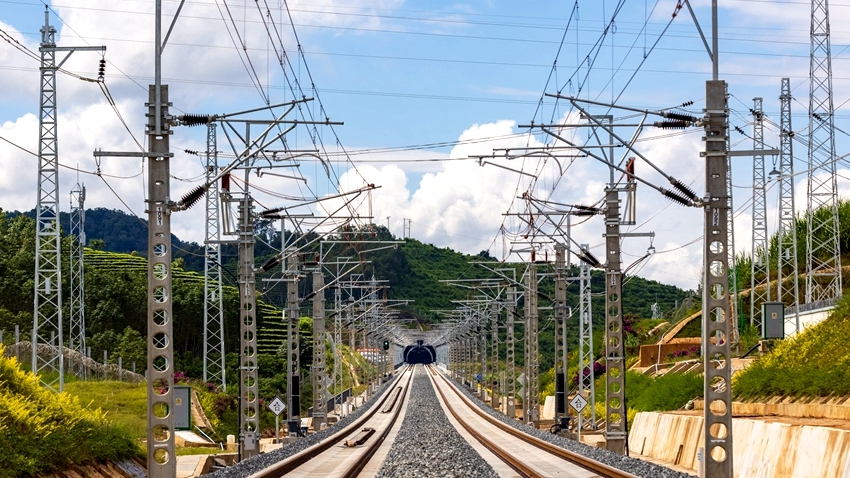
A section of the China-Laos railway in Xishuangbanna Dai Autonomous Prefecture, Yunnan Province, China, September 28, 2021. /Xinhua
Editor's note: Abu Naser Al Farabi is a Dhaka-based columnist and analyst focusing on international politics, especially Asian affairs. The article reflects the author's opinions and not necessarily those of CGTN.
Beyond the negotiation table for loans, developing countries, like Bangladesh, have to fight another battle while approaching China for development financing, particularly on infrastructural projects. They face a battle against "near-constant" and "unbridled" speculation about their countries falling into the debt trap. For developing countries in Asia, given the current China-U.S. relations with Asia turning into a hotbed of geopolitical hostility, have to constantly disprove the "factually false" and evidentially inconclusive claims that they are falling into China's debt trap.
Regarding the allegations of China's debt trap diplomacy and strategic use of debt, the conventional narrative goes like this: China "lures poor and developing countries into agreeing unsustainable loans to pursue infrastructural projects, so that, when they experience financial difficulty, Beijing can seize the asset, thereby extending its strategic or military reach."
Here, my purpose is not to discuss the broader spectrum of the debt-trap proposition, an issue overwhelmingly campaigned on but conclusively proven as untrue. Instead, it is to articulate how developing countries, like Bangladesh, continue to have consumed the economically harmful, politically embarrassing, and geopolitically inconvenient outcomes due to the hype drummed up around China's debt-trap myth.
The hype around Bangladesh's external debt to China, with the fallacy that "Bangladesh is going to ensnare itself into China's debt trap," substantially contradicts the facts on the ground. With Bangladesh's current 21.8 percent total external debt-to-GDP ratio, exacerbated in recent months due to the extremities induced by the war in Ukraine and Western sanctions, China's share of Bangladesh's total external debts, as of June 2021, is around 7 percent. It is far less than what Bangladesh owes to other major sovereign and institutional creditors, with Japan's 19 percent, Asian Development Bank's 23 percent, and World Bank's 36 percent.
But almost all of the media reporting and commentaries on China's debt trap in relation to Bangladesh, particularly in Indian media, are based on perspectives rather than actual events, and on opinion rather than facts. Among many such cases is the reporting by Indian media on Chinese investment in Bangladesh's Payra Port project, a seaport located at Kalapara in Patuakhali, Bangladesh. The article, with a frightening title, "Bangladesh's Payra shipping port could fall into Chinese hands," and with allegedly ominous comments from anonymous "officials in Dhaka," noted that two Chinese state-owned enterprises signed memoranda of understanding for projects components. But it willfully, if not dubiously, did not mention that firms from other countries also bidding on different components as the whole port development was divided into 19 components.
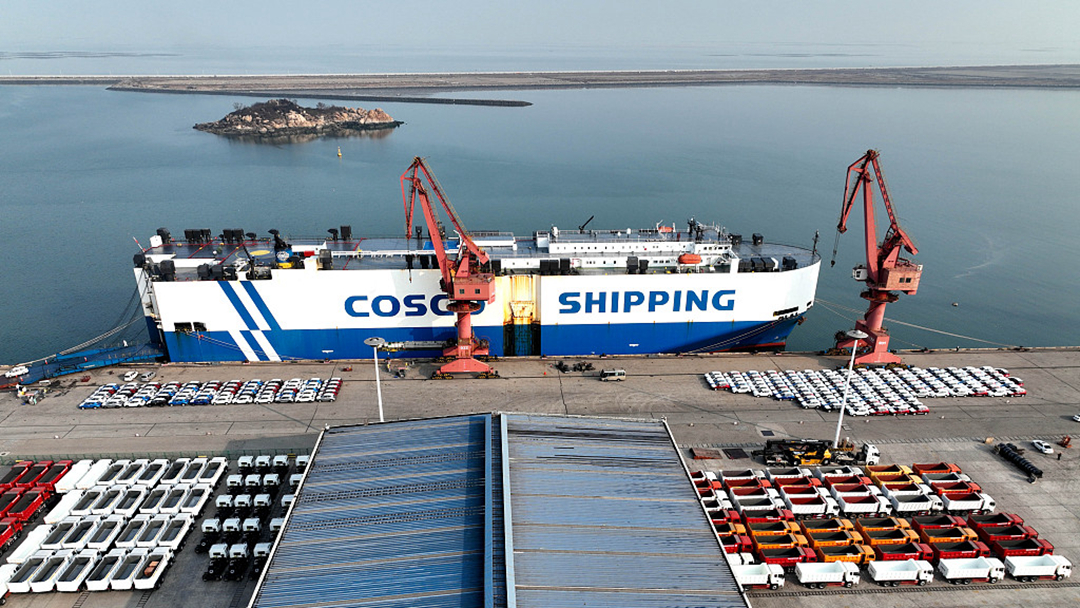
A view of the Port of Lianyungang in east China's Jiangsu Province, January 3, 2022. /CFP
Reporting on the Payra port is no unique case where "few examine how projects are designed, financed or awarded before making an allegation," as observed by Adam Pitman, "this is why projects involving China in any way are often mentioned as part of debt trap speculation." Bangladesh almost always follows Pyara-port-like "financing patterns" in its infrastructural project developments, dividing a particular project into multiple components and then distributing those among variable stakeholders.
But the overwhelming scale of propaganda and speculations around China's infrastructural investments in Bangladesh causes Bangladesh, like other developing countries, to face politically embarrassing situations.
In some countries, it is seen that opposition political parties, with the absence of strong political positioning at home, have made the politically-advantageous-but-economically-groundless debt trap allegations as their election campaign rallying cry. They promise to "push-back against China," only for them to be later proved economically unsound.
The narrative that China has lured Bangladesh into unsustainable investments with long-term strategic goals is out-and-out untrue, given that virtually a majority of the projects financed by China have been initiated by the host country, with economic feasibilities being cross-checked by third parties. And there are multiple precedents when China or Bangladesh refused to go along with the proposed projects because of the irregularities around the projects.
Finally, according to World Bank, the world, especially developing countries, will need $97 trillion of infrastructure investment by 2040, with an $18 trillion projected shortfall. Developing countries desperately need infrastructural development pushes to take their growth to sustainable trajectories. To that end, and for the greater good of the world, the proponents of China's debt trap diplomacy should approach with viable alternatives to China's investment endeavors other than pointing fingers from distance. Developing countries like Bangladesh welcome such alternatives and are efficient enough to discern the efficient one among the alternatives if ever proposed.
(If you want to contribute and have specific expertise, please contact us at opinions@cgtn.com. Follow @thouse_opinions on Twitter to discover the latest commentaries in the CGTN Opinion Section.)

Search Trends
Copyright © 2020 CGTN. 京ICP备16065310号

Disinformation report hotline: 010-85061466
Copyright © 2020 CGTN. 京ICP备16065310号
Disinformation report hotline: 010-85061466
Copyright © 2020 CGTN. 京ICP备16065310号
Disinformation report hotline: 010-85061466