- Home
- China
- World
- Asia-Pacific
- Americas
- Europe
- Middle-East and Africa
- Politics
- Business
- Opinions
- Tech & Sci
- Culture
- Sports
- Travel
- Nature
- Picture
- Video
- Live
- TV
- Documentary
- Radio
- Specials
- Learn Chinese


Share







Copied

The head of Serbia government's office for Kosovo, Peter Petkovic (R) leaves The European External Action Service (EEAS) Building in Brussels, August 18, 2022, after a high-level meeting of the Belgrade-Pristina Dialogue. /CFP
Editor's note: Nikola Mikovic is a freelance journalist based in Serbia. He covers mostly Russian, Ukrainian and Belarusian foreign policy issues. The article reflects the author's opinions, and not necessarily those of CGTN.
While the world remains preoccupied with the conflict in Ukraine, another potential crisis in Europe is brewing. The situation in Kosovo – Serbia's breakaway province that has unilaterally declared independence in 2008 – could soon escalate and have negative consequences for local Serbs.
On August 18, Serbian President Aleksandar Vucic and Kosovo's head of the ethnic Albanian-dominated government Albin Kurti met in Brussels to seek a deal over the license plate issue – a problem that reportedly threatens to destabilize the region. The authorities in Pristina, Kosovo's capital, plan to start implementing their latest decision on the re-registration of vehicles with Serbian plates from towns in Kosovo to Kosovan RKS plates on September 1. The Serbs living in northern Kosovo – where they make up a majority of the population – continue to use Serbia-issued license plates and identification documents, as they refuse to be integrated into Kosovo's legal system. For them, as well as for Belgrade, Kosovo is a part of Serbia.
According to Vucic, a new generation of young men in northern Kosovo will not put up with the terror that comes from Pristina, as they do not consider Kosovo an independent state. Kosovo's unilaterally declared independence has been recognized by most Western countries, although not by five members of the European Union: Spain, Romania, Greece, Slovakia and Cyprus. Besides them, China and Russia also support Serbia's territorial integrity. But the problem for the Balkan nation is that it is completely surrounded by NATO, whose troops have been deployed to Kosovo as a result of the Alliance's aggression against Serbia in 1999.
NATO's KFOR (Kosovo Force) mission acts as a "guarantor of stability" in Serbia's breakaway province, and promises to intervene if tensions between the Serbs in northern Kosovo and ethnic Albanian-led Kosovo's special police units lead to an escalation. From NATO's and Pristina's perspective, things will escalate if the Serbs, in response to Kosovo's authorities' attempts to force them to replace their Serbian-issued license plates with Kosovan ones, raise barricades in the north of the breakaway province. In other words, the West will blame the Serbs, rather than the authorities in Pristina, for any potential destabilization of the situation on the ground.
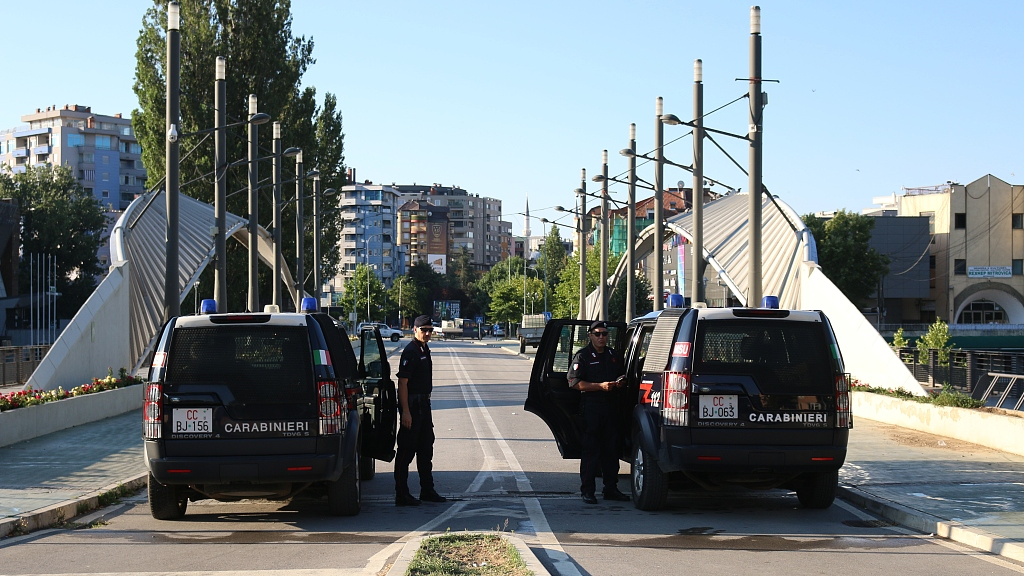
Members of Kosovo Force (KFOR) take measures at a checkpoint after Kosovo decided to postpone the implementation of a new law set to come into effect on August 1 making it mandatory for everyone, including Serbs living in Kosovo, to have a Kosovo ID card and license plate in Mitrovica, Kosovo, August 01, 2022. /CFP
In Ukraine, on the other hand, the United States and its allies strongly support the Eastern European country's territorial integrity, and see the self-proclaimed Donbas republics as the "Russian proxies." In the Balkans, the West is pressuring Serbia not to insist on its own territorial integrity, and to both de facto and de jure recognize the illegal secession of Kosovo. In the eyes of the West, Ukraine, unlike Serbia, has the right to oppose separatism.
Aware that Belgrade does not have much room for political maneuvers, Vucic said on August 21 that Serbia will "desperately seek a compromise for the next 10 days." After that, if no deal is reached, Pristina is expected to start confiscating vehicles in northern Kosovo that have Serbian-issued plates. Such an action could force the Serbs to raise barricades. Pristina, for its part, will deploy its special police forces to the north. How will things develop after that?
The U.S. and European Union will call on "both sides" to deescalate tensions, and KFOR is expected to increase its presence in northern Kosovo. Although some Western media and analysts will deliberately raise tensions, and accuse Serbia of planning to "invade" Kosovo, chances for Belgrade to deploy troops to its southern province are extremely small. Any clashes with Kosovo's security forces would place Serbia at risk of a direct confrontation against NATO. No politician in Belgrade, under the current geopolitical circumstances, would take such actions.
Nonetheless, it does not mean that Serbia would turn a blind eye to what is happening in northern Kosovo. Belgrade will likely call on local Serbs to boycott all institutions of the self-proclaimed Republic of Kosovo. But the problem for Serbia is that the West, no matter what happens, will always side with ethnic Albanians, rather than with the Serbs.
One thing is certain: a local dispute over the license plates has potential to destabilize the Balkans, although chances for such an outcome are minimal. The last thing that the West needs is another conflict in Europe, especially in the region that is firmly in the U.S.'s and the EU's geopolitical orbit. Washington, as the major sponsor of Kosovo, can pressure Kurti and other ethnic Albanian leaders to give up their ambitions to forcefully integrate the Serbs into the legal system of the self-proclaimed entity.
Finally, regardless of the outcome of a potential crisis in Kosovo, the West will continue on with double standards when it comes to the Serbs. From the Western perspective, some separatisms – for instance in Ukraine – are bad, and some – in Kosovo – are "morally justified." And such a policy will unlikely change any time soon, if at all.
(If you want to contribute and have specific expertise, please contact us at opinions@cgtn.com. Follow @thouse_opinions on Twitter to discover the latest commentaries on CGTN Opinion Section.)

Search Trends
Copyright © 2020 CGTN. 京ICP备16065310号

Disinformation report hotline: 010-85061466
Copyright © 2020 CGTN. 京ICP备16065310号
Disinformation report hotline: 010-85061466
Copyright © 2020 CGTN. 京ICP备16065310号
Disinformation report hotline: 010-85061466