- Home
- China
- World
- Asia-Pacific
- Americas
- Europe
- Middle-East and Africa
- Politics
- Business
- Opinions
- Tech & Sci
- Culture
- Sports
- Travel
- Nature
- Picture
- Video
- Live
- TV
- Documentary
- Radio
- Specials
- Learn Chinese


Share







Copied

Cowboy Dionatao Euzebio, 26, leads herd of cattle to pastures at the Marupiara farm in Tailandia, Para state, Brazil, September 18, 2021. /CFP
Editor's note: Thomas W. Pauken II is the author of "U.S. vs China: From Trade War to Reciprocal Deal," and a consultant on Asia-Pacific affairs and geopolitical commentator. The article reflects the author's opinions and not necessarily the views of CGTN.
Amid the looming dangers of food shortages, as well as the alarmingly high levels of inflation rates in many countries, the Latin-American agriculture sector has emerged as a surprising bright spot for this year. Many countries in Latin-America have enjoyed bountiful harvests along with rapid development in the livestock and dairy industries. Hence, the soaring food prices worldwide can lead to higher wealth generation for many rural communities in the region.
Nonetheless, large parts of the South American continent have also endured severe droughts, above average high temperatures and a number of other extreme weather conditions. Apparently, climate change has hit the Global South – Latin-America, Africa and Oceania countries – very hard. Yet, more Lat-Am governments are pursuing new policies to boost agriculture production levels along with embracing sustainable development and pro-environmental measures.
The actions are paying off since farmers, ranchers, and dairy producers in the region are collaborating more with China to upgrade their farming equipment and supplies, as well as receiving support from Chinese agriculture scientists so they can improve their methods for planting seeds, raising livestock and harvesting crops.
Modernized farming and ranching rely on agricultural innovations such as creating more drought-resistant seeds, taking a very scientific approach to breeding livestock and improving methods on water usage.
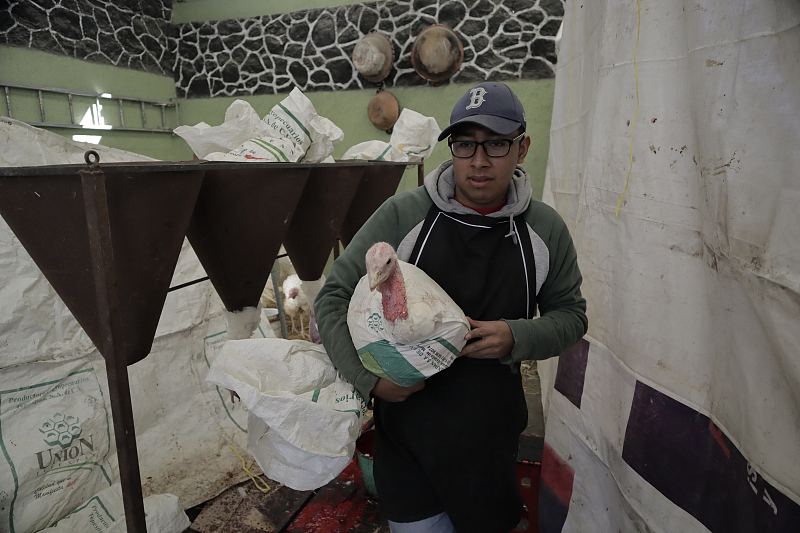
Farmer catches a turkey to weigh, kill, and pluck it for sale at market in Santiago Zapotitlán Tláhuac, Mexico City, Mexico, December 23, 2021. /CFP
Surging ahead on food production
Agriculture experts are forecasting a rosy prognosis for Latin-American food production. Feedlatina, the Latin American food industry association, hosted a workshop on regional food standardization in Mexico City last month. The United Nations Food and Agriculture Organization (FAO), International Food Industry Federation (IFIF) and the local Mexican Food Manufacturers Council (Conafab) had all taken part, according to media reports.
Feedlatina President Pablo Azpiroz highlighted his group's estimations that Latin America produced over 178.5 million metric tons of food in 2021, with Brazil and Mexico as the third and fifth largest food producers respectively in the world, as both had accounted for 67 percent of the regional total.
Additionally, Robert Betancourt, an IFIF board member, is quoted in reports as saying that Feedlatina plays a crucial role for IFIF as they believe Latin America represents the real future of the food industry. He predicts the region to become the world's largest food producer.
Presently, Brazil and Argentina are major corn and soybean producers, scoring high in international rankings. Mexico is a key food producer as well, despite its ongoing shortfalls in grains. The region is gaining deeper recognition as an important food basket for our world today. For instance, Argentina is successful with ranching while the country is expected to harvest over 53 million tons of corn by the end of the 2021-2022, which is the southern hemisphere's agriculture growing season. Buenos Aires will place greater emphasis on exporting more food to overseas markets as well.
Brazil-China agreement
Brazil stands tall as the regional hub for agriculture and the country keeps pushing ahead to stay ahead of their competitors, which are Argentina, Mexico, Chile, Peru, Colombia among many others. The Brazilian government has strengthened its bilateral relations and economic cooperation with Beijing. The two countries are well positioned to maintain close relations for the long-term outlook.
As reported by MercoPress, the two countries signed a new agreement to facilitate Brazilian agricultural exports to China. Helen Jacintho, an agronomist, touted the new agreement as further evidence that China is opening up its market for products including soybean meal, as well as concentrated soy protein, corn, peanuts, and citrus pulp.
"Excellent news, which (would) consolidate our position as a trustworthy global food producer," Jacintho wrote in Forbes magazine.
Additionally, Ricardo Arioli, president of the National Commission for Cereals, Fibers, and Oilseeds from CNA (Confederation of Agriculture and Livestock of Brazil), the agreement would place priority to other second-line produce, such as corn, sorghum, and sesame.
China's Ministry of Agriculture and Brazil's Ministry of Agriculture both endorsed protocols to lower bureaucratic barriers in industry inspection procedures and customs clearance. The agreement looks to be a game changer for both sides.
The Brazilian agribusiness firms were expecting authorization to export these products to China no earlier than 2023, after signing health protocol agreements. But Beijing already authorized officials from Mapa (Brazil's Ministry of Agriculture, Livestock and Supply) to conduct inspections to facilitate the process.
Last year, Brazil exported US$41 billion to China (34 percent from agriculture), making Brazil, China's largest supplier of agriculture produce, which accounted for about 20 percent of Beijing's imports.
Golden opportunity for Lat-Am agriculture
The geopolitical climate is getting more unfettered as the Russia-Ukraine conflict, stiff economic sanctions on Russia, energy shortages, sky-high inflation rates and severe supply chain disruptions are setting the stage for a gloomy global economy for another year or two down the horizon.
But amid each and every crisis comes chances for opportunities. The biggest beneficiaries of a high inflation and a low supply economy are the producers of food, energy, and raw materials along with the manufacturers of essential goods. Lat-Am farmers, ranchers and dairy producers can take advantage of rising food prices.
Many of those connected to the Latin-American agriculture sector are enjoying a newfound prosperity and their partnerships with China can expand the growth potential even further.
(If you want to contribute and have specific expertise, please contact us at opinions@cgtn.com. Follow @thouse_opinions on Twitter to discover the latest commentaries in the CGTN Opinion Section.)

Search Trends
Copyright © 2020 CGTN. 京ICP备16065310号

Disinformation report hotline: 010-85061466
Copyright © 2020 CGTN. 京ICP备16065310号
Disinformation report hotline: 010-85061466
Copyright © 2020 CGTN. 京ICP备16065310号
Disinformation report hotline: 010-85061466