- Home
- China
- World
- Asia-Pacific
- Americas
- Europe
- Middle-East and Africa
- Politics
- Business
- Opinions
- Tech & Sci
- Culture
- Sports
- Travel
- Nature
- Picture
- Video
- Live
- TV
- Documentary
- Radio
- Specials
- Learn Chinese


Share







Copied
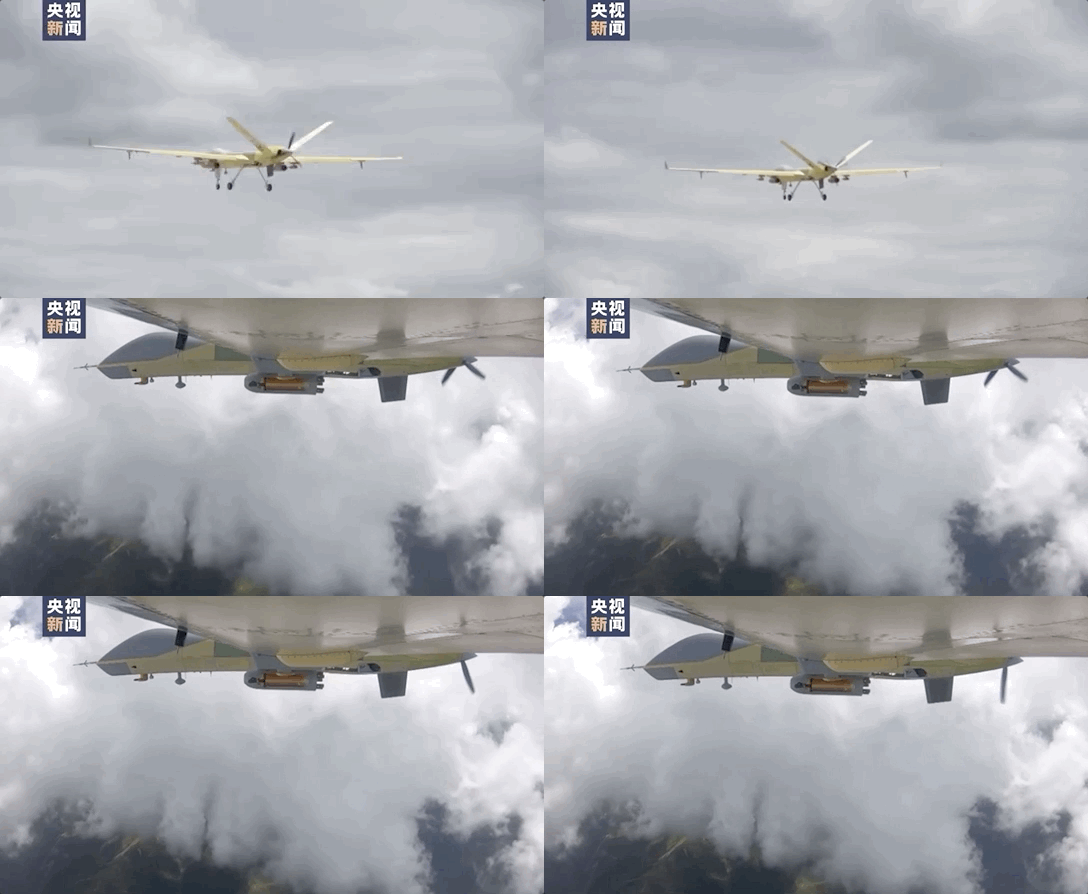
An unmanned aerial vehicle is conducting cloud seeding operation/China Media Group (CMG)
China has seeded clouds in the country's southwestern Sichuan Province and Chongqing Municipality in order to combat the ongoing drought that has swept across the Northern Hemisphere.
Chongqing on Wednesday launched six rods containing particles needed for precipitation, which induced 10 millimeter of precipitation that lasted for 20 minutes. Starting on Thursday, two massive drones were deployed for seeding works in Sichuan that will eventually cover an area of 6,000 square kilometers in operations lasting through Monday, according to China Media Group (CMG).
What is cloud seeding?
Rain falls to Earth when clouds become saturated, or filled, with water droplets. And in order for clouds to be condensed enough, rising air is needed to bring water vapor and particles of dust or salt floating in the atmosphere to form water droplets or ice crystals.
Cloud seeding is a process of adding small particles – usually silver iodide, potassium iodide or dry ice – to clouds. The operation is carried out by launching small rods into clouds, assisting the formation of crystals when these particles explode in the sky.
Other methodologies such as delivering electric charges to air molecules or directing infrared laser pulses are also practiced to catalyze the formation of droplets.
Once the droplets become heavy enough, they drop from the clouds as precipitation.
However, cloud seeding can only happen when there are at least some clouds already in the sky, and not all clouds can bring rain – they need to be as thick as two kilometers, filled with water vapor and have space for rising air.
Who is 'making it rain?'
Cloud seeding is widely practiced by countries around the world as a method to increase precipitation in areas experiencing drought.
It was first attempted in the U.S. in the 1940s.
The technique can also be used to induce snowfall or to soften hail.

Search Trends
Copyright © 2020 CGTN. 京ICP备16065310号

Disinformation report hotline: 010-85061466
Copyright © 2020 CGTN. 京ICP备16065310号
Disinformation report hotline: 010-85061466
Copyright © 2020 CGTN. 京ICP备16065310号
Disinformation report hotline: 010-85061466