- Home
- China
- World
- Asia-Pacific
- Americas
- Europe
- Middle-East and Africa
- Politics
- Business
- Opinions
- Tech & Sci
- Culture
- Sports
- Travel
- Nature
- Picture
- Video
- Live
- TV
- Documentary
- Radio
- Specials
- Learn Chinese


Share







Copied
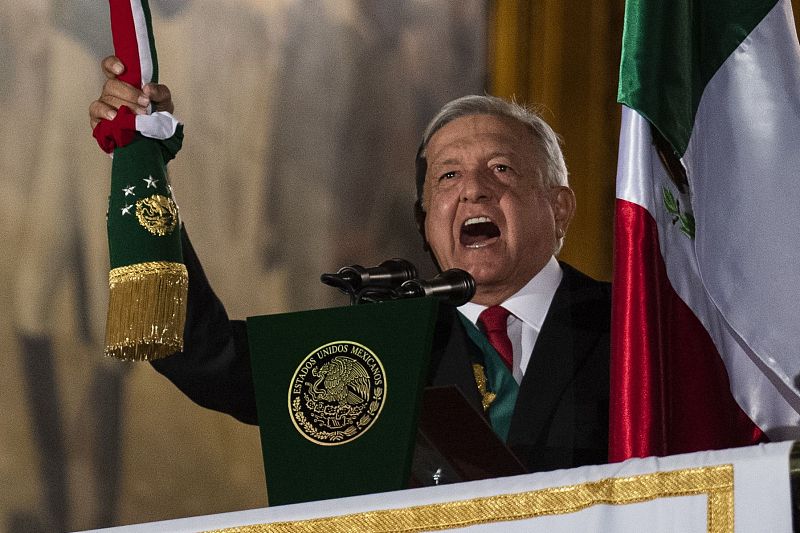
Mexican President Andres Manuel Lopez Obrador stands at balcony of National Palace, marking Independence Day celebrations in Mexico City, Mexico on September 15, 2019. /CFP
Editor's note: Thomas W. Pauken II is the author of "U.S. vs China: From Trade War to Reciprocal Deal," and a consultant on Asia-Pacific affairs and geopolitical commentator. The article reflects the author's opinions and not necessarily the views of CGTN.
Last month, the United States issued a formal request for dispute settlement consultations under the U.S.-Mexico-Canada Agreement (USMCA) over recent laws introduced by Mexican President Andres Manuel Lopez Obrador on domestic energy policies that limit foreign investments into its state-owned enterprises, the Federal Electricity Commission (FEC) and Pemex, oil & gas producer.
Washington argues that that Mexico's actions are illegal after ratification of the North American Free Trade Agreement (NAFTA) in 1994, in which the U.S., Mexico and Canada have lowered tariffs on imports while easing regulations on foreign direct investments (FDI). Additionally, former Mexican President Enrique Pena Nieto (2012-2018) enacted reforms for the domestic energy sector.
In 2013, Pena Nieto opened up the nationalized energy sector by granting permits and land rights to foreign investors. Back then, Mexico City was pushing for more FDI to upgrade oil & gas equipment for drilling and gas exploration projects along with boosting the nation's clean energy industry by developing new solar, wind and hydroelectric projects. Energy companies, mainly from the U.S. and Spain had poured tens of billions of U.S. dollars into Mexico.
Foreign investors have legitimate concerns but Mexico is a sovereign country that fervently upholds its independence on key issues such as energy policies. Mexico City is a major producer of oil and the country intends to prevent foreign-based companies from taking over their state-owned energy enterprises, which is a sound strategy.
Mexico worries that bowing down to Washington's meddling over its domestic energy policy could lead to a humiliating surrender policy, making Mexico City more subservient to the U.S. President Lopez Obrador, known as AMLO, is taking a strong stand.
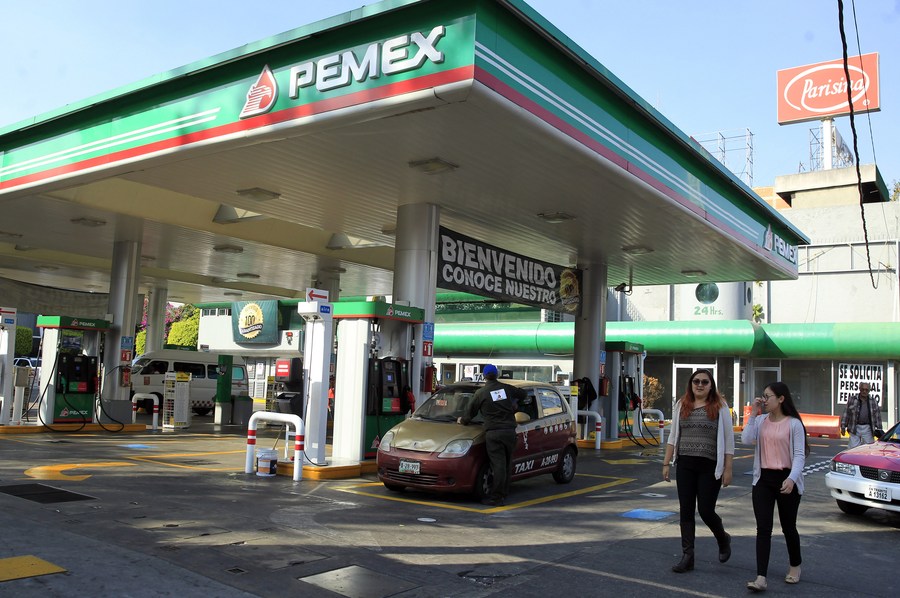
Gas pump attendant fuels a car at a gas station in Mexico City, Mexico, December 27, 2016. /Xinhua
AMLO calls consultations "foolish"
U.S.-Mexico bilateral ties have long been fraught by frayed tensions while they have hit terrible times between AMLO and U.S. President Joe Biden. They are acting stubborn, refusing to offer concessions as they deem such moves as signs of weakness. Meanwhile, the Biden administration is ramping up public support for U.S.-based clean energy companies, while Mexico continues to favor its reliance on fossil fuels.
AMLO has good reasons to stay strong with oil, gas and coal. The world is seeing soaring electricity prices. Fossil fuels are the most reliable source of energy and with oil and gas prices surging that can boost profit streams for Pemex, as well as increasing tax revenues for the government's coffers.
So it's basic common sense for AMLO to keep pushing for support for the nation's oil & gas sector, especially since Mexico holds an abundance of reserves underground and offshore. Why change course now when energy prices are so high and likely to stay that way for the mid to long-term outlook?
Hence, AMLO responded with scorn last week to the U.S.' criticisms. He held a press conference at the National Palace in Mexico City and said, "There is a consultation coming and it is totally foolish." and he added that Washington's position was "an arrogant tone of prepotency."
He was suggesting that Washington was meddling into the internal affairs of his country. AMLO scrapped Mexico's energy reforms in 2013, while Washington is threatening to raise tariffs by an estimated 10 to 30 billion US dollars on Mexico's exports. The U.S. market accounts for about 80 percent of Mexico's exports, according to former US Ambassador to Mexico Antonio Garza.
Heading for a collision course
Washington formally issuing consultations would mean that the parties involved have 75 days to reach a resolution. In this case, both Canada and U.S. support each other and that would result in Mexico losing out in a three-party vote. Therefore, Mexico would face many challenges to avoid punitive measures but AMLO holds another card.
His government can issue legal responses and pursue delaying tactics, which could take years before a resolution can be reached. But these actions can severely harm U.S.-Mexico bilateral relations. Mexico and Washington turning into bitter rivals would not benefit either side.
Accordingly, Mexico's Foreign Minister Marcelo Ebrard hinted that AMLO is expecting to reach a "mutually satisfactory solution" during the consultations' stage, according to media reports. Additionally, U.S. Secretary of State Antony Blinken is expected meet his counterpart in Mexico City on September 11-12, but it has not yet been confirmed if President Lopez-Obrador will meet Blinken.
U.S. losing more friends and allies
The Biden administration continues to stumble with its foreign policy agenda. To make matters worse, Mexico is beginning to turn its back on the U.S. AMLO is pursuing a pragmatic policy to support Mexico's state-owned enterprises by preventing foreign takeovers via the FDI route.
Every sovereign government has the right to enact its own laws protect its own national self-interests. Mexico worries that if foreign companies buy out their state-owned enterprises that could weaken the independence of Mexico. Besides, energy is a very sensitive business sector. Every national leader reserves the right to act this way if they choose to do so.
(If you want to contribute and have specific expertise, please contact us at opinions@cgtn.com. Follow @thouse_opinions on Twitter to discover the latest commentaries in the CGTN Opinion Section.)

Search Trends
Copyright © 2020 CGTN. 京ICP备16065310号

Disinformation report hotline: 010-85061466
Copyright © 2020 CGTN. 京ICP备16065310号
Disinformation report hotline: 010-85061466
Copyright © 2020 CGTN. 京ICP备16065310号
Disinformation report hotline: 010-85061466