- Home
- China
- World
- Asia-Pacific
- Americas
- Europe
- Middle-East and Africa
- Politics
- Business
- Opinions
- Tech & Sci
- Culture
- Sports
- Travel
- Nature
- Picture
- Video
- Live
- TV
- Documentary
- Radio
- Specials
- Learn Chinese


Share







Copied
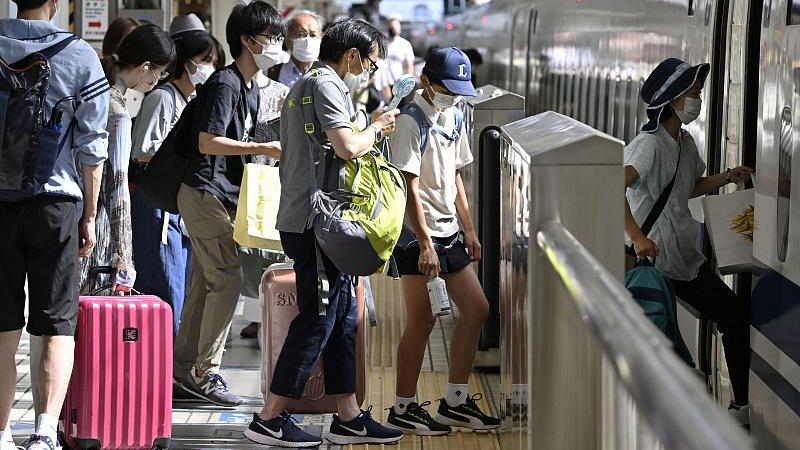
People board a Shinkansen bullet train at JR Tokyo Station on August 11, 2022, as many travelers head to their hometowns or resorts for Japan's "Bon" holidays in the first restriction-free summer since the start of the coronavirus pandemic. /CFP
Many countries have been still facing high COVID-19 infections after loosening or even dropping measures against the virus including necessary quarantine and COVID-19 tests, although the global number saw a gradual decline of the new wave since July.
Since March, a number of countries have been easing their COVID-19 restrictions as the Omicron variant of COVID-19 was deemed to have passed its peak.
Different places, more or less, let go of some precautions, allowing crowd gathering in public indoor venues, elbow-to-elbow seating in movie theaters, no masks in public places, etc.
However, the spread of COVID-19 has not stopped although people's life seems gotten back to normal. Globally, there are about 5-7 million new infections and over 10,000 deaths weekly from the virus since July.
In Japan, the new wave of COVID-19 has hit the country with the case number more than any other country in the world since late July, while the government has refused to set up strict measures.
The daily new confirmed case number hit over 150,000 with the highest of over 326,000 cases on August 29, as the country has been struggling to contain the current mainstream COVID-19 subvariant BA.5, according to the data from the World Health Organization (WHO).
Although the BA.5 infections are deemed milder than other variants, the country saw a steady rise of hospitalizations, even as ICU occupancy remained low, according to Our World In Data.
WHO: 1 million COVID-19 deaths alone in 2022
In 2022 alone, there had been over 1 million COVID-19 deaths worldwide by August 25, which was a "tragic milestone," World Health Organization (WHO) chief Tedros Adhanom Ghebreyesus reported.
"We cannot say we are learning to live with COVID-19 when 1 million people have died with COVID-19 this year alone, when we are two-and-a-half years into the pandemic and have all the tools necessary to prevent these deaths," said Tedros, speaking during his regular briefing from Geneva on August 25.
Maria Van Kerkhove, the WHO's technical lead of COVID-19, said the toll was "heartbreaking" and it was time for a reality check on the virus after the millionth death from the disease this year.
"Given we're in the third year of the pandemic, it's... all the more so tragic given that we have the tools that can actually prevent these deaths," she told a live interaction on the WHO's social media channels.
"A lot of us have become numb to the numbers," she warned.
"We need a reality check. We really need to take stock of where we are. We should not be in a position with 14,000 or 15,000 people dying every week. We just shouldn't."
She reiterated that the pandemic was not over.
"A lot of people are talking about living with COVID. But we need to live with this responsibly,"she pointed out. "A million deaths this year is not living with COVID. Having 15,000 deaths per week is not living with COVID-19 responsibly."
'Long COVID'
As COVID-19 restrictions ease in many countries, health professionals have repeatedly expressed concerns over a wave of people with "long COVID" or post COVID-19 syndrome.
According to the WHO, the most common symptoms of post COVID-19 condition include:
-Fatigue
-Shortness of breath or difficulty breathing
-Memory, concentration or sleep problems
-Persistent cough
-Chest pain
-Trouble speaking
-Muscle aches
-Loss of smell or taste
-Depression or anxiety
-Fever
People with "long COVID" may have difficulty functioning in everyday life, and their condition may affect their ability to perform daily activities such as work or household chores, the WHO said.
"Long COVID" is a global health problem, Jose Angel Cabrera, chief of cardiology at Quiron University Hospital in Madrid, Spain, told CGTN in an interview this June, adding that it will not only affect the health of individuals, but also the broader society.
Peter Wark, an Australian respiratory specialist and conjoint professor at University of Newcastle and Hunter Medical Research Institute, warned about the problem in Australia.
"We can ignore this problem simply. But even if you say that five percent of Australians will have significant symptoms from "long COVID", you're talking about nearly half a million people in Australia," he told Xinhua in July.
In the U.S., about one in five adults aged 18 and older have a health condition that might be related to their previous COVID-19 illness, according to a study of the U.S. Centers for Disease Control and Prevention (CDC) in May.
About 1 million Americans have been forced to leave the labor market because of "long COVID", according to a hearing held by the U.S. Select Subcommittee on the Coronavirus Crisis last month.
Read more:
The Long Haul with COVID-19: My story of fight against long COVID
The Long Haul with COVID-19: Spanish doctor: 'Long COVID-19' is a global health problem

Search Trends
Copyright © 2020 CGTN. 京ICP备16065310号

Disinformation report hotline: 010-85061466
Copyright © 2020 CGTN. 京ICP备16065310号
Disinformation report hotline: 010-85061466
Copyright © 2020 CGTN. 京ICP备16065310号
Disinformation report hotline: 010-85061466