
Share






Copied
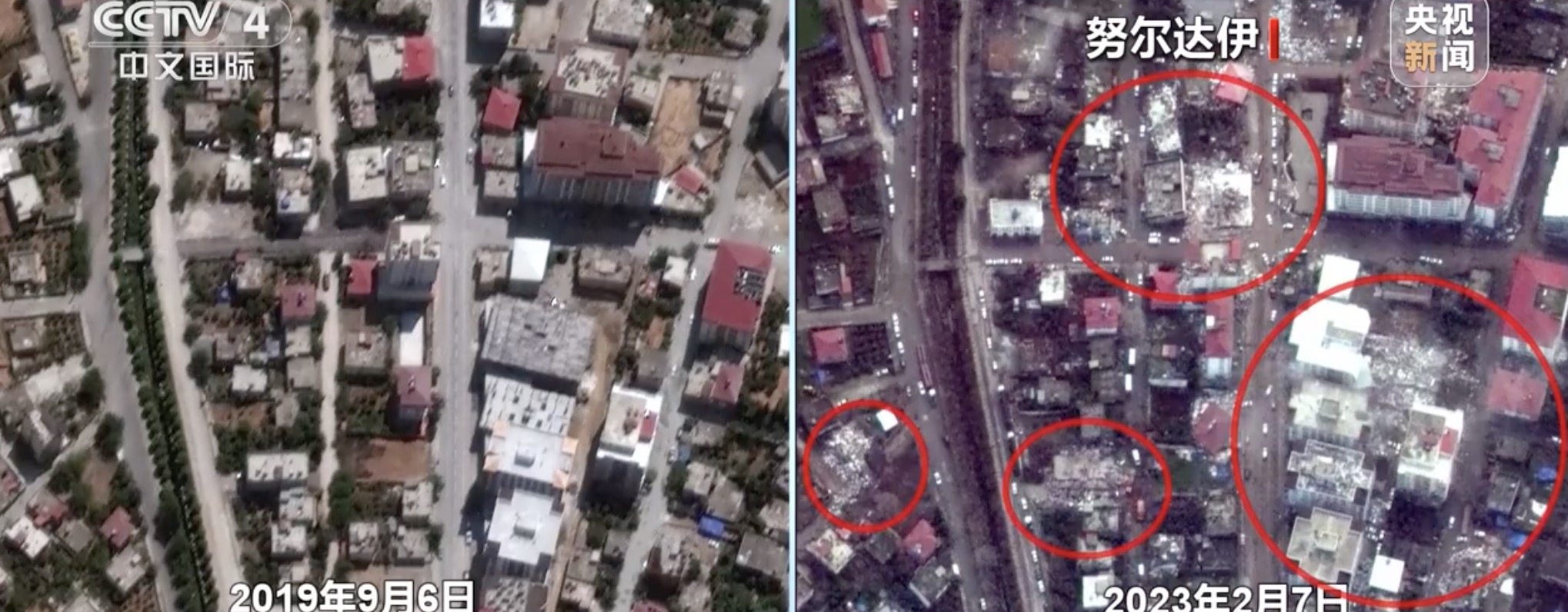
A comparison of SAR images between September 6, 2019 (L) and February 7, 2023 (R) in the earthquake-stricken areas of Nurdagi in Türkiye. /China Media Group
China has deployed several satellites to capture images of the quake-hit areas in Türkiye, helping the country to better analyze the disaster situation and allocate relief resources, according to the industry newspaper China Space News.
Using synthetic aperture radar (SAR) images provided by China's L-SAR 01, researchers accurately portrayed the extent of the damage caused by the earthquakes and provided important data support for post-earthquake rescue efforts in Türkiye, said the newspaper.
China's L-SAR 01 is a satellite group composed of two satellites equipped with L-band SAR, namely the L-SAR 01A and the L-SAR 01B. Both satellites were launched last year, and were tasked with providing data to support land resource management, mapping, forestry, and disaster prevention and relief.
"SAR" refers to a microwave-imaging radar system that emits electromagnetic waves to Earth and receives echoes. It can take high-definition microwave pictures of the land surface.
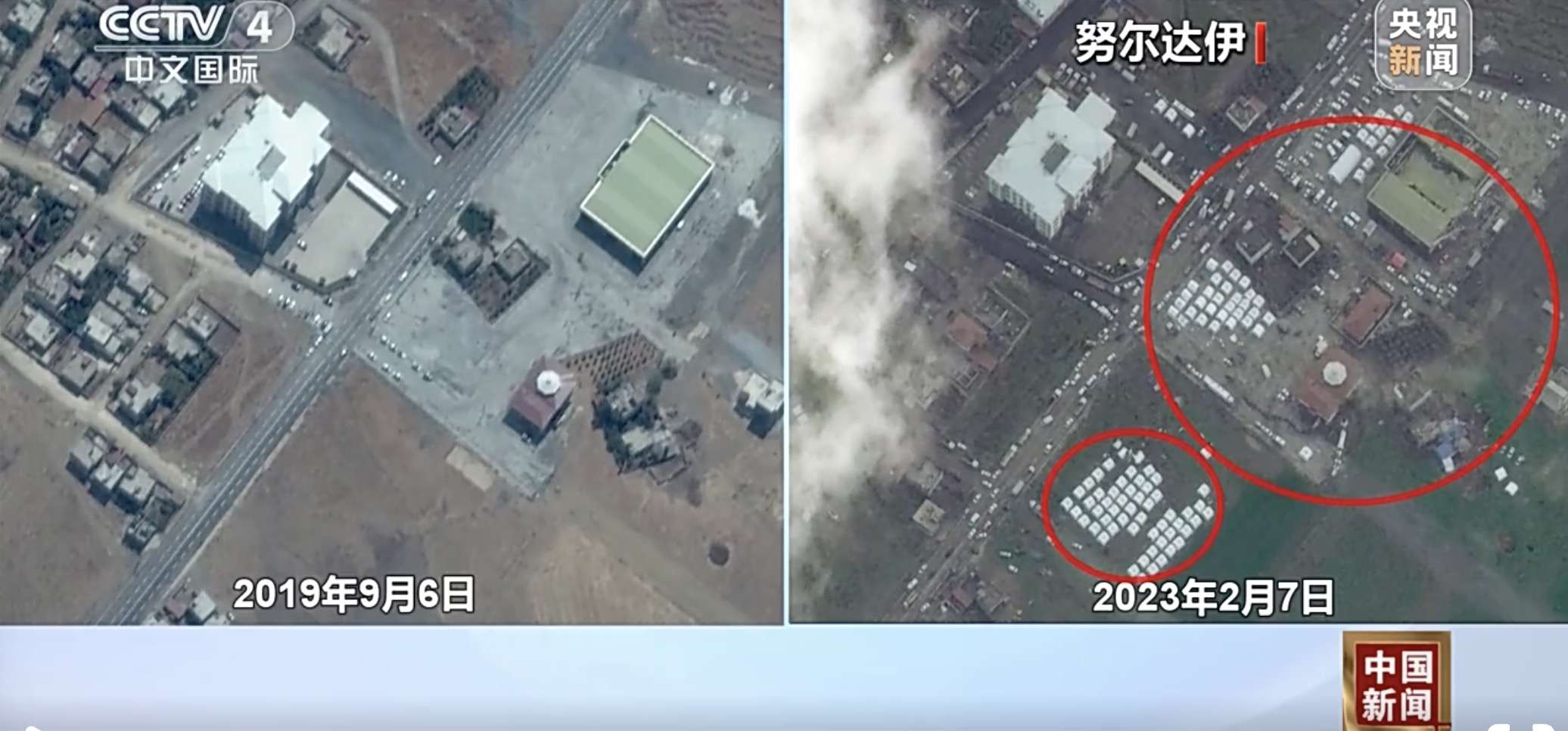
A comparison of SAR images between September 6, 2019 (L) and February 7, 2023 (R) in the earthquake-stricken areas of Nurdagi in Türkiye. /China Media Group
Post-earthquake SAR images
Following the twin earthquakes that rocked Türkiye and Syria on February 6, Chinese researchers acquired post-earthquake SAR images from L-SAR 01 on February 10.
After differential interference processing with the pre-earthquake SAR images, they obtained the isoseismic deformation field of the two strong earthquakes, the newspaper noted.
Moreover, after the massive earthquakes, satellite images taken by China's Gaojing-1 04 satellite on February 8 showed that a fire broke out in Iskenderun port in southern Türkiye and that some of the port's containers collapsed, according to the newspaper.
"The satellite images helped people analyze the situation in quake-affected areas and carry out rescue work," it said.
The newspaper also pointed out in its microblog that more than 10 civil and commercial satellites, including Gaofen-1 02/03, Gaofen-2, and Gaofen-3 01/03 were deployed to capture images of the quake-hit areas in Türkiye.
By February 10, a total of 67 remote sensing images were obtained, including 34 optical images and 33 SAR images, it added.
According to the newspaper, analysis results of the satellite image data were sent to the Chinese international rescue team in Türkiye, and were also provided to the Turkish government through the International Charter Space and Major Disasters.
Participation of academic institutions
In addition, some academic institutions in China are also analyzing data from Chinese satellites to assist the relief efforts.
A research team from Wuhan University used China's high-resolution satellites to carry out the high-precision monitoring of lights in affected areas at night, providing data to the United Nations Satellite Centre to aid relief work.
The earth science satellite SDGSAT-1, developed by the Chinese Academy of Sciences, provided pre-disaster data for researchers to compare with post-disaster conditions.
The commercial space telescope Yangwang-1, developed by Origin Space Technology Co., Ltd., and the micro-nano satellite QMX-1, developed by Wuhan University, have also been deployed.
Read More:
Chinese scientists generate Turkish earthquake relief analysis for UN
(With input from Xinhua)
Search Trends
SITEMAP
Copyright © 2023 CGTN. 京ICP备16065310号

Disinformation report hotline: 010-85061466
SITEMAP
Copyright © 2023 CGTN. 京ICP备16065310号
Disinformation report hotline: 010-85061466