
Share







Copied
Three representatives from the China Ethnic Minorities' Association for External Exchanges (CEMAFEE) presented China's achievements in the protection of the rights of ethnic minorities at the 52nd regular session of the United Nations Human Rights Council (UNHRC) on Thursday and Friday.
Qiu Peng, deputy secretary general of the CEMAFEE, said enhancing national solidarity, promoting common development and safeguarding national unity are the necessary conditions and important basis for safeguarding the human rights of ethnic minorities.
Zunong Nasierding, a Uygur scholar from the Minzu University of China, shared his education experience and noted that he had received education in schools in the Uygur language. He took the college entrance exam in Uygur and got his PhD in Uygur language literature.
The scholar has also worked in teaching ethnic languages and has contributed to the preservation of the culture and language of ethnic groups. He added that his personal experience demonstrated the fact that China values and protects the rights of all ethnic groups to use and develop their own spoken and written languages.
Chen Jiuyang, an ethnic representative, introduced his experience living in China as a Mongolian. He said that China protects the political, economic, social, cultural and other rights of ethnic minorities in accordance with the law, as well as the participation of ethnic minorities in the formulation, implementation and supervision of relevant laws and policies.
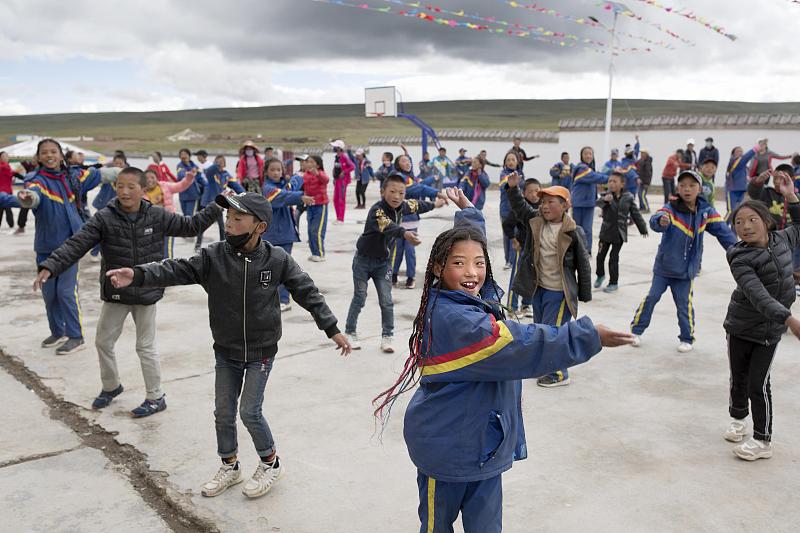
Students dance at a playground in a boarding primary school, Qumalai County, Yushu Tibetan Autonomous Prefecture, Qinghai Province, August 10, 2018. /CFP
A side meeting organized by the CEMAFEE was also held at the 52nd UNHRC session on Friday. Scholars and representatives of ethnic groups attended the event and shared insights on the human rights situation in China at the meeting.
Li Xi, director of the China Association for Preservation and Development of Tibetan Culture, introduced the development of boarding schools in China's remote areas, including Tibet, saying setting up boarding schools is one of the most effective ways to guarantee the education rights of students in remote agricultural and pastoral areas, and has achieved good results.
Boarding schools are set up in accordance with parents' and students' needs and all these schools have attached great importance to a family's involvement in the student's education. Boarding schools have helped to promote equality and high-quality development of education, Li added.
Li's introduction debunked disinformation by some anti-China groups that China imposed boarding schools in Tibet for the purpose of "assimilation."
Another representative named Ling Hui from the Zhuang ethnic group, also the secretary-general of YouChange China Social Entrepreneur Foundation, delivered a speech on poverty alleviation and rural revitalization projects in different areas of China inhabited by ethnic minority groups.
Ling shared her observations on the training program for ethnic female inheritors of intangible cultural heritage. She said that with these training programs, local ethnic minority women have not only lifted themselves out of poverty and become self-sufficient, but also helped their fellow villagers achieve common development.

A representative inheritor of intangible cultural heritage displays hand-made embroidery, Jinxiu Yao Autonomous County, Laibin City, south China's Guangxi Zhuang Autonomous Region, September 25, 2020. /CFP
China has put the people first when protecting the rights of ethnic groups. However, some countries and organizations are spreading disinformation on its policies with the purpose of smearing and containing China, said Li Huancai, vice-chairman of CEMAFEE.
Li expressed hope for the international community to know more about China's ideals and practices in safeguarding the rights of ethnic minorities.
Christoph Stueckelberger, president of the Geneva Agape Foundation, also participated in the Friday event and said that he saw with his own eyes the harmonious scenes of different ethnic minorities living, studying and working together in China. He was impressed by the degree of respect and unity. The various patterns of human rights protection and development should be respected, said Stueckelberger.
Mark Levine, an American expert at the Minzu University of China, said that Chinese people use pomegranate seeds as a metaphor to describe how different ethnic groups in China have united together. His students from different ethnic groups are proud of being Chinese as the country provides them with a variety of learning opportunities, he said. They know that only a united Chinese nation can protect their future, Levine noted.
(Cover: The UN headquarters in Geneva, Switzerland. /CFP)
Search Trends
SITEMAP
Copyright © 2023 CGTN. 京ICP备16065310号

Disinformation report hotline: 010-85061466
SITEMAP
Copyright © 2023 CGTN. 京ICP备16065310号
Disinformation report hotline: 010-85061466