
Share







Copied
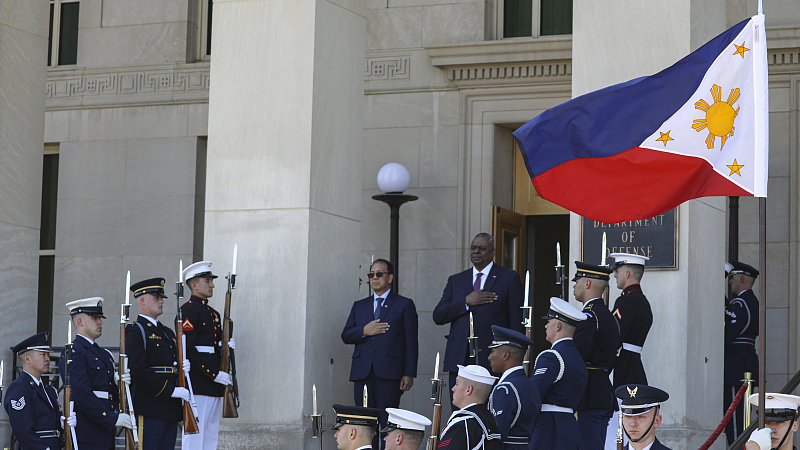
U.S. Secretary of Defense Lloyd Austin welcomes Defense Minister of Phillippines Carlito Galvez Jr. at the Pentagon in Washington, United States, April 12, 2023. /CFP
Editor's note: Hannan Hussain is a foreign affairs commentator, author, and assistant research associate at the Islamabad Policy Research Institute. The article reflects the author's opinions and not necessarily the views of CGTN.
On April 11, the United States and the Philippines kicked off their largest-ever joint military drills across the South China Sea and the Taiwan Straits, featuring live fire, complex weapon systems, and a range of U.S. warships, fighter jets, and missiles. The annual military drills – termed the Balikatan (shoulder-to-shoulder) Exercise – arrive on the back of a coordinated U.S. push to strengthen military deployments in the Philippines.
The U.S. has been busy courting bases in proximity to China's sovereign territories, hoping to step-up access and escalate regional tensions under the pretext of bilateral defense cooperation. The three-week event could carry groundwork for a new normal in U.S.-influenced wargaming across stable waters, with several potential implications for Asia-Pacific security.
First, Washington's overt projection of amphibious operations and High Mobility Artillery Rocket Systems in sensitive waterways is likely to feed misguided impressions of maritime instability. Heightened threat perceptions were key to Washington's recently updated Enhanced Defense Cooperation Agreement with Manila. The outcome helped scale-up joint drills and created a false sense of regional alarm that benefited U.S. aspirations for stronger troop engagement. All these send an unmistakable signal that the U.S. is more inclined to use the Balikatan drills to simply test out its "light and flexible" maritime operations with an eye on China.
Close proximity to the Taiwan Straits also makes the exercise a counterproductive follow-up to China's military drills around the Taiwan region. This is despite Southeast Asia's insistence on countries to prioritize "maximum restraint." As recently as August last year, the Association of Southeast Asian Nations took a clear stand against provocative actions that fueled miscalculation, regional volatility and unpredictable consequences in the neighborhood. It is here that planned rocket-firing near Chinese maritime territory, and joint military drills around controversial U.S. bases in the Philippines, call into question the determinants of truly defensive military cooperation. One doesn't "target any third party" and is "conducive to regional peace and stability."
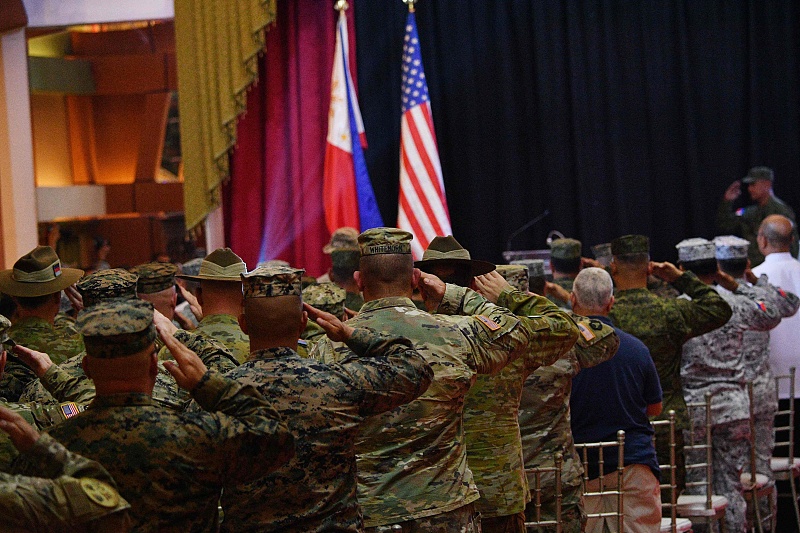
Philippines and U.S. soldiers salute in front of their national flags while their national anthems are played during the opening ceremony of the Balikatan joint military exercise at the military headquarters in Quezon City, suburban Manila, Philippines, April 11, 2023. /CFP
Given the sheer scale of this year's Balikatan Exercise, there is little to show for strengthening maritime deterrence in the Asia-Pacific. After all, the United States represents a lion's share of participating troops and has virtually ensured that aggressive wargaming activities remain increasingly focused in the South China Sea this time. Make no mistake: This is a marked departure from earlier years when joint U.S.-Philippines military drills were refused a show of power in stable waters to prevent undue interference in the maritime space.
Amicable resolution of maritime issues continues to serve as a recurring feature of the Philippines' neighborhood diplomacy. But America's outsized role in marketing dangerous weapon systems and sophisticated military technologies at the event tells a different story on defense optics. It offers underlying incentives to court Western allies and prioritizes arms spending in the region, all to threaten the protection of maritime and security interests of all parties in the neighborhood.
Interestingly, skewed logic of perceived adversaries and imaginary conflict scenarios dominate the 2023 Balikatan drills. "Through this exercise, the Philippines and U.S. forces will sharpen our inter-operability ... ensuring we are prepared to respond to real-world challenges together," alleged U.S. Marine Corps Major General Eric Austin, U.S. exercise director representative.
In reality, part of the rationale is to strengthen combat postures based on a range of unspecified conflict scenarios. For Asia-Pacific, this represents an ominous pursuit that lacks regional endorsement and denies a buffer against unnecessary military deployments. Still, Washington's lead role in pressing select allies to participate in the drills leaves fundamental questions unanswered: How "bilateral" is the current trajectory of U.S.-Philippines joint military drills? Who benefits from wargaming at the expense of maritime rights? And does live-fire and military deployment strengthen – or undermine – a truly representative rules-based order in the Asia-Pacific?
Without question, the answers from this year's joint military drills are clearly underwhelming. U.S. influence was a decisive factor in expanding the exercise and should be seen as a convenient inlet to serve America's regional encirclement strategy under the cover of defense cooperation with Manila.
(If you want to contribute and have specific expertise, please contact us at opinions@cgtn.com. Follow @thouse_opinions on Twitter to discover the latest commentaries in the CGTN Opinion Section.)
Search Trends
SITEMAP
Copyright © 2023 CGTN. 京ICP备16065310号

Disinformation report hotline: 010-85061466
SITEMAP
Copyright © 2023 CGTN. 京ICP备16065310号
Disinformation report hotline: 010-85061466