
Share







Copied
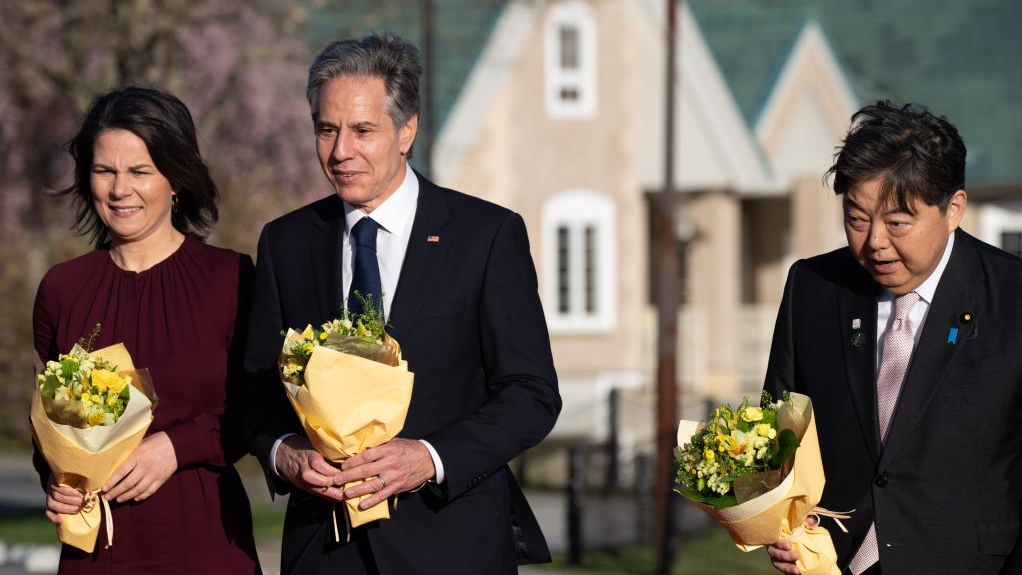
German Foreign Minister Annalena Baerbock (L), U.S. Secretary of State Antony Blinken (C), and Japanese Foreign Minister Yoshimasa Hayashi are pictured during a welcome ceremony at the Karuizawa station of shinkansen train in Nagano Prefecture, Japan, April 16, 2023. /Xinhua
Editor's note: Yan Zeyang is an assistant researcher at the Institute of Northeast Asian Studies, China Institutes of Contemporary International Relations. The article reflects the author's opinions and not necessarily the views of CGTN.
From April 16 to 18, the G7 foreign ministers' meeting was held in Nagano, Japan. The meeting focused on several major topics including the Indo-Pacific, the Ukraine crisis and nuclear disarmament and non-proliferation, and issued a joint statement. As the host of this meeting, Japan has shown its real purpose at the meeting.
Japan's real purpose
Japan took the opportunity of this home diplomacy to realize its own purpose, reflecting Japan's own political intentions.
First, Japan leads the agenda setting to enhance its international status. Taking advantage of the convenience as the host country, Japan emphasizes that it is the only Asian representative of the G7, and intends to lead the agenda setting and research direction as a major country, and enhance the global discourse power and international status. For example, Japan has raised concerns such as China, DPRK, and "denuclearization" to the focus of global attention.
During the foreign ministers' meeting, Japanese Foreign Minister Hayashi Yoshimasa also met with the foreign ministers of the United States, the United Kingdom, and Germany respectively, and reached an agreement on strengthening the deterrence and response capabilities of the Japan-U.S. alliance and promoting the early entry into force of the Reciprocal Access Agreement.
Second, Japan caters to the strategic needs of the United States and shapes the pattern of "camp confrontation." Recently, Japan has actively followed the United States strategically, and wants to submit a "vote certificate" to the United States through the agenda setting of the G7 foreign ministers' meeting in exchange for the support of the United States, so as to enhance its regional status. At the same time, Japan is also trying its best to shape the pattern of confrontation in East Asia, in an attempt to seek dividends from confrontation as Hayashi Yoshimasa criticized China in the East China Sea while attending the NATO foreign ministers' meeting in Belgium.
The third purpose is to warm up for the G7 summit and increase the approval ratings for Japanese Prime Minister Fumio Kishida. Fumio Kishida visited five of the G7 member countries in January; in March, he made a surprise visit to Ukraine after his visit to India. Diplomatic achievements boosted the Kishida cabinet's approval rating more obviously. Kishida hopes to continue to use the G7 foreign ministers' meeting to build momentum for the May summit, create diplomatic highlights, polish the "Kishida diplomacy" signboard, and stabilize the domestic fundamentals.
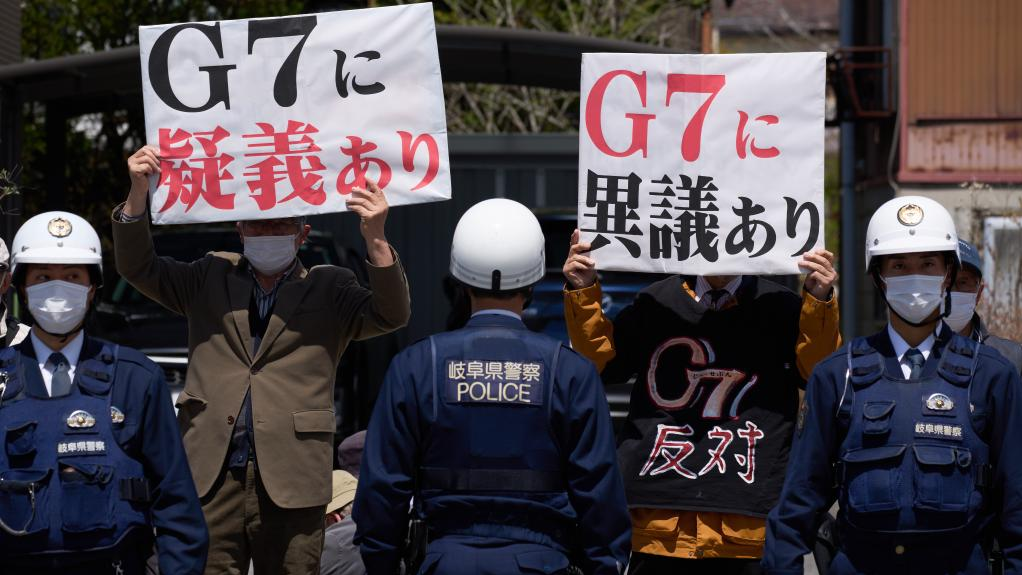
Protesters holding placards are pictured near the Karuizawa station of shinkansen train in Nagano Prefecture, Japan, April 16, 2023. /Xinhua
The influence of the G7 foreign ministers' meeting
Although the G7 foreign ministers' meeting seems to have a variety of agendas and a wide range of issues, it cannot conceal the fact that the overall influence of the G7 has declined and internal differences have become increasingly obvious.
On the eve of the G7 foreign ministers' meeting, Fumio Kishida was suddenly thrown "explosives" in public. This is another attack at the site of a leader's speech after the assassination of former Prime Minister Shinzo Abe last year. The outside world is worried about whether this country, which has seen little violence and is known for its security, is no longer safe. Especially as the host country of the G7 summit, whether Japan can ensure the safe hosting of the G7 series of meetings.
In addition, in the past few days, the leakage of confidential documents of the U.S. military has continued to ferment. Not only did intelligence about the Ukraine crisis come to light, but it also leaked about the U.S. eavesdropping on its allies. It is doubtful how much trust is left between other G7 countries to the United States.
At the same time, the voices of divergence in Europe's China policy are getting louder. French President Emmanuel Macron has repeatedly stressed after his visit to China that Europe should strengthen its strategic autonomy, stop being a "follower of the United States" and avoid getting involved in the confrontation between China and the United States on the Taiwan question. Macron's statement has received a lot of support in Europe. Behind these phenomena, it means that the role and influence of the G7 platform are declining. People no longer care about its role in global governance, but the extent to which the United States and its Western allies have shown a gesture of unity.
This year marks the 45th anniversary of the signing of the China-Japan Treaty of Peace and Friendship. However, many of Japan's recent actions have increased bilateral tensions, which is not conducive to the healthy development of Sino-Japanese relations. At present, mankind is facing various challenges such as climate change and economic downturn, which require the concerted efforts of the international community to solve them. Unity is strength, and division leads nowhere. Only when countries replace division with unity, confrontation with cooperation, and exclusivity with tolerance, can they jointly solve the issues of the times and create a better future together.
(If you want to contribute and have specific expertise, please contact us at opinions@cgtn.com. Follow @thouse_opinions on Twitter to discover the latest commentaries on CGTN Opinion Section.)
Search Trends
SITEMAP
Copyright © 2023 CGTN. 京ICP备16065310号

Disinformation report hotline: 010-85061466
SITEMAP
Copyright © 2023 CGTN. 京ICP备16065310号
Disinformation report hotline: 010-85061466