
Share







Copied
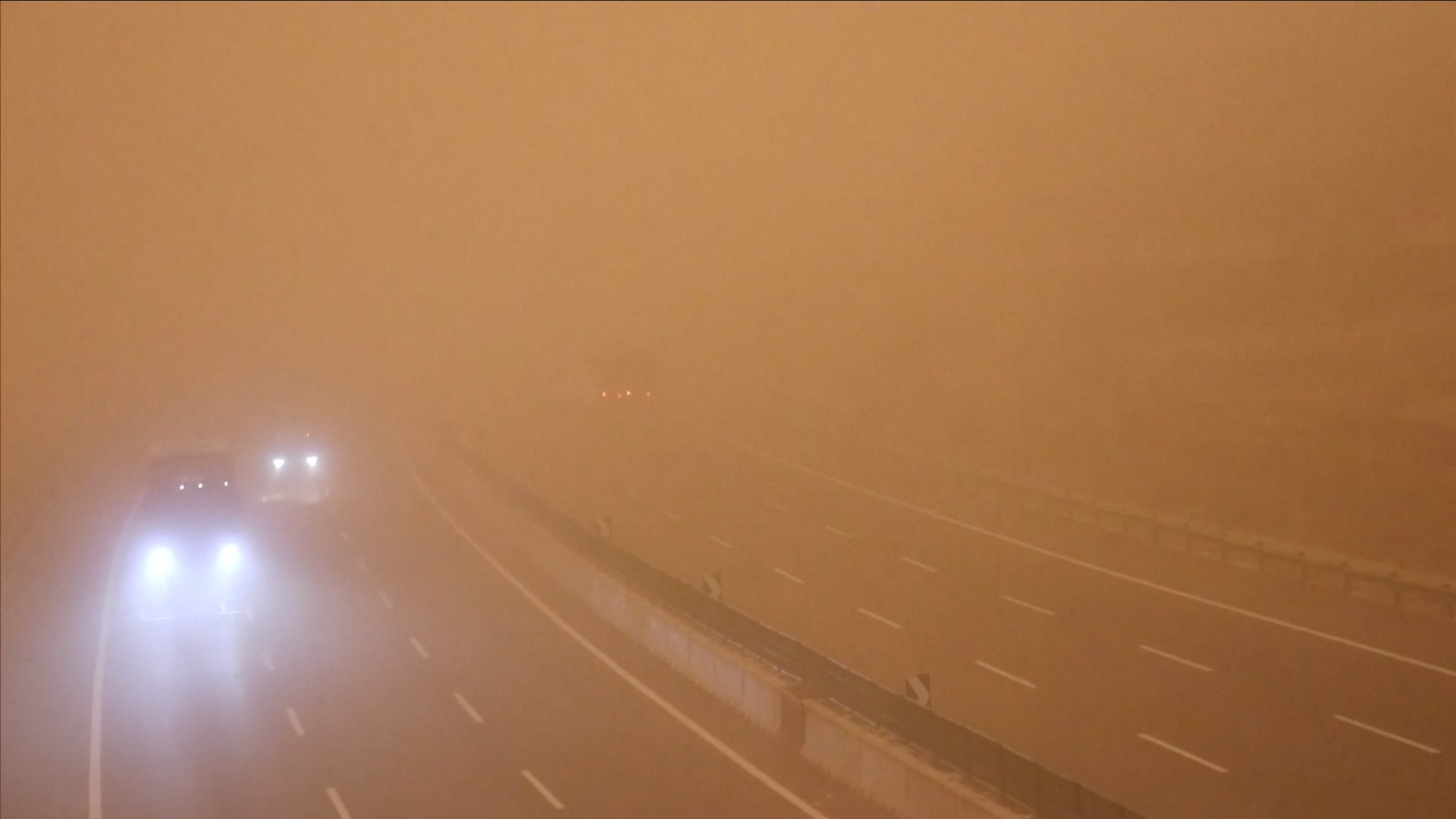
China has been making continuous and concrete efforts to tackle cross-border sandstorms and restore clean air, an arduous project that calls for collaborative concerns and solutions, by setting carbon emission goals and joining hands with neighboring countries.
China has seen its tenth sandstorm since early Spring, two times more than the average number over the past ten years.
The increasing frequency of sandstorms calls for climate action once again. Experts say global warming and human activity are to blame.
"Last autumn and winter, the area with a lot of sand and dust experienced less snowfall. This spring, the area warmed up earlier than usual. With frequent cold fronts and Mongolian cyclones, this fine dust can be carried hundreds of kilometers and sometimes thousands of kilometers [away]. Meteorologists and scientists globally tend to believe the hotter air caused by the climate change will create more frequent or more powerful sand and dust storms," said Ma Jun, director of Institute of Public and Environmental Affairs, a non-profit organization.
Over the past two decades, China has partnered with Mongolia to combat cross-border sandstorms and desertification through capacity building and experience sharing.
"There are some 1.6 million square kilometers of land still suffering from desertification. And across the border in the Mongolian Republic, there are also massive [parts of the] Gobi Desert [which have] suffered from severe overgrazing and mining activities, and from more frequent droughts. Mongolia is rich in coal and mineral resources, but it's also very rich in renewable energy sources. So there's plenty of room for us to work together to transform our energy supply and restructure our industry," Ma said.
As China aims to achieve carbon neutrality by 2060, the nation is striving to bring more health benefits to its people through cleaner air.
"The PM2.5 annual concentration [has dropped] from 33 micrograms per cubic meter of air to 29, meaning that it is lower comparing to the existing standard. China has ranked [among the countries with] the most stringent air quality standards in the world for the coal fire power plants emission control and the transport sector emission control policies, meaning that we transformed from being a follower to the leader in setting emission control standards in the world," said Wan Wei, China program director at Clean Air Asia, another environmental protection organization.
"Based on our calculation from 2013 to 2020, our life expectancy was increased by about half a year, which means over 170 days. We found improvement in the lung and metabolic functions, and even the cost in medical expenditure was reduced after cleaning up the air," said Xue Tao, a researcher with the School of Public Health of Peking University.
(If you want to contribute and have specific expertise, please contact us at nature@cgtn.com.)
Search Trends
SITEMAP
Copyright © 2023 CGTN. 京ICP备16065310号

Disinformation report hotline: 010-85061466
SITEMAP
Copyright © 2023 CGTN. 京ICP备16065310号
Disinformation report hotline: 010-85061466