
Share







Copied
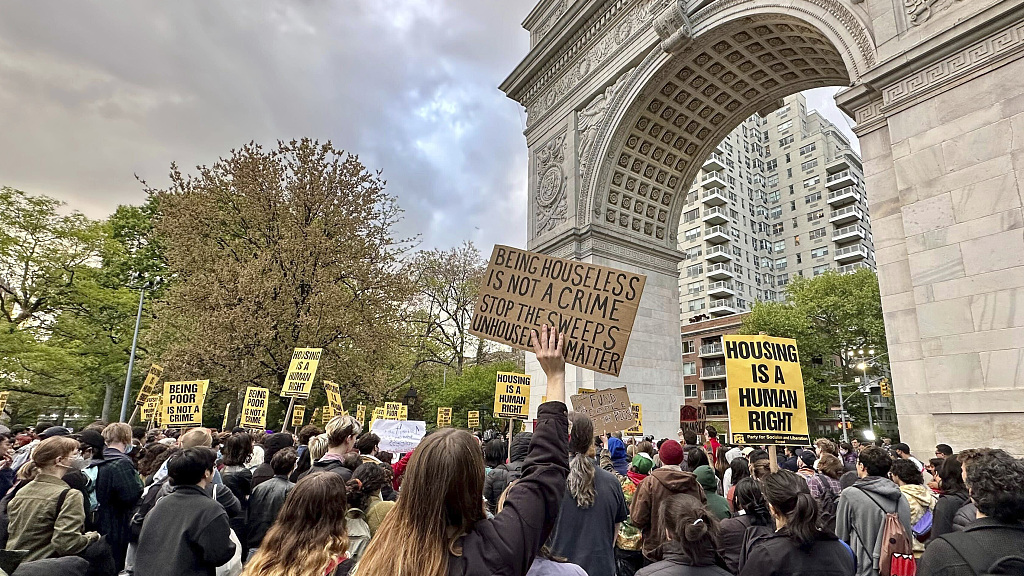
A group of several hundred people protest the death of Jordan Neely at Washington Square Park in New York City, May 5, 2023. /CFP
"Increasingly, it is not safe to be in public, to be human, to be fallible" in the United States, read an opinion piece published by The New York Times (NYT) on Thursday.
In Kansas City, Missouri, Ralph Yarl, a Black 16-year-old, got shot twice after ringing a wrong doorbell. In upstate New York, 20-year-old Kaylin Gillis got shot and killed by a homeowner after driving into a driveway. In Illinois, William Martys got killed by his neighbor when he was using a leaf blower in his yard. Two cheerleaders were shot in a Texas parking lot after one of them got into a wrong car.
"All of these innocent people who lost their lives were in the wrong place at the wrong time," said the opinion piece. "In most cases, armed assailants deputized themselves to stand their ground or enforce justice for a petty crime. Some claimed self-defense, said they were afraid, though some of their victims were unarmed women and children."
The United States is "at something of an impasse," said the article. "The list of things that can get you killed in public is expanding every single day. Whether it's mass shootings or police brutality or random acts of violence, it only takes running into one scared man to have the worst and likely last day of your life."
Anti-Black racism and the society's dehumanizing attitude toward people seen by others as "mentally ill" are on full display in the United States this week in victim-blaming narratives surrounding the murder of Jordan Neely, reported the website Truthout on Friday.
Neely, a 30-year-old Black subway rider, was choked to death by a 24-year-old white ex-Marine on the New York City subway on May 1 as other passengers looked on.
The former Marine sergeant who placed Neely in the chokehold was questioned by police and released on Monday, local media reported.
U.S. news outlets have described the murder in a way that downplays the violence of the killing and exonerated the killer by casting the lethal chokehold as somehow understandable because "there were serious mental health issues in play here," said the Truthout report quoting New York City Mayor Eric Adams.
Dave Giffen, executive director at Coalition for the Homeless chastised city and state officials for a inadequate response to the mental health crisis, and questioned why the veteran was not charged criminally.
"The fact that someone who took the life of a distressed, mentally ill human being on a subway could be set free without facing any consequences is shocking," he said. "This is an absolute travesty that must be investigated immediately."
(With input from agencies)
Search Trends
SITEMAP
Copyright © 2023 CGTN. 京ICP备16065310号

Disinformation report hotline: 010-85061466
SITEMAP
Copyright © 2023 CGTN. 京ICP备16065310号
Disinformation report hotline: 010-85061466