
Share







Copied
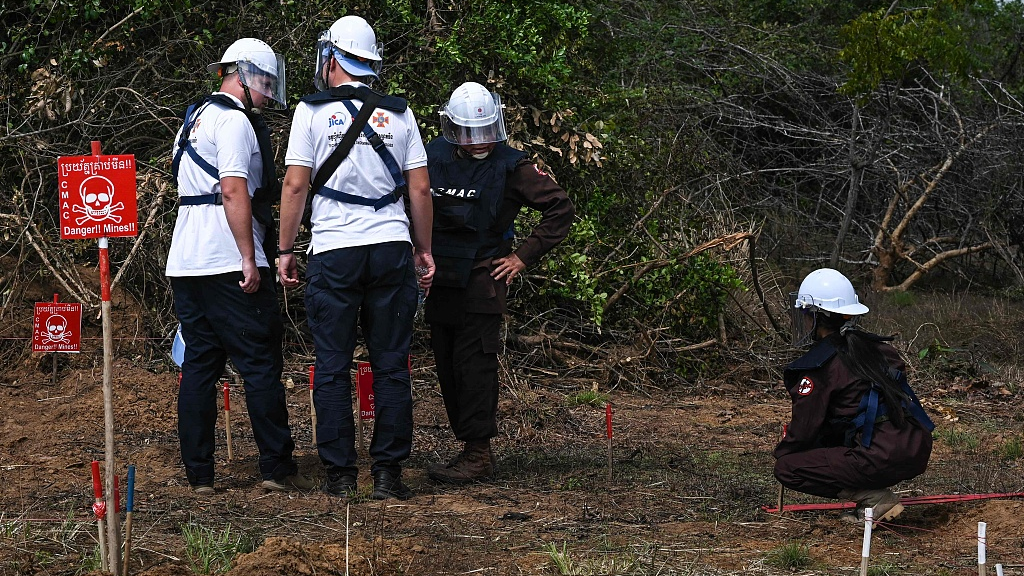
Deminers look at a mine in the ground during a technical training session on demining technologies in Battambang Province, Cambodia, January 19, 2023. /CFP
Cambodia had cleared some 2,579 square km of landmines and explosive remnants of war (ERW)-contaminated land in the last 30 years, a senior official said on Thursday.
Ly Thuch, first vice president of the Cambodian Mine Action and Victim Assistance Authorities (CMAA), disclosed the figure during a meeting here.
"For 30 years, the international community and the United Nations have worked side by side with Cambodia to clear roughly 2,579 square km of landmine/ERW-contaminated land from 1992 to 2022," he said. "This land has been returned to communities for productive purposes such as agriculture, resettlement, roads, schools, and other social infrastructure."
Thuch said the Southeast Asian nation still has 563 square km of land contaminated with landmines and 1,322 square km with cluster munitions and other ERWs.
These remaining landmines, ERW and cluster munitions lurk beneath the surface, silently waiting to claim their next victims, hindering reconstruction, impeding economic development, and denying people access to essential services such as clean water, education and healthcare, he said.
"We must redouble our efforts and accelerate action to achieve the goal of a mine-free 2025," he said. "This requires political will, policy coherence, and sustained commitment from all sectors of society."
Thuch previously said around 1 million people in Cambodia still live in fear and work in areas contaminated by mines, ERWs and cluster munitions.
Cambodia is one of the countries worst affected by landmines, ERWs and cluster munitions. An estimated 4 million to 6 million landmines and other munitions had been left over from three decades of war and internal conflicts.
According to Yale University, between 1965 and 1973, the United States dropped some 230,516 bombs on 113,716 sites in Cambodia.
The CMAA's latest report showed that from 1979 to April 2023, landmine, ERW and cluster bomb explosions claimed 19,819 human lives and either injured or amputated 45,198 others in Cambodia.
Search Trends
SITEMAP
Copyright © 2023 CGTN. 京ICP备16065310号

Disinformation report hotline: 010-85061466
SITEMAP
Copyright © 2023 CGTN. 京ICP备16065310号
Disinformation report hotline: 010-85061466