
Share







Copied
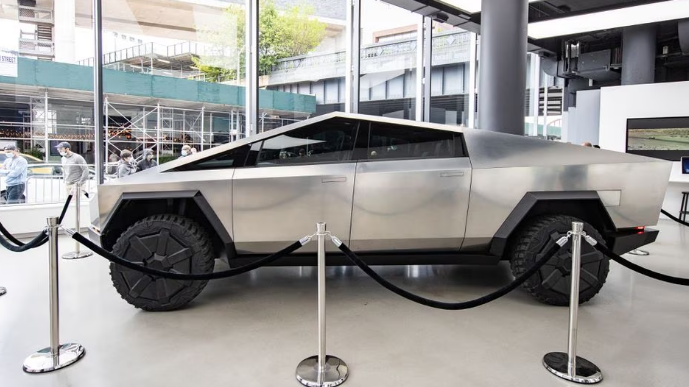
Tesla's Cybertruck is displayed at Manhattan's Meatpacking District in New York City, U.S., May 8, 2021. /Reuters
Tesla has built its first Cybertruck at the electric-vehicle marker's plant in Austin, Texas, the company said in a tweet on Saturday, after two years of delays.
Tesla founder Elon Musk introduced the pickup truck in a 2019 reveal where the vehicle's designer cracked the vehicle's supposedly unbreakable "armor glass" windows.
With its wedge shape and stainless-steel body – which Tesla calls the exoskeleton – the Cybertruck looks nothing like a traditional pickup. Some analysts have panned it as a niche product that won't have broad appeal.
The whole construction of the truck is integrated, which is uncommon among all the vehicle designs, keeping the cost to its lowest. Such design combines the chassis and the body, providing greater strength and lightness. For electric vehicles, lightweight design means longer driving range per unit of battery capacity.
The Cybertruck is also equipped with rear-wheel steering technology, the first of its kind among Tesla models. Rear-wheel steering will also make it easier for Cybertruck to move around on narrow urban roads in the future.
Musk said in April that the company expected to deliver the first truck probably in the July-through-September quarter. He said that as with other new products, production would start slowly and then speed up.
"It takes time to get the manufacturing line going," he said, "and this is really a very radical product. It's not made in the way that other cars are made. So let's see."
Tesla originally said it would make three versions of the truck, ranging from about $40,000 to $70,000. Later the company removed prices from the page where customers can decide whether to plunk down $100 and place an order.
The company has pushed back production timing since then and Musk had last year cited shortages in sourcing components as the reason for pushing the launch of Cybertruck into 2023.
In a May shareholder meeting, Musk said that Tesla would like to produce a quarter-million Cybertrucks a year, depending on demand.
The U.S. pickup truck market is one of the world's most profitable vehicle segments and is dominated by Ford, General Motors and Fiat Chrysler Automobiles. The Cybertruck launch will give Tesla an EV entrant in one of the most profitable segments of the U.S. market and a competitor to electric pickups from the likes of Ford Motor and Rivian Automotive, both of which have launched models in still-limited numbers.
(With input from agencies)
Search Trends
SITEMAP
Copyright © 2023 CGTN. 京ICP备16065310号

Disinformation report hotline: 010-85061466
SITEMAP
Copyright © 2023 CGTN. 京ICP备16065310号
Disinformation report hotline: 010-85061466