
Share







Copied
The boreal forests in Canada's wildfire region will likely not regrow if the climate there has changed, a Canadian climate system scientist has warned.
"We can't assume that when a forest burns down, it will be replaced over time by another forest," Paul Beckwith said in a recent interview, explaining that if the annual temperatures have changed and the precipitation in that region has also changed and reduced, the region where the forests used to be will become savanna – mostly grasslands with the odd, isolated trees or just pure grassland.
Formerly an assistant professor at the University of Ottawa, Beckwith studies abrupt climate system changes related to oceans, the biosphere, air temperatures, the lithosphere and the cryosphere.
"We haven't seen fires like this before in Canada for an awful long time. Maybe ever," Beckwith said.
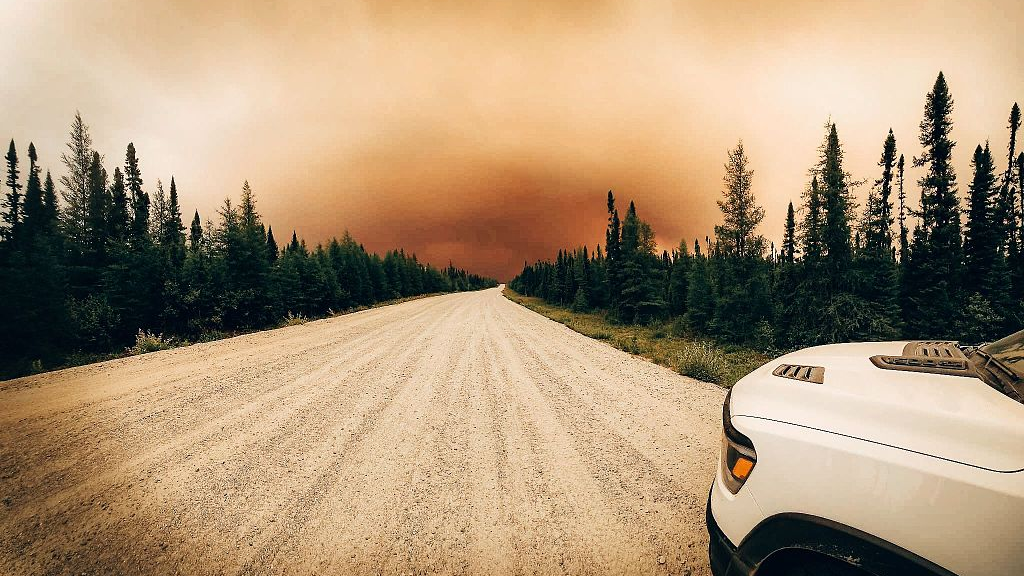
Wildfire smoke clouded the sky in the northern zone of Canada's Quebec Province on July 14, 2023. /AFP
The wildfires in Canada are exceptional by any measure, and this wouldn't be happening without the heat waves and the lack of moisture. A boreal forest is a wet and cold-adapted forest that gets lots of rain and sunlight. But now Canada has warmed at over double the rate of the rest of the planet, Beckwith said.
Beckwith said typically, the return time of large fires in a boreal forest is about 50 to 100 years, and forest fires are a part of the life cycle of boreal forests.
If a fire ignites in July or August, it's generally out in the fall because there's more rainfall as the weather gets colder. So the fire is left alone to burn if it's not interfering with infrastructure, towns, roads and rail, etc. It just burns itself out, he explained.
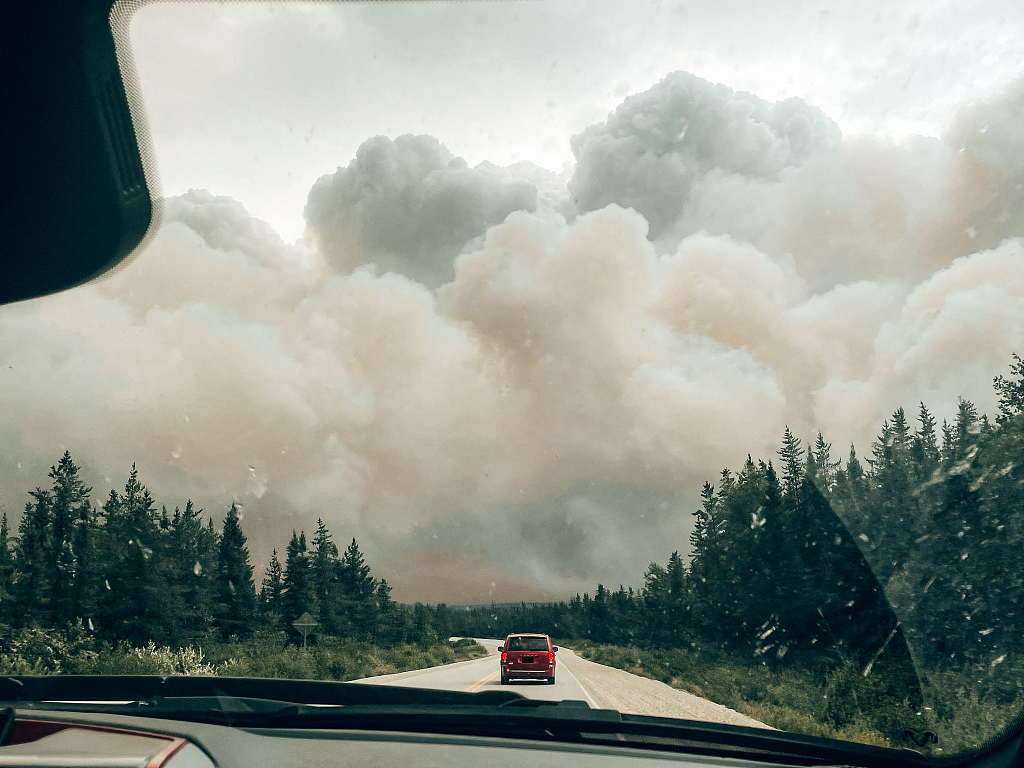
Wildfire smoke engulfs a forest in the northern zone of Canada's Quebec Province. /AFP
But when there are too many at any one time, it really overstretches firefighting resources, he said. "The problem is that when you get these fires igniting in the remote areas in the spring, do you really want to let them burn all summer? We've got to do firefighting differently in this country, for sure."
The problem with forests burning is that they are a huge carbon sink. And when they burn, that carbon is released rapidly into the atmosphere-ocean system. And you also lose the carbon sink, and the forests no longer exist to absorb all of that carbon, said Beckwith.
The Canadian Interagency Forest Fire Centre said on Sunday that there were 888 active wildfires nationwide and that the number of out-of-control wildfires was 586. The number of wildfires in the country so far this year has reached 4,152, devouring about 100,000 square kilometers of land.
(If you have specific expertise and want to contribute, or if you have a topic of interest that you'd like to share with us, please email us at nature@cgtn.com.)
Search Trends
SITEMAP
Copyright © 2023 CGTN. 京ICP备16065310号

Disinformation report hotline: 010-85061466
SITEMAP
Copyright © 2023 CGTN. 京ICP备16065310号
Disinformation report hotline: 010-85061466