
Share







Copied
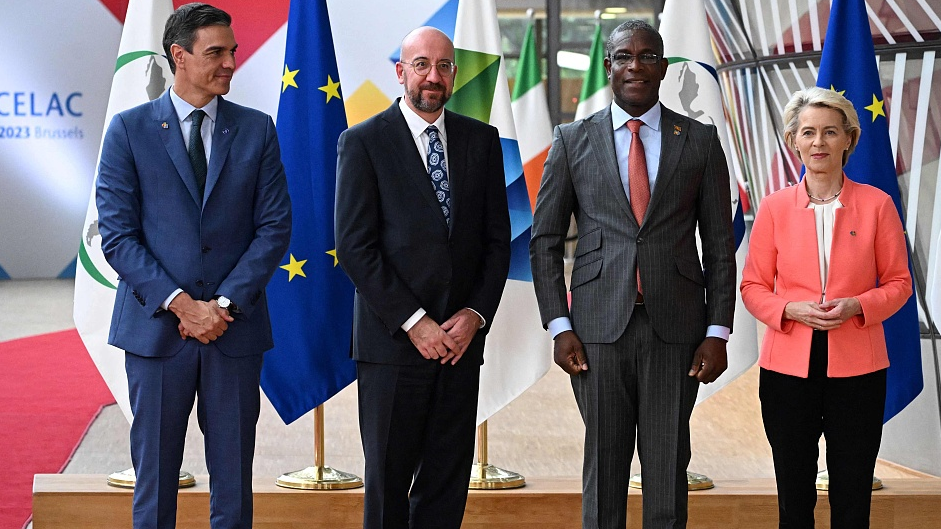
From left to right, Spain's Prime Minister Pedro Sanchez, European Council President Charles Michel, Grenada's Minister for Foreign Affairs, Trade and Export Development Joseph Andall, and President of the European Commission Ursula von der Leyen pose as they arrive for the first day of a summit of European Union-Community of Latin American and Caribbean States Summit (EU-CELAC) at The European Council Building in Brussels, Belgium, July 17, 2023. /CFP
Editor's note: Fu Liyuan, a special commentator on current affairs for CGTN, is a research assistant of the Department of Latin American and Caribbean Studies of the China Institute of International Studies (CIIS). The article reflects the author's opinions and not necessarily the views of CGTN.
Over 50 leaders from the European Union (EU), Latin American and the Caribbean States (CELAC) have gathered in Brussels, celebrating their two-day bi-regional meeting in eight years after the second EU-CELAC summit back in 2015. Even though a stronger economic partnership has been long expected by both sides, there is still an apple of discord and several issues left unsolved, which may play down expectations of a breakthrough during this event. Sixty leaders are invited to the Brussels talks, the presidents of El Salvador, Mexico, Peru and Venezuela are among those not expected to travel.
In the face of new global scenarios, what brought EU and Latin American and the Caribbean leaders together can be self-explanatory. Washington's unilateralism and protectionism, Brussels' growing dependence on China as an economic partner and competitor, changing of supply chain caused by the COVID-19 pandemic, and the Russian-Ukraine crisis have all strengthened the quest for EU strategic autonomy, which entails having the ability to cooperate and even forge alliances with international and regional partners wherever possible.
Given the EU's precarious position after a clear cut-off with its biggest gas supplier Russia, the two D-words ("decoupling" and "de-risking") policies has pushed EU leaders to diversify supply sources. Hence countries in the Global South, especially Latin American and Caribbean countries' stance, matter more than ever.
On October 27, 2022, EU-CELAC foreign ministers laid out a 2022-2023 roadmap for renewing the bi-regional partnership to strengthen peace and sustainable development. The EU's recent joint communication on a new agenda for Latin American and Caribbean (LAC) countries has prepared the ground for progress at this event on three pending agreements – trade, political dialogue, and cooperation.
At present, the EU is pressing ahead with a trade agreement with Chile, the world's largest copper producer and second largest lithium producer. It is also seeking to unlock trade deals struck with Mexico in 2018 and with the South America trade bloc Mercosur in 2019. Word has it that the EU may also unveil details on its plans to invest 10 billion euros ($11.2 billion) in CELAC infrastructure projects as part of its Global Gateway initiative.
EU flags. /Reuters
Nonetheless, to live up to its strategic goal, the EU needs to work harder on rekindling this long-lost friendship. A joint declaration condemning Russia is an apple of discord between EU and CELAC countries. Request to invite Ukraine's President Volodymyr Zelenskyy met strong objections in the CELAC bloc and was retrieved as a refusal to turn this event into a support for Ukraine. Besides, Brazil's President Luiz Inácio Lula da Silva has also maintained the regional non-interventionist tradition as a peacekeeper, setting an example of neutrality for LAC countries over this "European affair," which has been followed by most regional leaders.
However, as stated Gustavo Martinez Pandiani, Argentine Foreign Ministry's undersecretary for Latin American and Caribbean Affairs, "the most important issue of the meeting is the meeting itself." No matter what the outcome will be, this reunion is a showcase of bi-regional relation resilience. Still, whether this summit can revitalize bi-regional partnership remains unclear.
Latin American regionalism remains in crisis, which will largely affect how binding agreements can be. Besides, policy divergence concerning mineral and trade cooperation remains. Although keen for foreign investment, CELAC countries' concerns contradict the EU's goal of setting the region as a source of raw material. Also, decades-long discussion on a free trade agreement between EU and Mercosur has been complicated by extra European environmental policy requirements, exemplified by the EU-Mercosur association agreement, which has been negotiated in principle since 2019 but still waiting to be signed.
There is no shortcut if the EU wants the EU-CELAC bi-regional roadmap to live up to its expectations. Different development agenda on both sides can hardly be compensated by friendly handshakes, and the EU-CELAC's ship can only sail the geopolitical tides of the time while having both paddles work, otherwise this summit will remain ashore.
(If you want to contribute and have specific expertise, please contact us at opinions@cgtn.com. Follow @thouse_opinions on Twitter to discover the latest commentaries in the CGTN Opinion Section.)
Search Trends
SITEMAP
Copyright © 2023 CGTN. 京ICP备16065310号

Disinformation report hotline: 010-85061466
SITEMAP
Copyright © 2023 CGTN. 京ICP备16065310号
Disinformation report hotline: 010-85061466