
Share







Copied
Spain was heading for a hung parliament with neither left nor right likely to secure a majority in the Sunday election, paving the way for drawn-out and potentially fruitless negotiations to form a government.
With 99 percent of votes counted by 11:45 p.m. local time, the opposition People's Party (PP) had 136 seats, while Prime Minister Pedro Sanchez's ruling Socialists (PSOE) had 122 seats in the 350-seat parliament – both far from the 176 needed for a governing majority.
Parties with the greatest potential to be kingmakers were nearly even, with far-right Vox on 33 and far-left Sumar on 31 seats.
Turnout was up, at 71.31 percent compared to 66.23 percent in the last election in 2019.
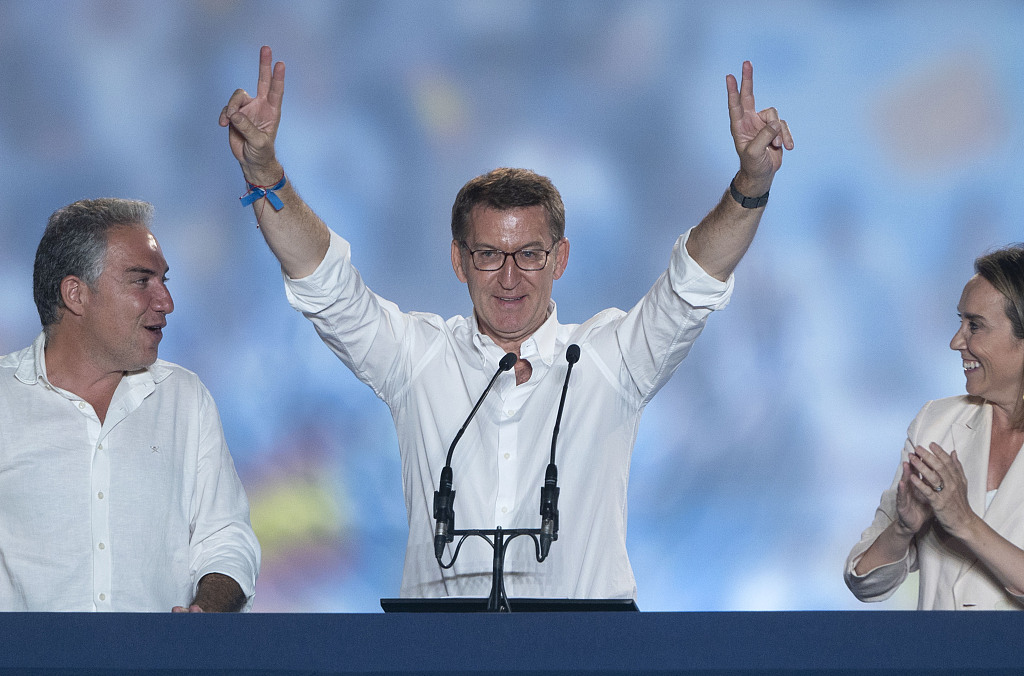
Alberto Feijoo (C), leader of the PP, signals to supporters outside the party headquarters following Spain's general election in Madrid, Spain, July 23, 2023. /CFP
What's next?
Negotiations by the two blocs to form governments will start after a new parliament convenes on August 17. King Felipe VI will invite leader Alberto Nunez Feijoo of the PP, the top vote winner, to try to secure the prime ministership. In a similar situation in 2015, PP leader Mariano Rajoy declined the king's invitation, saying he could not muster the support.
If Feijoo declines, the king may turn to Sanchez with the same request. The law does not set a deadline for the process, but if no candidate secures a majority within two months of the first vote on the prime minister, new elections must be held.
Hung parliaments have become the norm in recent years due to the fragmentation of Spain's politics and the emergence of new parties challenging the dominance of the PP and the PSOE.
The country held two elections within six months in late 2015 and 2016, after which there was a 10-month standoff until the Socialists finally agreed to abstain from a confidence vote to allow the PP to form a minority government. In 2019, two more elections were held before the PSOE and far-left Podemos agreed to form Spain's first coalition government.
Sanchez called a surprise snap election after the left took a drubbing in local elections in May.

The President of the Government of Spain and Secretary General of the PSOE, Pedro Sanchez, thanks his voters at the headquarters of the Socialist Party in Madrid, Spain, July 23, 2023. /CFP
Both claim victory
Feijoo said his party had won Sunday's parliamentary election minutes after Sanchez claimed victory for the left.
"As the candidate of the party that won the most seats, I believe it is my duty 'to try to form a government,'" Feijoo told supporters gathered outside the PP headquarters in Madrid.
He asked that "no one fall into the temptation of blocking the formation of a new government," adding that Spain did not need a period of uncertainty.
Sanchez was also celebrating the result from the balcony of his party headquarters late Sunday, as the Socialists had won more seats and a higher percentage of the votes than in the 2019 election.
"The backward-looking bloc that wanted to roll back all the progress we made over the past four years has failed," Sanchez said.
"The regressive block made up of the Popular Party and Vox were beaten," he said, adding that "there are many more who want Spain to keep advancing than those who want to step backward."
(With input from agencies)
(Cover: A man waits outside a polling station to vote in general elections in Madrid, Spain on Sunday, July 23, 2023. /CFP)
Search Trends
SITEMAP
Copyright © 2023 CGTN. 京ICP备16065310号

Disinformation report hotline: 010-85061466
SITEMAP
Copyright © 2023 CGTN. 京ICP备16065310号
Disinformation report hotline: 010-85061466